Haute-LoireL'Éveil de la Haute-Loire · Monday 14 September 2026 · p. 6-7
Small game Laussonne, a territory of experiments
On this Sunday 13 September, opening day of the hunting season in Haute-Loire, all eyes were turned towards Laussonne, where an experiment that is exceptional in the department is being conducted with the hunters' federation and Petit gibier 43, to recover a wild strain of pheasants.
PHILIPPE SUC
The opening of the hunting season that has just taken place in Haute-Loire on Sunday is an opportunity to highlight an exemplary operation: the introduction of pheasants, a strain of “wild type”, though farm-reared, carefully selected by the Isère company Gibis (établissements Guilloud). Birds that have nothing in common with the “cocottes”, as hunters call them, those birds released into the wild a few days before the opening and which let you approach to within just a few metres, so strongly are they imprinted on humans. Voices are raised to deplore this old practice, questionable on ethical grounds but also with regard to the work of the pointing dogs. The fact remains that releases of pheasants for shooting did indeed take place again this season. But some are thinking of the future of hunting and of game.
This introduction, which took place in mid-August across the whole territory of Haute-Loire, is a first for the department, at least on this scale. 25 territories or Accas had placed orders for birds. That says something about the enthusiasm the initiative has aroused. Some 900 pheasants in total were introduced in this way. The operation is the fruit of a collaboration between the Haute-Loire departmental hunters' federation and Petit gibier 43. A few years ago we reported on a similar initiative in the Bains and Séneujols area, but a more limited one. It has often been pointed out how difficult it is even to maintain the pheasant in the wild state. In recent years, one of the federation's priorities has above all been to bet on the grey partridge, present, among other places, on the plateaux of the Devès, a native wild species much prized by hunters. To be convinced of it, one need only recall the success the Sanssac-l'Église field trial used to enjoy. Competitors came from all over France. Yet the grey partridge is now keeping a lower profile. Should the effects of climate change be seen in this?
The Petit gibier 43 association was created three and a half years ago on the basis of a threefold observation: the decline of native small game populations, an often lacking dialogue between hunters and farmers that the association wants to foster, and the feeling among hunters of small furred or feathered creatures that they were somewhat forgotten compared with big game, which takes all the limelight and the resources, with compensation for damage. Such an association of small game enthusiasts now exists in some thirty départements of mainland France.
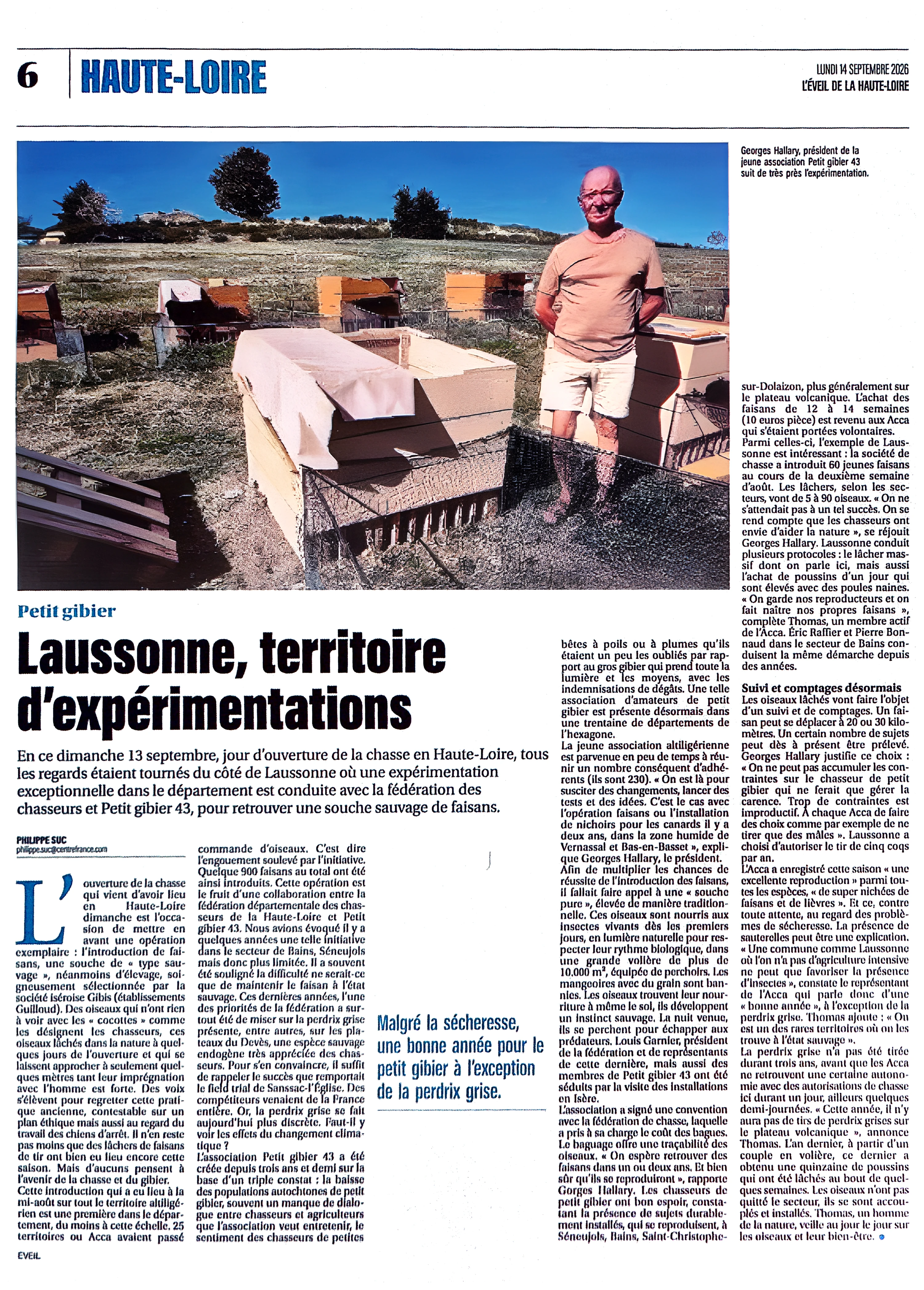
In a short time, the young Haute-Loire association has managed to gather a substantial number of members (there are 230 of them). “We are here to bring about change, to launch trials and ideas. That is the case with the pheasant operation or the installation of nest boxes for ducks two years ago, in the wetland of Vernassal and Bas-en-Basset,” explains Georges Hallary, the president.
To maximise the chances of success of introducing the pheasants, it was necessary to call on a “pure strain”, reared in the traditional way. These birds are fed on live insects from the first days, in natural light to respect their biological rhythm, in a large aviary of more than 10.000 m², fitted with perches. Feeders with grain are banned. The birds find their food on the ground itself, and they develop a wild instinct. When night falls, they roost to escape predators. Louis Garnier, president of the federation, and representatives of the latter, but also members of Petit gibier 43, were won over by the visit to the facilities in Isère.
The association has signed an agreement with the hunting federation, which has covered the cost of the rings. Ringing gives traceability of the birds. “We hope to find pheasants again in a year or two. And, of course, that they will breed,” reports Gorges Hallary. Small game hunters are hopeful, noting the presence of birds that have settled for good and are breeding, at Séneujols, Bains, Saint-Christophe-sur-Dolaizon, and more generally on the volcanic plateau. The purchase of the 12-to-14-week-old pheasants (10 euros each) fell to the Accas that had volunteered.
Among these, the example of Laussonne is interesting: the hunting club introduced 60 young pheasants during the second week of August. The releases, depending on the area, range from 5 to 90 birds. “We didn't expect such a success. We realise that hunters want to help nature,” says a delighted Georges Hallary. Laussonne is running several protocols: the mass release discussed here, but also the purchase of day-old chicks that are reared with bantam hens. “We keep our breeding birds and hatch our own pheasants,” adds Thomas, an active member of the Acca. Éric Raffier and Pierre Bonnaud in the Bains area have been following the same approach for years.
Monitoring and counts from now on
The released birds will be monitored and counted. A pheasant can travel 20 or 30 kilometres. A certain number of birds may be shot from now on. Georges Hallary justifies this choice: “We can't pile constraints on the small game hunter, who would do nothing but manage scarcity. Too many constraints are unproductive. It is up to each Acca to make choices, such as shooting only males”. Laussonne has chosen to allow the shooting of five cocks a year.
The Acca has recorded “excellent breeding” this season among all species, “great broods of pheasants and hares”. And this, against all expectations, given the drought problems. The presence of grasshoppers may be one explanation. “A commune like Laussonne, where there is no intensive farming, can only favour the presence of insects,” observes the Acca's representative, who thus speaks of a “good year”, with the exception of the grey partridge. Thomas adds: “We are one of the rare territories where they are found in the wild”.
The grey partridge was not shot for three years, before the Accas regained a certain autonomy with shooting authorisations for one day here, a few half-days elsewhere. “This year, there will be no shooting of grey partridges on the volcanic plateau,” Thomas announces. Last year, from one pair in an aviary, he obtained some fifteen chicks that were released after a few weeks. The birds did not leave the area; they paired up and settled. Thomas, a man of nature, watches over the birds and their welfare day by day.
Photo caption (p. 6): Georges Hallary, president of the young association Petit gibier 43, is following the experiment very closely.
Pull quote (p. 6): Despite the drought, a good year for small game with the exception of the grey partridge.
Species Towards a return of the red-legged partridge?
In recent years, the grey partridge has been the focus of all attention in Haute-Loire. Yet it is keeping a lower profile. An experiment on its sister, the red-legged, has been launched.
PHILIPPE SUC
Another game bird in favour with the hunters of Laussonne: the red-legged partridge. It is said to be particularly resistant to extreme climatic conditions. “It is found in Andalusia, for example. It drinks from the dew. It has moved up as far as Scotland. It has a great capacity for adaptation. You don't find it in crops but rather on hillsides, in slightly wild places,” comments Georges Hallary, president of Petit gibier 43.
Bantam hens as foster mothers
Double nesting (two nests incubated by the two parents) also argues in favour of its establishment. One observation: it is scarce in Haute-Loire at present. Hence the experiment launched by the very keen people of Laussonne: every year for three years, the Acca and Petit gibier 43 have decided to buy 200 chicks and have them reared by bantam hens.
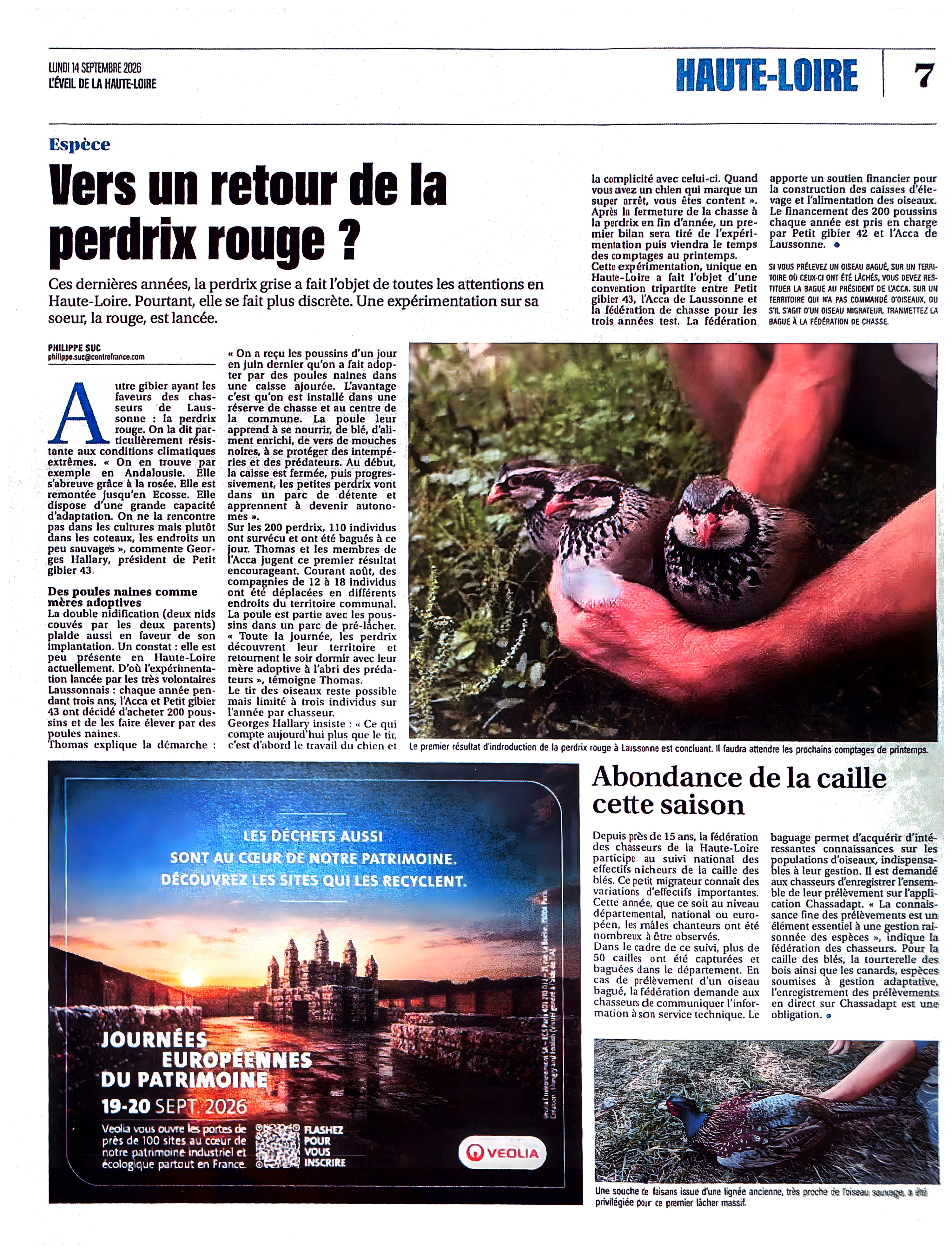
Thomas explains the approach: “We received the day-old chicks last June and had them adopted by bantam hens in a slatted crate. The advantage is that we are set up in a hunting reserve and in the centre of the commune. The hen teaches them to feed, on wheat, enriched feed and black fly larvae, to protect themselves from bad weather and from predators. At first the crate is closed, then gradually the little partridges go out into a run and learn to become independent”.
Of the 200 partridges, 110 individuals have survived and been ringed to date. Thomas and the members of the Acca consider this first result encouraging. During August, coveys of 12 to 18 individuals were moved to various spots across the commune. The hen went off with the chicks into a pre-release pen. “All day long, the partridges explore their territory and go back in the evening to sleep with their foster mother, safe from predators,” Thomas reports.
Shooting the birds remains possible but is limited to three individuals a year per hunter.
Georges Hallary insists: “What counts today, more than the shot, is first of all the work of the dog and the bond with it. When you have a dog that comes to a superb point, you are happy”. After the close of the partridge season at the end of the year, a first assessment of the experiment will be drawn up, and then will come the time for the spring counts.
This experiment, unique in Haute-Loire, has been the subject of a three-way agreement between Petit gibier 43, the Acca de Laussonne and the hunting federation for the three trial years. The federation provides financial support for building the rearing crates and feeding the birds. The funding of the 200 chicks each year is borne by Petit gibier 42 and the Acca de Laussonne.
Caption of the partridge photo (p. 7): The first result of introducing the red-legged partridge at Laussonne is conclusive. We will have to wait for the next spring counts.
Quail abundant this season
For nearly 15 years, the Haute-Loire hunters' federation has taken part in the national monitoring of the breeding population of the common quail. This small migrant experiences large fluctuations in numbers. This year, whether at departmental, national or European level, many singing males were observed.
As part of this monitoring, more than 50 quail were caught and ringed in the department. If a ringed bird is shot, the federation asks hunters to pass the information on to its technical department. Ringing makes it possible to gain interesting knowledge about bird populations, indispensable for their management. Hunters are asked to record all their bag on the Chassadapt app. “Detailed knowledge of the bag is an essential element of reasoned management of species,” the hunters' federation states. For the common quail, the turtle dove and ducks, species subject to adaptive management, recording the bag in real time on Chassadapt is compulsory.
Caption of the pheasant photo (p. 7): A strain of pheasants from an old bloodline, very close to the wild bird, was favoured for this first mass release.
PDF · 2 pages · 13.5 MB — proofs of pages 6 and 7 (original in French)