
Hunting game farm — Chatte, Isère (38)
How we raise our game: from hatchery to return to the wild, in Chatte (Isère)
Discover how a hunting game farm works: GIBIS, a family business in Chatte, Isère, since 1951, takes you behind the scenes of its 70 hectares, including 15 hectares of planted aviaries — the complete chain from hatchery to return to the wild, strain selection, feeding and biosecurity. Aviary visits are possible by appointment; pheasants, partridges, mallards, wild rabbits and hares are raised from the egg to a bird ready to join your hunting ground, and delivered in our own trucks throughout France.
1951
year founded
70 ha
including 15 ha of aviaries
n° 38001
approved farm, Isère
3
Guillioud generations
The production site
A 70-hectare hunting game farm in Chatte, Isère
To understand how a hunting game farm works and what you discover on a visit, you first have to look at the land. Our farm covers 70 hectares of agricultural and wooded land in the commune of Chatte, Isère (38160), between Saint-Marcellin and the Isère valley. This is not a trading site with a few demonstration pens: it is a complete agricultural operation, where cereals grow in the same fields that border the aviaries, and where the hatchery, the brooding buildings, the aviaries and the grassy runs all stand on the same land, a few hundred metres from one another. The estate is crossed by natural streams and bordered by country hedgerows: the birds grow up in a climate, humidity and vegetation that resemble those they will meet after their return to the wild. The site also lies at the crossroads of the A49 and the Rhône valley, which lets us reach most French départements within a day's drive by truck.
- 70 hectares in a single block
- Cereal fields, woods, hedgerows and meadows: the area that lets us rotate the runs and never raise birds two years in a row on the same ground.
- A biotope, not a shed
- Hedgerows, woods, streams and natural meadows: the birds get to know cover, rain and wind well before the day of their return to the wild.
- Chatte, Isère (38160)
- At the foot of the Vercors, 20 minutes from the A49: deliveries across mainland France, Belgium, Switzerland, Luxembourg and for export.
The aviaries
15 hectares of planted aviaries: the heart of the farm
The 15 hectares of aviaries are what makes the difference between a farmyard bird and a hunting bird. Each aviary is sown with cover crops — sorghum, maize, sunflower — that recreate the structure of a natural habitat: dense areas where the bird takes cover, open lanes where it runs, shaded areas, shelter from rain and wind. There the pheasant learns to hide, to run, to flush vertically and to land. Densities are deliberately low: the number of birds per aviary is calculated to give each one the space to develop its flight muscles and its plumage — a cock's full tail is the visible sign of an aviary that has not been overstocked. For the FAISAN PUR CHASSE® strain, the aviaries exceed 10,000 m² and the birds are regularly flushed with a pointing dog to keep up their flight reflex.
15 hectares of aviaries
One of the largest game-breeding aviary complexes in France, on a single site.
Planted aviaries, not bare wire pens
Sorghum, maize and sunflower sown in the aviaries every year: cover, shade and live food on the spot.
Low density, trained flight
Fewer birds per square metre means less feather pecking, complete plumage and a full tail; tall aviaries and flushing with a pointing dog keep up the flight reflex.
What our birds eat
Feeding: cereals from the farm and live insects
A large share of the cereals eaten on the farm is grown on our own land: wheat, maize, sorghum and sunflower, with no GMOs and no growth-promoting antibiotics. This control of the food chain means we know the origin of every ration and can adjust the formulations to the species, age and season — a very high-protein starter feed for the young, then grower feed, then maintenance or breeding feed. Pellets, however, are only part of the story. Pheasant chicks, and above all partridge chicks, live on insects in their first weeks: we distribute live insects, and the planted aviaries naturally produce them in abundance. A bird that has learned to look for an insect in the grass and to husk a wild seed can feed itself the day after its return to the wild — which is exactly what a bird raised only on pellets indoors lacks. On the hunting ground, game feeding and game crops take over this work.
Cereals grown on site
Wheat, maize, sorghum and sunflower grown on our 70 hectares: known origin, every batch of feed documented, from grain to bird.
Live insects for the young
The natural diet of pheasant poults and young partridges in their first weeks: it is what builds vitality and the foraging reflex.
Formulations by stage
Starter, grower, maintenance, breeding: one ration per species and per age, with no growth-promoting antibiotics.
The production stages
From hatchery to grassy run: the complete egg-to-adult chain
A true hunting game farm controls the whole chain, and that is what we do in Chatte. Our breeding pens are made up of birds selected for hardiness, behaviour and morphology; on the PUR CHASSE® strain, mating and incubation are natural. Eggs are collected every day, graded — size, cleanliness, shell — then set in our incubators and hatchers, where temperature and humidity are continuously controlled. After hatching, the chicks move to heated brooding rooms, then to growing aviaries, and finally to the large planted aviaries and grassy runs where they finish growing outdoors. This journey takes 14 weeks for a summer restocking poult and at least 20 weeks for an adult for the hunting season. In season, we also sell part of our production as pheasant hatching eggs and fertile partridge eggs, for breeders and federations that run their own incubation.
1. Breeding stock and hatchery
Selected breeding pens, daily egg collection and grading by size, then incubation in incubators and hatchers with controlled temperature and humidity.
2. Brooding
Heated rooms, protein-rich starter feed, gradual transition to the outdoors; vitality and hatch rates tracked batch by batch.
3. Aviaries and grassy runs
Outdoor growth under plant cover up to 14 weeks (poult) or 20 weeks and more (adult for the season).
Quality control
Health, biosecurity and animal welfare
A hunting game farm is a livestock establishment subject to the same health requirements as any professional poultry farm, and to biosecurity rules that have been tightened since the avian influenza outbreaks. We apply a prophylaxis plan drawn up with our veterinarian, with regular testing, species-specific vaccinations, sanitary breaks and run rotation, controlled entry routes, footbaths and dedicated clothing. Every batch of animals intended for sale is inspected before loading — plumage, tail, legs, general condition — and accompanied by a health certificate issued by an approved veterinarian. Our facilities are inspected by the Isère veterinary services. Animal welfare is not an extra: low densities, plant cover, shelters, limited handling and adapted transport are also what produces a bird that flies.
Health certificate with every delivery
A compliant veterinary document, handed over with the invoice: it is the document that proves where your birds come from.
Biosecurity and veterinary checks
Prophylaxis plan, sanitary breaks, run rotation, controlled routes and access; regular inspections by the Isère veterinary services.
Animal welfare
French and European standards applied; staff trained in animal welfare and biosecurity.
Transportation
Our fleet: direct delivery, no middlemen
GIBIS has its own fleet of trucks and vans fitted out for transporting live game: compartments suited to each species, ventilation, temperature control, crates at controlled density. It is our own drivers — who know the birds — who deliver, from the farm to your hunting ground, with no forwarder or intermediate hub. This is a point on which we do not compromise: every extra handling costs stress, and stress is paid for in mortality and in flight quality in the days following the return to the wild. Delivery rounds are grouped by region according to a planned schedule; direct collection at the Chatte farm remains possible, with no minimum order.
Specialist vehicles
Trucks and vans with ventilated compartments, controlled crate density, live arrival guaranteed.
Direct delivery
No middlemen: our drivers deliver directly from the farm to your territory.
France, neighbouring countries and export
Mainland France, Belgium, Switzerland, Luxembourg; shipments within the European Union with TRACES documents.
The regulatory framework
Our approvals and traceability
Breeding game for return to the wild falls under a strict regulatory framework. Our authorisations, our inspections and our traceability are verifiable — this is what allows a hunting ground to justify the origin of its animals to its administration, and it is the first thing a serious buyer should ask for. The obligations that fall on you, on the hunting-ground side — return-to-the-wild declaration, authorised species, periods, register — are detailed on our small game regulations page.
Farm no. 38001
An establishment registered and holding the veterinary, health and environmental approvals in force.
Certificate of competence
Our staff hold the certificate of competence for running a breeding farm, together with training in animal welfare and biosecurity.
Full traceability
A health certificate and supporting invoice provided with every delivery; TRACES documents for shipments within the European Union.
Continuity of service
During an avian influenza outbreak, GIBIS was able to keep delivering game under prefectural authorisation.
Our history
Établissement Guillioud, 1951: three generations in Chatte
The story began in 1951, when Établissement Guillioud set up in Chatte, in Isère. More than seventy years later, the farm is still in the same place and still in the same family: three generations of the Guillioud family have succeeded one another here, and it is this continuity that makes possible what no reseller can improvise — selecting strains over the long term. The FAISAN PUR CHASSE®, a registered trademark, is the product of several decades of selection on the single criterion of flight; our pure French-strain grey partridges are kept without crossbreeding, whereas most farms have switched to more prolific lines. GIBIS is today one of the few French farms to cover feathered game, small furred game and big game alike, with an export business to Europe, the Middle East and North Africa. This big game side — live roe deer of French origin and mouflon — complements the feathered game and small furred game.
- Since 1951
- More than 75 years of continuous breeding on the same site, in the Isère.
- Family business
- Three generations of the Guillioud family, an SARL with a share capital of €271,300.
- Exclusive strain
- FAISAN PUR CHASSE®, a registered trademark: a strain that we alone produce.
- International references
- Deliveries and projects carried out across Europe, the Middle East and North Africa.
- A farm visited by the federations
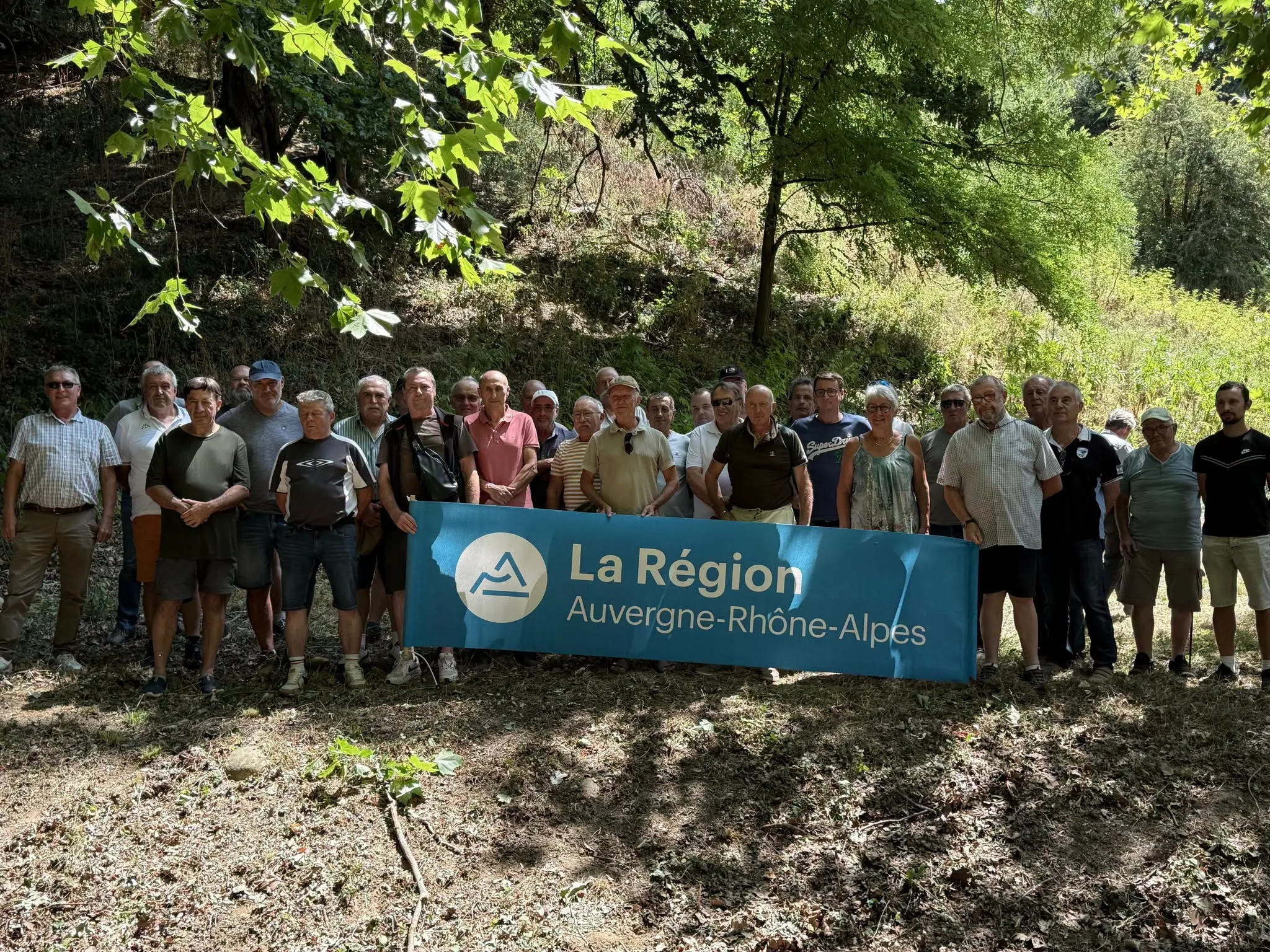
- In July 2026, the Fédération des Chasseurs de l'Isère chose our farm to present its young-pheasant scheme to some forty hunters from Haute-Loire. The account of the visit is on our young-pheasant page.
Our production
The species produced on our game farm
Our game farm produces feathered game and small ground game — poults and young partridges for summer restocking, and adult birds for the shooting season. The prices below are our 2026 catalogue prices per bird, falling with quantity; they exclude transport, which is quoted according to the delivery round. We do not produce quail — returning them to the wild is prohibited in France — and we stopped breeding Reeves’s pheasant more than twenty years ago: we would rather tell you straight away than waste your phone call.
| Species produced | Summer restocking | Shooting season (adults) |
|---|---|---|
| Common pheasant and US cross | Poult, 14 weeks — €11.60 | €14.90 each; cock only €16.50 |
| FAISAN PUR CHASSE® | Poult, 14 weeks — €13.50 | €19.00 each |
| Red-legged partridge | €10.30 each; covey of 10 (9 + 1 leader) €102.00 | €11.40 each |
| Grey partridge (pure French strain) | €10.60 each; covey of 10 (9 + 1 leader) €105.00 | €11.70 each |
| Mallard duck | Vaccinated young, 8-10 weeks — €13.00 | €16.50 each |
| Wild rabbit | €16.30 each; pair €49.50; trio €75.00 | Same — restocking all year round |
| Hare | French leveret, 3-4 months — €95.00 | Quotation subject to availability |
Four pheasant strains
Common, FAISAN PUR CHASSE®, Chinese and melanistic: the strain selection guide tells you which one suits your ground.
Red-legged and grey partridges
In reconstituted coveys of 10 birds or singly, and as fertile partridge eggs.
Small ground game
Wild rabbits singly, in pairs or in trios, and French leverets for restocking programmes.
Mallard reared on the pond
Breeding stock living free on open water: powerful fliers that settle quickly on a new pond.
Telling the difference
Breeder or dealer: five questions to ask before you order
The live-game market is full of middlemen: dealers who buy consignments abroad, hold them for a few days and resell them under their own name. Nothing illegal about it, but it is not the same thing as a breeding farm — and the difference shows on the day the birds are returned to the wild, not on the quotation. Here are the five questions that settle it in a single phone call. A genuine breeder answers them without hesitating, and invites you to come and see for yourself. We welcome group visits — federations, hunting associations, shooting clubs — by appointment; that is how some forty hunters from the Haute-Loire came to see our aviaries in July 2026, as our federation references page recounts.
1. “What is your holding number?”
A breeder has an establishment number and approvals in his own name — ours is no. 38001. A dealer will talk to you about his “supplier”.
2. “Where were the birds hatched?”
Hatched and reared on site, or bought in abroad as a consignment two weeks before delivery? The stress of a double journey is paid for in mortality after the return to the wild.
3. “How long have you had this strain?”
Selecting a strain takes decades. If nobody can tell you where the blood of their breeding stock comes from, there is no selection going on.
4. “May I come and see the aviaries?”
A farm that refuses visits has something to hide: stocking density, plumage, the cocks’ tails. With us, a visit is booked by telephone.
5. “What paperwork comes with the delivery?”
A veterinary health certificate, a proof-of-origin invoice, and TRACES documents for the European Union. That is what covers you in an inspection.
The support
What we bring beyond the birds: return-to-the-wild advice
A game farm that simply delivers crates misses the point: the success of a return to the wild depends as much on the ground as on the aviary. We have more than seventy years of field feedback — shooting clubs, hunting associations, departmental federations, large estates — and we make it available before you order, not afterwards. In practice: which strain for your habitat, what age of bird for your opening date, how many birds per 100 hectares, where to site the acclimatisation pens, which feeders and cover crops to establish, and what paperwork to anticipate. That twenty-minute phone call is often what changes the season’s recovery rate — and we sometimes recommend ordering fewer birds and managing the ground better instead.
A successful return to the wild
Timing, densities, acclimatisation pens and aviaries: the full method is on achieving a successful return to the wild.
Managing the ground
Feeding, game cover crops, water points and winter cover: see feeding and habitat management.
Choosing the right strain
Plain, hedgerow country, woodland or hills: the pheasant strain guide decides according to your ground.
Getting the rules right
Declarations, permitted species, periods for returning birds to the wild: see small game regulations.
Our references
Federations, hunting associations, estates and export: who buys our game
Our customers are first and foremost the organisations that manage game populations over the long term: departmental hunters’ federations, ACCA and AICA hunting associations, village shooting clubs and game management groups, but also private estates, shooting grounds and organisers of shooting days. In the summer of 2026, 2 312 FAISAN PUR CHASSE® poults were delivered to 59 shooting-rights holders in the Isère under the poult scheme of the Isère departmental hunters’ federation, and in July 2026 our aviaries welcomed 24 hunting associations from the Haute-Loire who came to see how the birds they return to the wild are produced. The sourced details of these operations are on our they trust us page. Internationally, we have carried out deliveries and game-farm establishment projects in Europe, the Middle East and North Africa.
- Departmental federations
- Collective restocking operations, with specifications covering strain, age and densities for the return to the wild.
- Hunting associations and shooting clubs
- From a batch of 50 poults for a small commune to multi-year programmes: no minimum order for collection at the farm.
- Estates and shooting grounds
- Staggered, quality returns to the wild for organised days, where the flight of the birds carries your reputation.
- Export
- Intra-EU consignments with TRACES documents; game-farm projects supported in the Middle East and North Africa.
When to call us
Ordering: how a game farm plans its year
A breeding farm works a year ahead: next summer’s numbers are decided when the breeding pens are made up, in winter. In practice, that means the best ordering dates are far earlier than most hunters imagine. From January to April, summer poults and young partridges are booked, along with hatching eggs; from May to July, summer restocking deliveries are scheduled and final volumes adjusted; from August to December come the season’s adult birds and birds returned to the wild for shooting, in staggered deliveries. August and September are our two tightest months: at that point, what has not been booked is not necessarily available. Orders are taken by telephone on 04 76 38 31 01 or by e-mail — we have no online ordering, because every quotation starts with a conversation about your ground.
January – April
Booking of the coming season’s poults, young partridges and hatching eggs. The window in which you get the strains you want.
May – July
Delivery of summer restocking poults and young partridges, between 15 June and 15 August depending on the specifications.
August – December
Shooting-season adults and birds returned to the wild for shooting, in staggered deliveries, to be ordered at least three to four weeks before the date you want.
Quotation by telephone
04 76 38 31 01: prices fall with quantity, transport quoted according to the regional delivery round.
Frequently Asked Questions
What is a hunting game farm?
Where is your game farm located?
What game species do you rear, and at what price?
What approvals does a game farm need, and which ones do you hold?
How can you tell a genuine breeder from a mere game dealer?
Can we visit the farm or collect our birds on site?
When should you order to be delivered on time?
Do you deliver throughout France and abroad?
See also
Let's talk about your ground before we talk about quantities
Area, habitat, opening date, objective: describe your ground to us on 04 76 38 31 01 or by e-mail, and we will tell you which species, which strain and which age of bird will give the best results on your ground — quote within 48 hours. GIBIS game farm, Chatte, Isère, since 1951. Hunting, the natural way!