
Knowledge base
Game encyclopaedia
One profile per species: scientific classification, description, biology, breeding, habitat, behaviour, history and conservation status. Written at Chatte, in Isère, by a game farm established in 1951, and sourced line by line. Here we explain the animal — we do not sell it.
What you will find here
A game encyclopaedia written from a game farm
GIBIS has been rearing game at Chatte, in Isère, since 1951: three generations of the Guillioud family on the same 70-hectare estate, including 15 hectares of aviaries. This knowledge base gathers together, species by species, what the scientific literature and the publications of public bodies establish about the animals we live alongside. Each species is given a profile built like an encyclopaedia article: a scientific classification box at the top, a table of contents, thematic sections — description, taxonomy, distribution, habitat, breeding, behaviour, history, status — and numbered footnote markers pointing to a list of references at the end of the article. Every notable fact is attributed to its source, with author and year; anything that cannot be verified is left out, or flagged as uncertain.
- One profile per species, always the same plan
- Classification, description and identification, taxonomy, distribution, habitat and diet, breeding, behaviour, conservation status. From one profile to the next, the structure does not change.
- Every notable fact is sourced
- Author, publication, year: the claims that matter point to a numbered reference, listed at the foot of the page and clickable from the text.
- What we do not know is stated
- A disputed figure is presented as disputed, an estimate as an estimate. When two serious sources disagree, both figures are given and the discrepancy is flagged.
- No prices, no offers
- These pages sell nothing. Prices, availability and delivery terms belong in the catalogue, not in the encyclopaedia.
- Freely accessible
- Consultation without registration, for hunters, land managers, students, hunting federations and the simply curious.
Species profiles
The published profiles
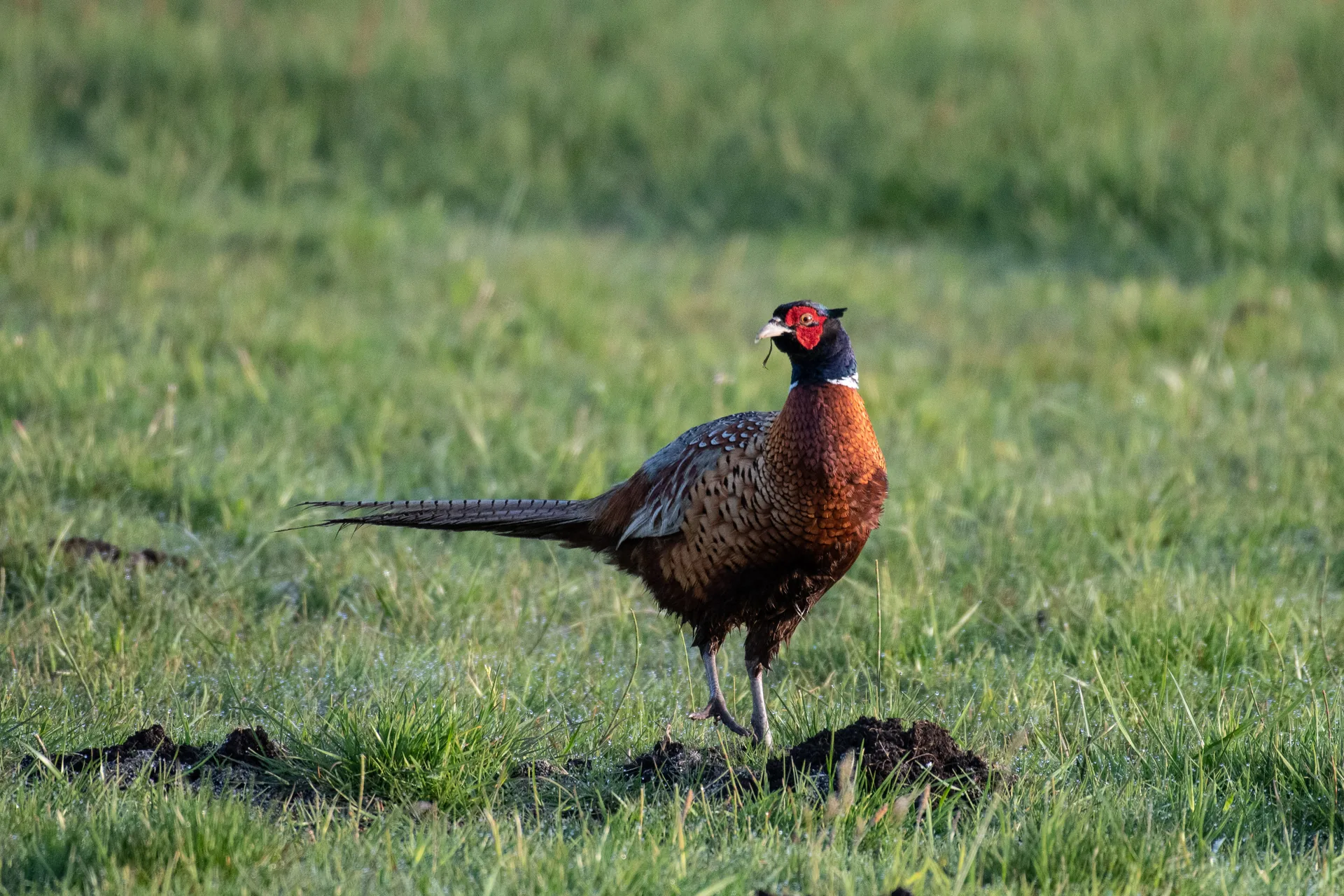
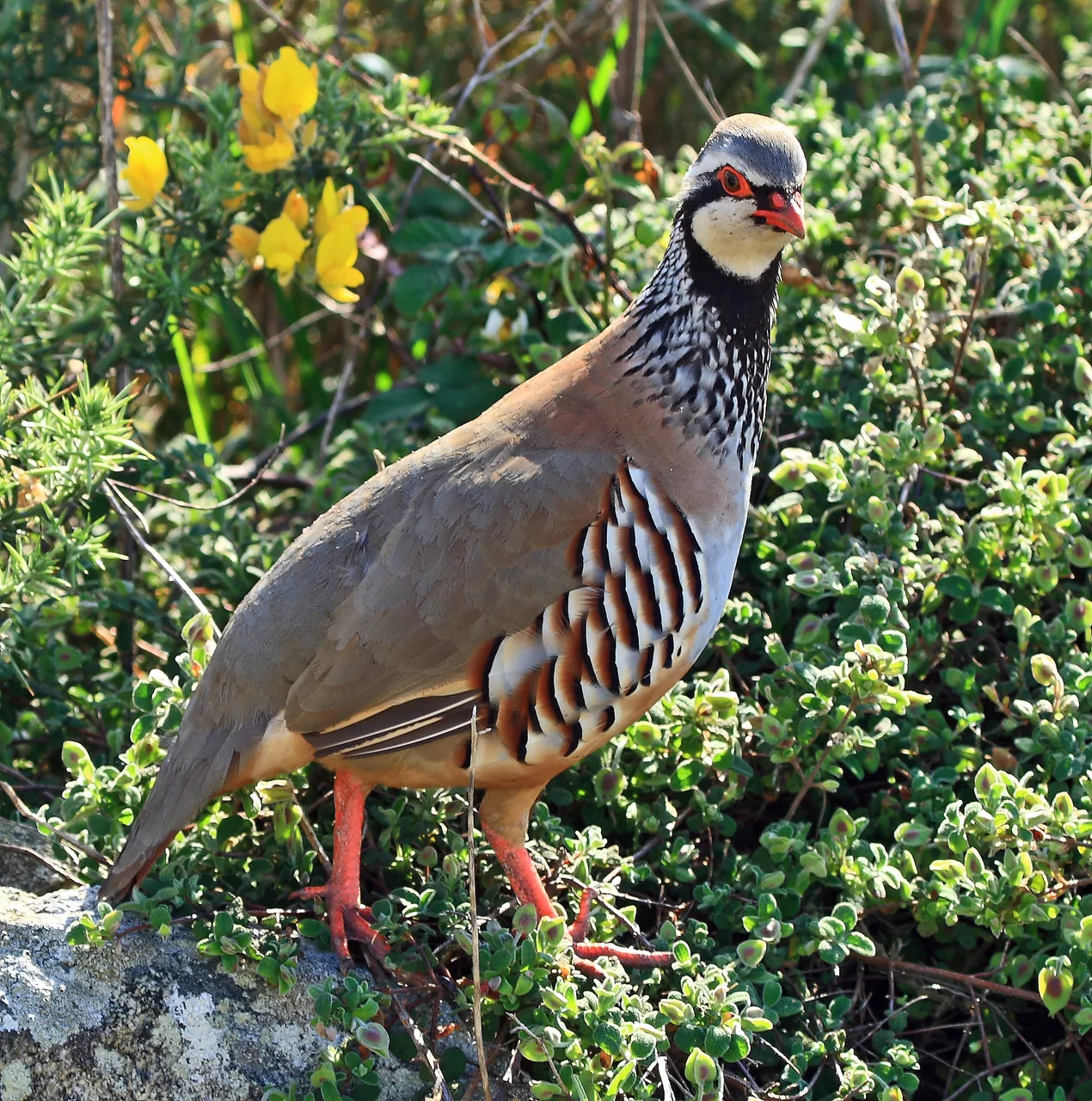
Two profiles open the knowledge base, devoted to the two most familiar game birds of the French countryside. The first: common pheasant (Phasianus colchicus), the bird described by Linnaeus in 1758, native to a discontinuous range extending from the Caucasus to the Far East, and whose establishment in Western Europe dates back to Roman times — subspecies, sexual dimorphism, annual cycle, diet and conservation status. The second: red-legged partridge (Alectoris rufa), a species almost endemic to Western Europe and likewise described by Linnaeus in 1758, whose profile details pair bonding, the double clutch, habitat and the practical differences from the grey partridge and the rock partridge. The two articles can be read independently and answer one another: questions of terminology, subspecies and hybridisation are treated the same way in both.
Common pheasant — Phasianus colchicus
Origin and natural range, subspecies and varieties (nominate form, ring-necked forms, melanistic pheasant), plumage of cock and hen, laying and rearing of the young, diet, predation, the history of acclimatisation in Europe, status on the IUCN Red List.
Red-legged partridge — Alectoris rufa
Western European distribution, identification criteria against the grey partridge and the rock partridge, pair formation, double clutch and shared incubation, habitat on hillsides and in vineyards, decline and conservation.
Not to be confused
Encyclopaedia or catalogue: two readings, two roles
The distinction is worth stating clearly, because confusing the two would make both useless. The encyclopaedia explains the animal: what it is, where it comes from, how it lives, what it eats, how it breeds, what the scientific literature says about its status. The catalogue, for its part, describes what our farm produces and delivers: strains, ages, seasons, transport, health documents. Two different needs, and therefore two different pages. If you are trying to understand a species, you are in the right place. If you are looking for birds for an estate, it is the pheasants, partridges and game catalogue pages that answer, with the our animals page giving the overview. Each encyclopaedia profile does end with a short "At GIBIS" section pointing to the corresponding commercial page — and never the other way round in the body of the text.
The encyclopaedia answers "what is"
What is a common pheasant? How many eggs does a red-legged partridge lay, and who incubates them? Where does it live, and why is its status a cause for concern? Those questions, and their sources.
The catalogue answers "how do I obtain one"
Strains, age at release, the season's calendar, delivery in a purpose-fitted vehicle, health certificates: these subjects belong to the product pages, not to the species profiles.
One animal, two points of view
The pheasant of the encyclopaedia is the species as ornithologists describe it; the one in the catalogue is a farm-reared bird produced by selective breeding. The profiles also explain what separates them.
Our method
How these profiles are written
Three rules, upheld page after page. The source first: every notable fact points to an identified publication — author, title, year — listed at the end of the article and recalled in the body of the text by a numbered footnote marker. We give priority to the publications of public bodies, foremost among them those of the Office français de la biodiversité and the former ONCFS, to peer-reviewed ornithological journals, to standard monographs and to taxonomic reference databases. Caution next: anything that cannot be verified is left out or flagged as uncertain, third-party quotations are kept short and attributed, and no figure is rounded to look good. Neutrality last: nothing on these pages is written in order to sell. It is the same standard as on our references and federations page, where every figure is tied to its source, caveats included.
Priority to scientific and public publications
Work by the OFB and the former ONCFS, ornithological journals, monographs and taxonomic reference databases: the profile rests on texts that can be consulted rather than on oral tradition or collaborative encyclopaedias.
Discrepancies are shown, not smoothed over
When the OFB and an ornithological species account do not give the same clutch size or the same length, both values appear and the choice made is explained.
Corrections welcome
An error, a more recent reference, a contradictory regional observation? Write to us: these profiles are reviewed and corrected as we go.
Small game above all
The encyclopaedia covers the small game species we know at close quarters, feathered and furred alike. We do not write about what we neither rear nor observe.
See also
A question about a species? A correction to report?
This encyclopaedia is written from a game farm, not from an office. If a profile seems incomplete to you, if you have a more recent reference, or if you would like to discuss the behaviour of a species on your own ground, write to us. Visits to the farm at Chatte are possible by appointment.