Skip to content
Home Hunting Dog Training

Game bird encyclopaedia

Red-legged Partridge

Alectoris rufa (Linnaeus, 1758). A stocky galliform of dry, sunny country, all but endemic to Western Europe, famous for its double nesting — two nests incubated in parallel, one by the male and one by the female.
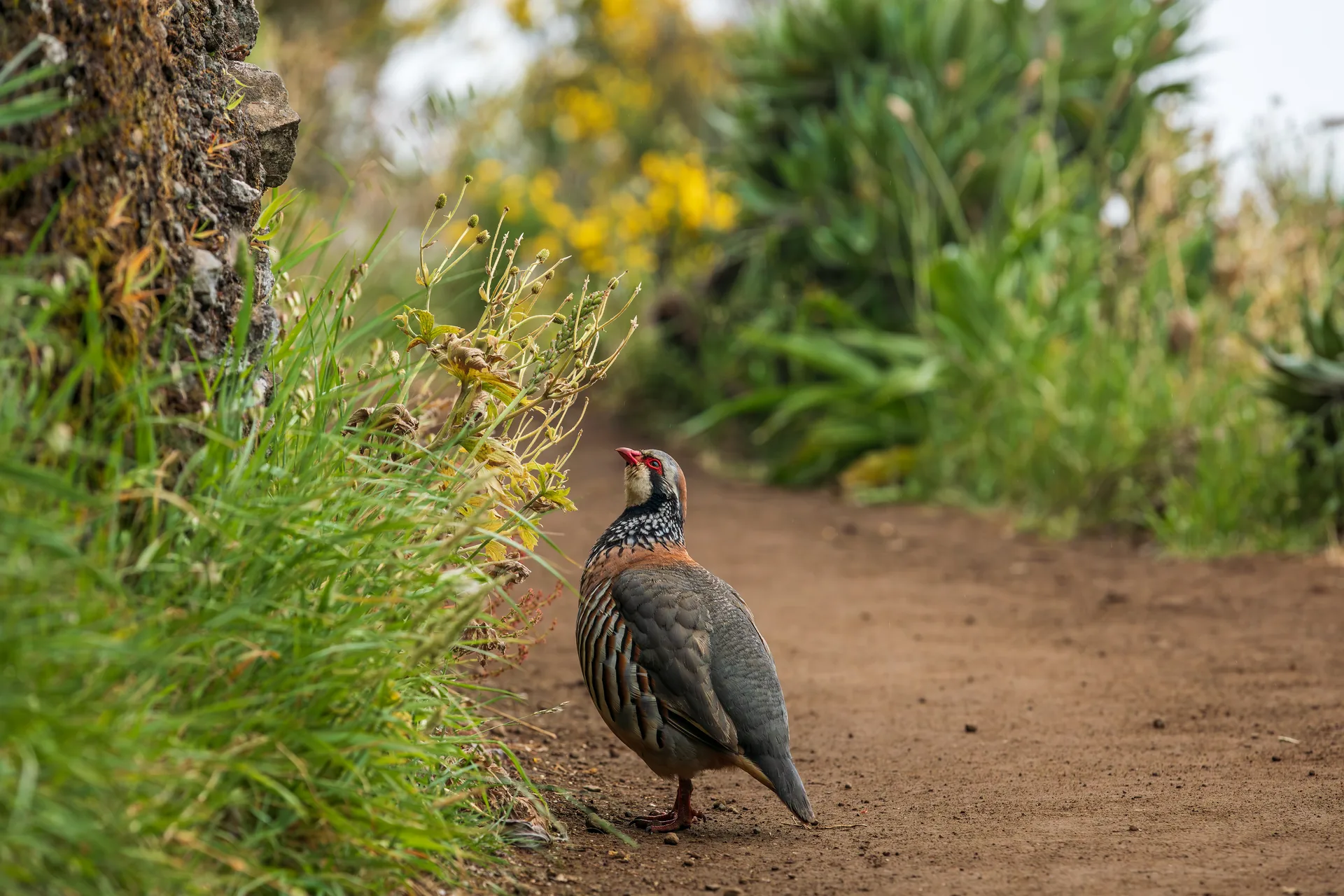
Red-legged Partridge

Not to be confused with the grey partridge (Perdix perdix), which belongs to a different genus, nor with the chukar partridge (Alectoris chukar) and the rock partridge (Alectoris graeca), two species of the same genus. For the other large lowland galliform reared in France, see Common Pheasant.

Description
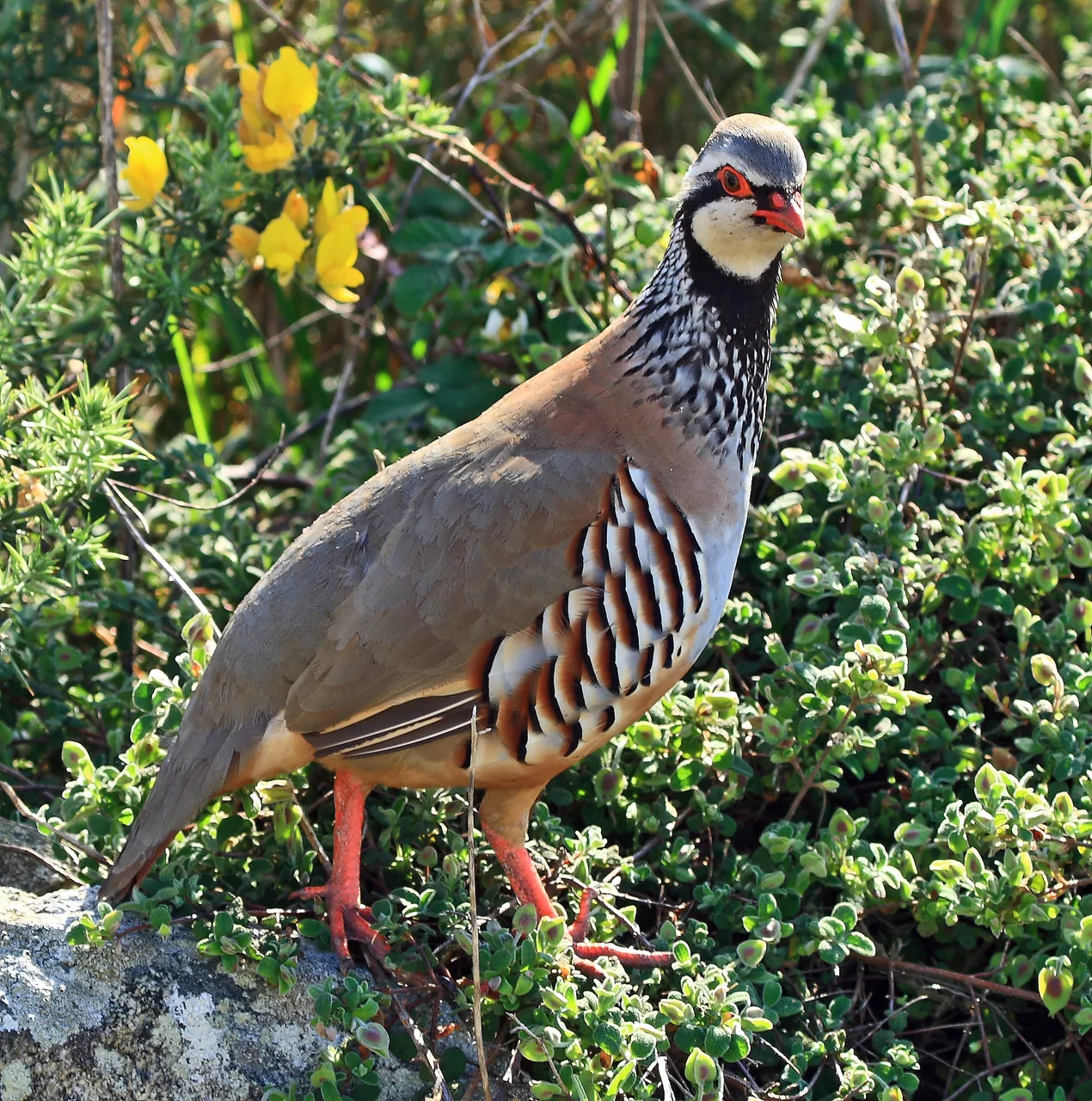
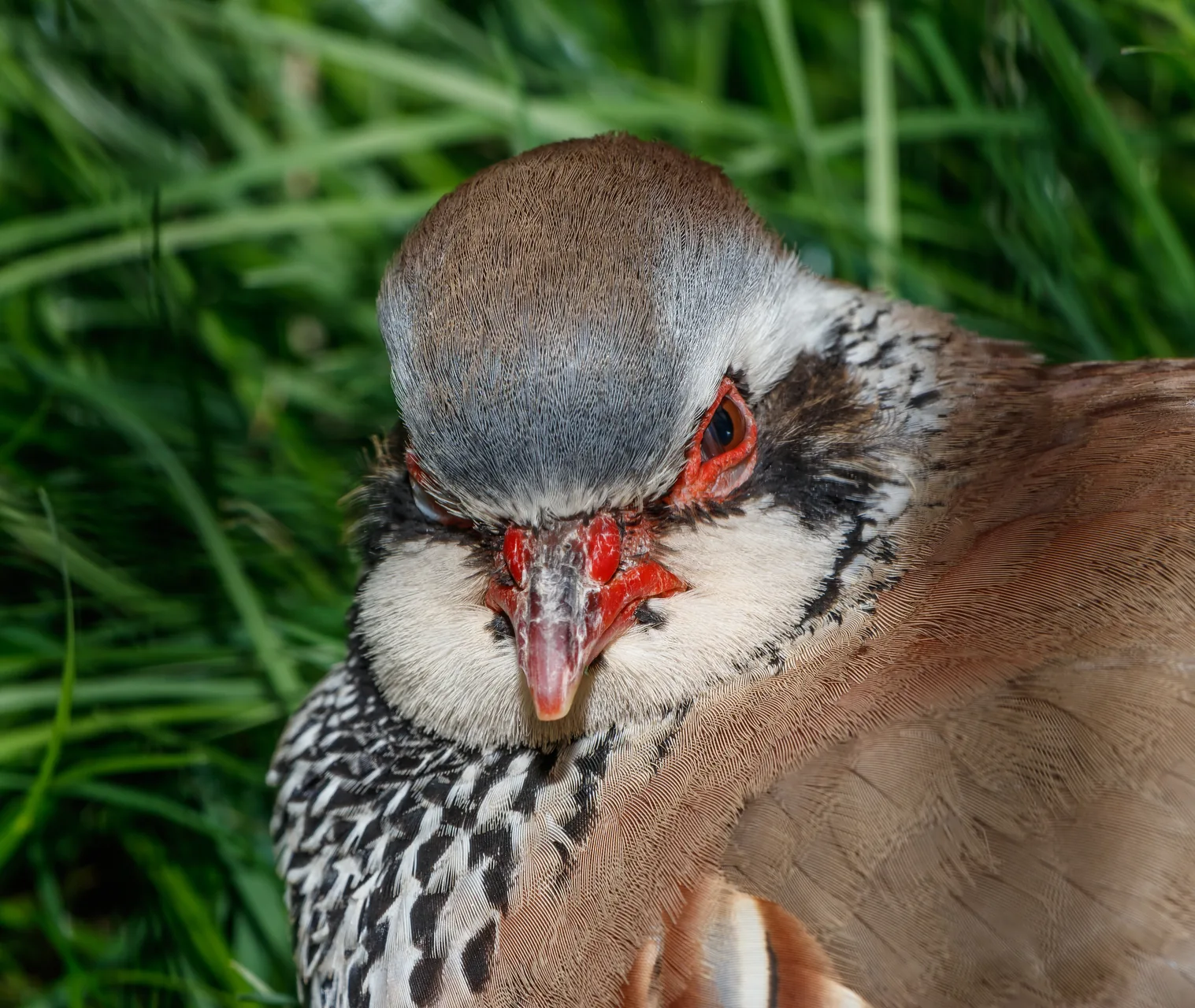
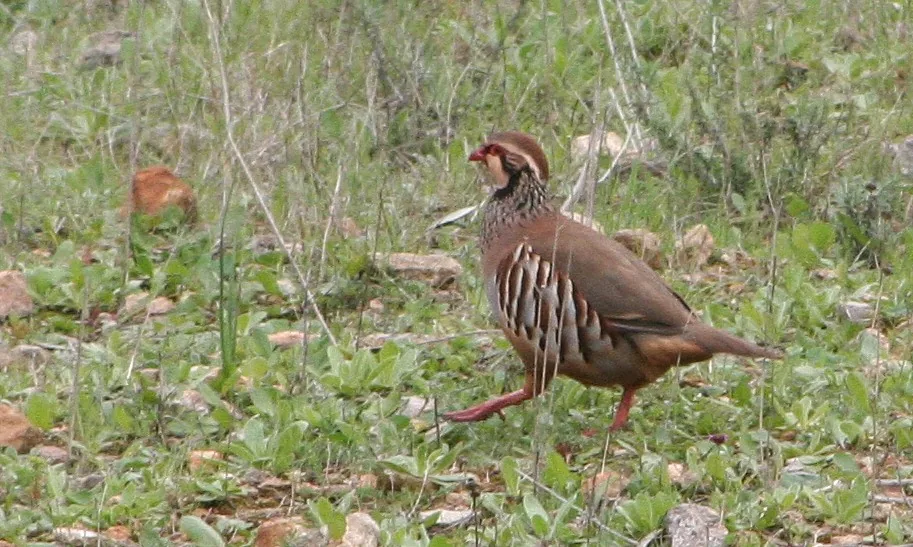
The red-legged partridge is a stocky galliform 32 to 34 cm in length, with a wingspan of 47 to 50 cm and an average mass of 480 g in the male and 400 g in the female.[1] The head is four-coloured: coral-red bill and orbital ring in the adult, white cheeks and throat outlined in black, and a white band above the eye.[5] The breast is pale grey to blue-grey, the belly rufous brown, and the flanks bear strongly contrasting vertical bars of rufous, black and white.[5] The most useful field character is the necklace: in the red-legged partridge the black border does not stay clean-edged but breaks up over the upper breast into a mass of small triangular speckles and fine streaks that stand out against the sandy grey ground colour — this is what separates it from the rock partridge and the chukar, whose necklace is clean-edged and closed.[5] Sexual dimorphism is slight: males and females wear the same plumage, the male is on average a little larger, and adult males have spurs on the legs, which females lack.[1][5] Published measurements vary between sources, some giving a total length of up to 38 cm;[5] the range of 32 to 34 cm used here is that of the Office français de la biodiversité.[1]
Red-legged Partridge in profile: four-coloured head, speckled necklace and barred flanks

Size and mass

32 to 34 cm in length, 47 to 50 cm wingspan; 480 g on average in the male, 400 g in the female.[1]

Four-coloured head

Coral-red bill and orbital ring, white throat and cheeks bordered with black, white supercilium.[5]

Broken necklace

The black of the necklace breaks up into triangular speckles over the upper breast: the key character against the rock partridge and the chukar.[5]

Subtle dimorphism

The same plumage in both sexes; only the spurs of adult males and average size tell them apart.[1][5]

Taxonomy and systematics

The species was described by Carl von Linné in 1758 under the name Tetrao rufus. It was later transferred to the genus Alectoris, erected by the German naturalist Johann Jakob Kaup in 1829: it is this change of genus that explains the parentheses around the author in the valid binomial, Alectoris rufa (Linnaeus, 1758).[2] The generic name derives from the Ancient Greek alektoris, which denoted the farmyard hen; the specific epithet rufa is Latin for "reddish".[3] Three subspecies are recognised: A. r. rufa in France, Corsica, north-western Italy and the introduced populations of Britain; A. r. hispanica in the north and west of the Iberian Peninsula; A. r. intercedens in the east and south of the Iberian Peninsula.[4] The genus Alectoris also includes the chukar partridge and the rock partridge, with which the red-legged partridge can hybridise; the grey partridge, by contrast, belongs to a separate genus, Perdix, and is therefore not simply a colour variant of the red-legged partridge.[13]

Protonym

Tetrao rufus Linnaeus, 1758 — reclassified in the genus Alectoris erected by Kaup in 1829, hence the parentheses around the author.[2]

Etymology

Alectoris, from the Greek alektoris, the farmyard hen; rufa, Latin for reddish.[3]

Three subspecies

A. r. rufa (France, Corsica, north-western Italy), A. r. hispanica (north-western Iberia), A. r. intercedens (eastern and southern Iberia).[4]

Related species

Same genus: chukar partridge (A. chukar) and rock partridge (A. graeca). Different genus: grey partridge (Perdix perdix).[13]

Distribution

The natural world range of the red-legged partridge is confined to the Iberian Peninsula, France, north-western Italy, the Balearic Islands and Corsica: it is a species all but endemic to Western Europe.[1][5] In France it occupies the southern two thirds of the country, Corsica included, and is virtually absent north and east of a line joining Mont-Saint-Michel, Paris, Dijon, Lyon and Briançon.[1] Outside this range, the species was successfully introduced in East Anglia, Britain, around 1770 from French stock; well established by the end of the 18th century, it nonetheless spread only slowly across the island and did not reach its present distribution until the 1930s.[12] The European population is today estimated at 4.97 to 6.85 million pairs.[1]

World range

Iberian Peninsula, France, north-western Italy, Corsica and the Balearic Islands: a very narrow natural distribution.[1][5]

In France

Southern two thirds of the country, Corsica included; absent north-east of a Mont-Saint-Michel – Paris – Dijon – Lyon – Briançon line.[1]

British introduction

Introduced in East Anglia around 1770 from France; present distribution reached only in the 1930s.[12]

European population

Estimated at 4.97 to 6.85 million pairs.[1]

Habitat and diet
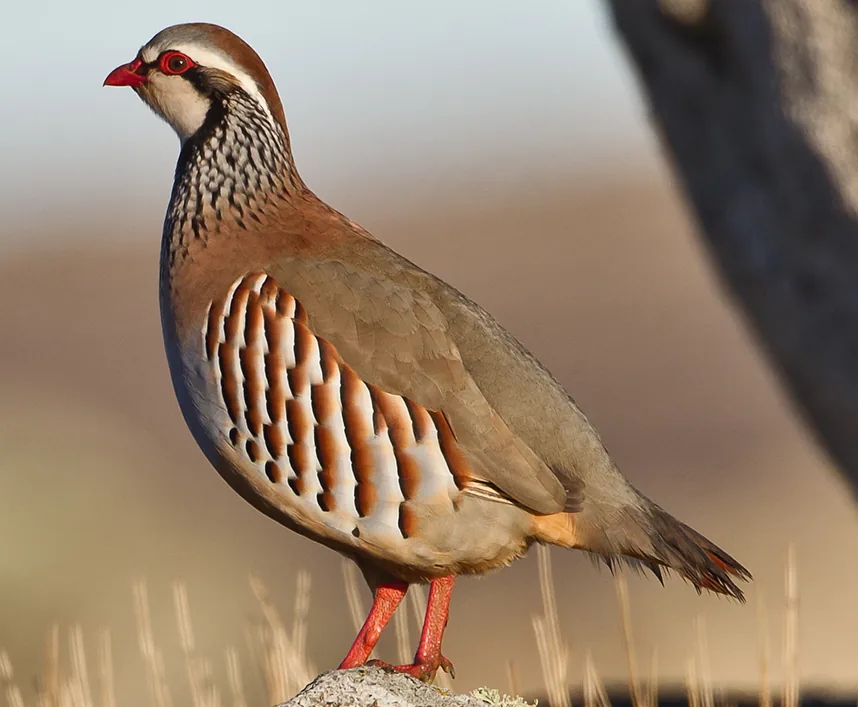
The red-legged partridge frequents dry, sunny habitats at low and middle elevations, open or semi-open: garrigue, bushy hillsides, vineyards, dry heath, farmland and stony ground.[1] It seeks out mosaic landscapes alternating areas of dense herbaceous cover for feeding with bushy sectors that serve it as shelter and nesting sites, and conversely avoids dense woodland and wetlands.[1][5] It occurs from sea level up to about 1,300 metres in altitude,[5] at densities of the order of 5 to 10 pairs per 100 hectares.[6] The diet changes radically with age. Adults are essentially vegetarian: seeds, leaves, buds and fruit, with a clear predominance of grasses, legumes and composites.[1] The chicks, for their part, have a diet dominated by invertebrates before the age of three weeks: ants, grasshoppers and beetles are essential to them from the first days after hatching.[1] This initial dependence on insects explains the importance of grassy margins and untreated cover in the survival of young coveys.
Red-legged Partridge in dry herbaceous cover, bushy hillside habitat

Preferred habitats

Garrigue, bushy hillsides, vineyards, dry heath and mosaic farmland; dense woodland and wetlands avoided.[1]

Altitude

From sea level up to about 1,300 m.[5]

Densities

About 5 to 10 pairs per 100 hectares under favourable conditions.[6]

Adult diet

Seeds, leaves, buds and fruit, dominated by grasses, legumes and composites.[1]

Chick diet

Invertebrates predominant before three weeks: ants, grasshoppers and beetles from the very first days.[1]

Breeding and double nesting
Pairs form from February to April and establish their territory.[6] Laying takes place in April-May in France, with about a dozen eggs on average.[1] The nest is a simple scrape some twenty centimetres across, made on the ground and hidden beneath a bush.[6] Incubation lasts 23 to 24 days and is carried out by both parents;[1][6] hatching is spread from late May to late August.[1] The species' most remarkable peculiarity is double nesting, described by R. E. Green in Ibis in 1984: the female may lay two clutches in two different nests, one immediately after the other. The two nests are then incubated separately — the male takes charge of the first clutch, the female the second — and incubation of the two nests begins at approximately the same time.[7] The pair thus raises two broods almost simultaneously. The frequency of this behaviour varies between datasets: the Office français de la biodiversité puts it at 20 to 40 % of cases,[1] while Green reports 60 to 80 % in older females[7] — the two figures do not refer to the same population and are not directly comparable. Double laying should not be confused with the replacement clutch, known in French as the ponte de recoquetage, laid after destruction of the first nest and numbering 8 eggs on average.[1] The chicks are nidifugous: they leave the nest very soon after hatching, follow the adults, reach adult size at about two months and remain with their parents until the following winter; sexual maturity is reached the following spring.[6][5] Double-nesting behaviour and differences in breeding success between the sexes have been the subject of later work on wild populations.[8]
Red-legged Partridge on the ground among vegetation, breeding season

Calendar

Pairs formed from February to April, laying in April-May, hatching from late May to late August.[1][6]

Clutch

About a dozen eggs on average in a ground scrape some 20 cm across, hidden beneath a bush.[1][6]

Incubation

23 to 24 days, carried out by both parents — each on its own nest in the case of double laying.[1][7]

Double nesting

Two clutches in two separate nests, incubated separately by the male and by the female: 20 to 40 % of cases according to the OFB, 60 to 80 % of older females according to Green.[1][7]

Replacement clutch

Replacement laying of 8 eggs on average after destruction of the nest — to be distinguished from double laying.[1]

Young

Nidifugous chicks, adult size at about two months, accompanied by the parents until winter, maturity the following spring.[6][5]

Behaviour and covey life

The red-legged partridge is a gregarious species. It usually lives in coveys of six to ten birds — ten to fifteen according to some sources[5] — generally made up of a pair and its brood, sometimes joined by unattached adults. In autumn and during cold winters, these coveys merge into gatherings that may exceed forty or even seventy individuals.[5] When disturbed, the red-legged partridge much prefers to run — naturalists speak of it as running on foot rather than flushing — instead of taking wing: it moves along the ground, head high, using the cover, and takes off only as a last resort, in a low, fast flight.[5] This habit of escaping on foot distinguishes it from the grey partridge, which is quicker to take wing.[13]
Group of Red-legged Partridges on the ground, gregarious covey behaviour

Coveys

Usual groups of 6 to 10 birds, up to 10-15 according to some sources.[5]

Winter gatherings

Gatherings of more than 40, even 70 individuals in autumn and during cold winters.[5]

Running on foot

Escape on foot preferred; a low, fast flush only as a last resort.[5]

How to tell the three partridges apart
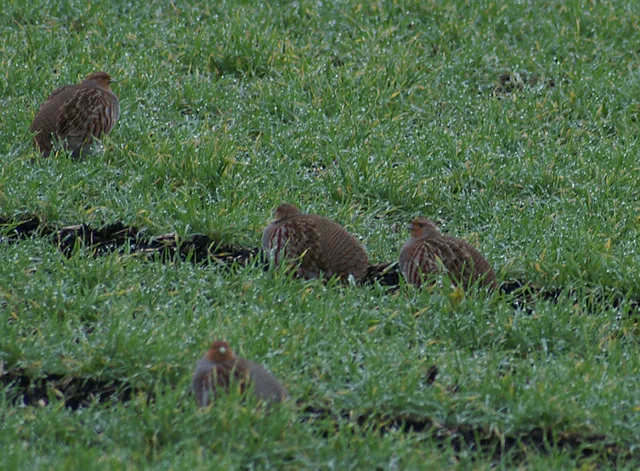
Three "partridges" sit side by side in everyday vocabulary, but they are neither the same size, nor of the same genus, nor of the same status. The grey partridge, Perdix perdix (Linnaeus, 1758), belongs to the genus Perdix and not to Alectoris: it is therefore not a colour variant of the red-legged partridge.[13] It is slightly smaller (29 to 31 cm, wingspan 45 to 48 cm) and much duller: neck and breast grey and vermiculated, back grey-brown barred with chestnut, head rufous; the male bears a horseshoe-shaped chestnut patch on the breast, absent or incomplete in the female, the only constant sexual character.[13] The two species share France in an almost complementary way: broadly speaking, the grey occupies the northern half, plus the Pyrenees and the Massif Central where relict populations survive, and the red-legged the southern two thirds.[1][13] The chukar partridge, Alectoris chukar (Gray, 1830), is of the same genus as the red-legged but larger; its black necklace is broad and clean-edged, encircles the neck and runs up through the eye, without the speckling that breaks up that of the red-legged partridge.[14] Its natural range extends from eastern Europe and the Balkans to Manchuria and does not overlap that of the red-legged partridge.[14] Hybridisation is the major management issue in the genus. Mediterranean populations of red-legged partridge and rock partridge are affected by genetic pollution in which the chukar is the most frequently detected introgressive taxon, with chukar genes of East Asian origin found in Spain, France and Italy.[10] On the island of Elba, 84 % of the wild partridges studied (n = 25) proved to be A. rufa × A. chukar hybrids, and introgression frequencies reaching 67 % were recorded in a sample of twenty captive birds from Corsica.[10] In Majorca, chukar mitochondrial DNA was detected in 16 individuals out of 93 sampled, even though their phenotype was indistinguishable from a pure red-legged partridge[9]: identification by eye is therefore unreliable, and only genetic analysis can settle the matter. Britain banned the release of chukar partridges and of chukar × red-legged partridge hybrids as early as 1992.[12] Natural hybridisation also occurs in France: where the range of the red-legged partridge overlaps that of the rock partridge in the southern Prealps, the two species produce fertile hybrids known as perdrix rochassières,[1][16] whose plumage characters are not stable: some individuals tend towards the red-legged, others towards the rock partridge, with every intermediate shade.[16]
Grey Partridge (Perdix perdix), dull plumage and the male's breast horseshoe

Grey partridge (Perdix perdix)

Different genus, 29 to 31 cm, dull plumage, chestnut horseshoe on the male's breast; northern half of France.[13]

Chukar partridge (Alectoris chukar)

Same genus, larger, clean-edged black necklace running up through the eye; natural range from the Balkans to Manchuria.[14]

The necklace character

Necklace broken up into speckles in the red-legged, clean-edged and closed in the chukar and the rock partridge.[5][14]

Chukar introgression

84 % hybrids among 25 wild partridges from the island of Elba; chukar mitochondrial DNA in 16 birds out of 93 in Majorca.[10][9]

Detection

Red-legged × chukar hybrids are visually indistinguishable from a pure red-legged partridge: only genetics can decide.[9]

Perdrix rochassière

Fertile red-legged × rock partridge hybrid of the southern Prealps, with unstable plumage.[1][16]

Status and management in France

The red-legged partridge is classed as Near Threatened (NT) on the IUCN global Red List, a status assigned in the 2020 update on the basis of the BirdLife International assessment; the European status is the same, while the French Red List still classed it as of least concern (LC) in 2016.[1] The population trend is declining: the 2020 assessment puts the European decline at 40-45 % over ten years, based on the data submitted by member states to the European Commission under Article 12 of the Birds Directive.[11] In France, the 2019 reporting records 214,000 pairs over the period 2008-2017 (range 132,000 – 300,000), with a decline estimated at -32 % between 2001 and 2018 and at -51 % between 2009 and 2019.[1] The species remains quarry: it is listed in Annex II/2 B of the Birds Directive, as well as in Annex III, which permits sale, keeping and transport.[1] The main threats identified are habitat loss — agricultural intensification on the one hand, scrub encroachment following rural land abandonment on the other —, extreme weather events, hunting bags and predation.[1] Two underlying factors complete the picture, brought to light by the sequencing of the species' genome. The first is genetic: the authors identify a demographic collapse that occurred about 140,000 years ago, which they link to the warming of the Riss-Würm interglacial, and from which the genetic diversity of the red-legged partridge has never recovered — its levels remain minimal today.[15] The second is climatic: warming has a negative effect on breeding success in the southern part of the range and may be linked to an increased prevalence of certain infectious diseases.[15] On the management side, the OFB finally points out that survival to the following spring of farm-reared birds from late-summer releases is very low, below 5 %[1]: this figure documents the ecology of late shooting releases, not the conduct of a rearing operation; it underlines that lasting reinforcement of a population depends on habitat quality and on operations carried out outside the hunting season.

IUCN status

Near Threatened (NT) at global and European level since 2020; French Red List: least concern (LC) in 2016.[1]

European decline

Decline estimated at 40-45 % over ten years according to Article 12 reporting under the Birds Directive.[11]

French numbers

214,000 pairs over 2008-2017 (132,000 – 300,000); -32 % between 2001 and 2018, -51 % between 2009 and 2019.[1]

Legal framework

Quarry species, listed in Annexes II/2 B and III of the Birds Directive.[1]

Threats

Habitat loss through agricultural intensification and scrub encroachment, weather hazards, hunting bags and predation.[1]

Low genetic diversity

Demographic collapse dated to about 140,000 years ago, from which the species has never recovered genetically.[15]

At GIBIS

GIBIS has been rearing partridges since 1951 at Chatte, in Isère. The red-legged, grey and chukar partridges produced on site are intended for restocking and for shooting, and are presented on the partridge page; the rearing practice — planted aviaries, low densities, development of flight — is described on the our rearing page, and the principles of population reinforcement operations on the restocking page. This encyclopaedic article remains independent of those pages: it documents the wild species, its biological characters and its status, with no commercial aim.

A family farm since 1951

Production of feathered game and small game at Chatte, in Isère.

Partridges reared

Red-legged partridge, grey partridge and chukar partridge: see the site's partridge page.

Restocking

Population reinforcement operations are detailed on the restocking page.

Références

  1. Office français de la biodiversité (OFB), species profile « Perdrix rouge (Alectoris rufa) », ofb.gouv.fr, accessed in 2026.
  2. Kaup J. J., *Skizzirte Entwickelungs-Geschichte und natürliches System der europäischen Thierwelt*, Darmstadt, 1829 — erection of the genus *Alectoris*.
  3. Jobling J. A., *The Helm Dictionary of Scientific Bird Names*, Christopher Helm, London, 2010.
  4. Madge S. & McGowan P. J. K., *Pheasants, Partridges and Grouse*, Christopher Helm, London, 2002.
  5. Oiseaux.net, profile « Perdrix rouge (Alectoris rufa) », accessed in 2026.
  6. Fédération départementale des chasseurs des Pyrénées-Atlantiques (FDC64), « La perdrix rouge », accessed in 2026.
  7. Green R. E., « Double nesting of the Red-legged Partridge Alectoris rufa », *Ibis*, vol. 126, no. 3, 1984, pp. 332-346.
  8. Casas F., Mougeot F. & Viñuela J., « Double-nesting behaviour and sexual differences in breeding success in wild Red-legged Partridges Alectoris rufa », *Ibis*, vol. 151, no. 4, 2009, pp. 743-751.
  9. Tejedor M. T., Monteagudo L. V., Mautner S., Hadjisterkotis E. & Arruga M. V., « Introgression of Alectoris chukar Genes into a Spanish Wild Alectoris rufa Population », *Journal of Heredity*, vol. 98, no. 2, 2007, pp. 179-186.
  10. Barbanera F., Guerrini M., Khan A. A. et al., « Human-mediated introgression of exotic chukar (Alectoris chukar, Galliformes) genes from East Asia into native Mediterranean partridges », *Biological Invasions*, vol. 11, no. 2, 2009, pp. 333-348.
  11. BirdLife International, *Alectoris rufa* profile, IUCN Red List of Threatened Species, 2020 assessment.
  12. Game and Wildlife Conservation Trust (GWCT), « Red-legged partridge », gwct.org.uk, accessed in 2026.
  13. Office français de la biodiversité (OFB), species profile « Perdrix grise (Perdix perdix) », ofb.gouv.fr, accessed in 2026.
  14. Oiseaux.net, profile « Perdrix choukar (Alectoris chukar) », accessed in 2026.
  15. Balaji C., Forcina G., Garg K. M., Irestedt M., Guerrini M., Barbanera F. & Rheindt F. E., « Novel genome reveals susceptibility of popular gamebird, the red-legged partridge (Alectoris rufa, Phasianidae), to climate change », *Genomics*, vol. 113, no. 5, 2021.
  16. « Biologie de reproduction d'une population de perdrix rochassière (Alectoris graeca saxatilis × Alectoris rufa rufa) dans les Alpes méridionales », *Revue d'écologie (La Terre et la Vie)*, vol. 45, no. 4, 1990.

See also

Gallery

See also

Continue reading

This article is part of the game bird encyclopaedia of GIBIS, a breeder at Chatte (Isère) since 1951. For a question about the species or about our birds, the team can be reached by telephone or e-mail.

Call us