
Game encyclopaedia
Leveret
The young of the European hare (Lepus europaeus): born on bare ground, furred and with its eyes open, left alone during the day and suckled once a day, at dusk.
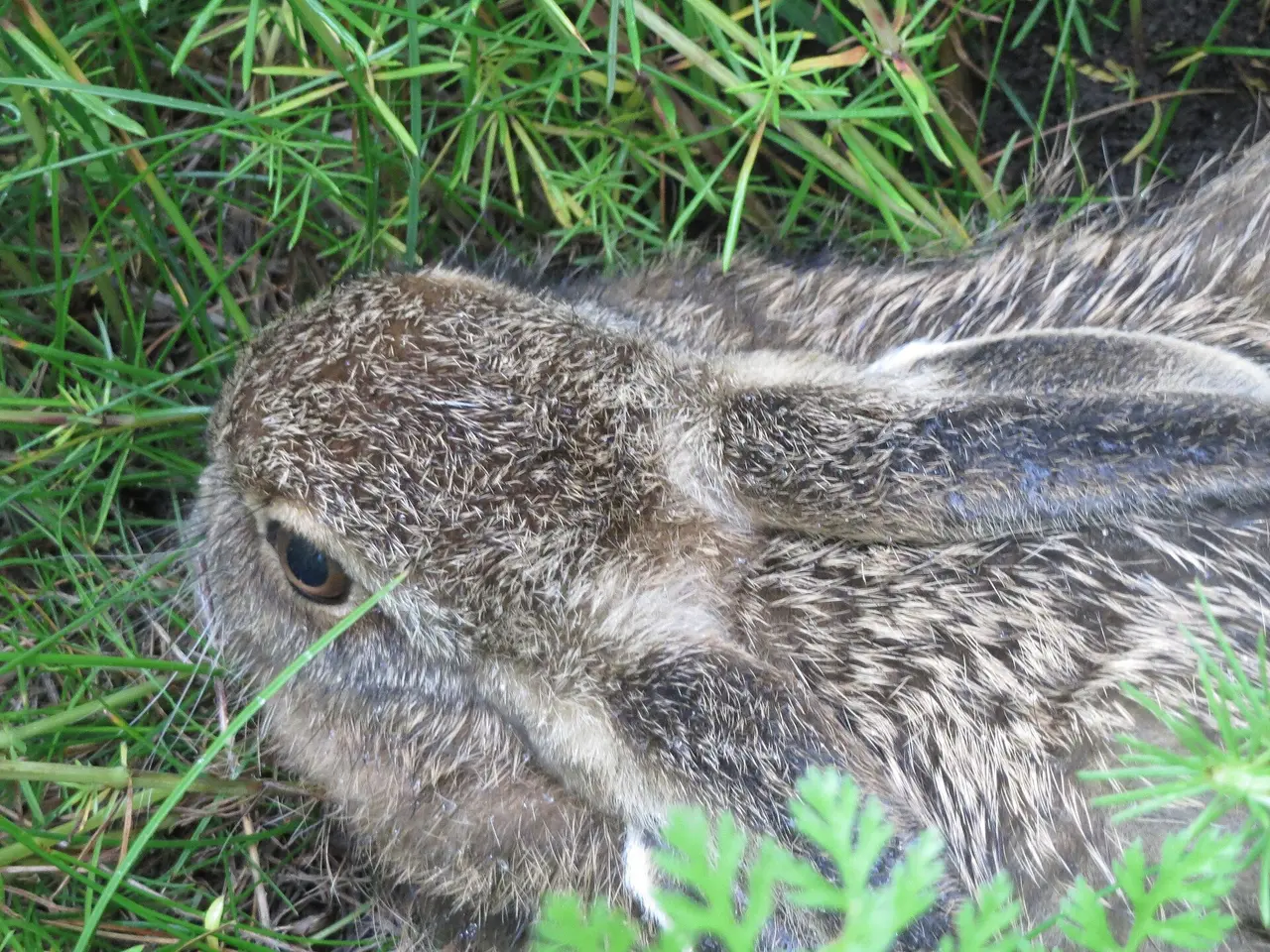
This article covers the young of the European hare. For the species, see European hare; for the young of the rabbit, the kit, see European rabbit.
Definition and vocabulary
The leveret is the young of the hare; in French it is « levraut », also spelt « levreau ».[1] The mother is the doe — in French « hase », a word borrowed from the German Hase, which simply means « hare » — and the male, in the language of hunting, is the buck — in French « bouquin », derived from « bouc ».[1] The leveret is not a « baby rabbit »: the hare and the European rabbit belong to two different genera, and their young come into the world in two opposite ways. The leveret is born precocial, covered in fur and with its eyes open, in a simple depression in the ground, and can move about shortly after birth;[2][3] the rabbit kit, by contrast, is born naked and blind at the bottom of a burrow (see European rabbit). This « fully dressed » birth governs the leveret's whole life during its first weeks: immobility, dispersal, and a single visit from the mother each day.
Birth
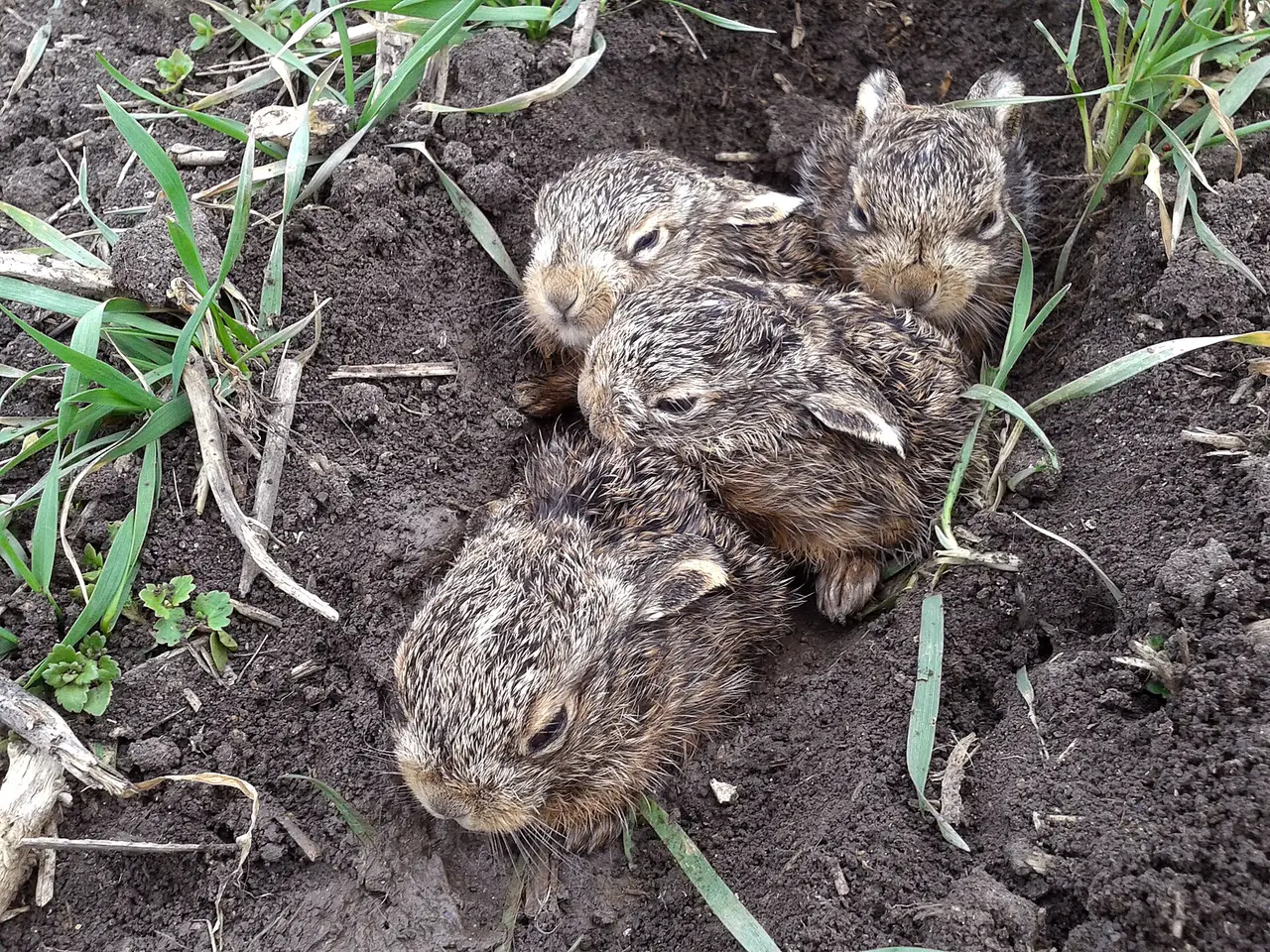
After a gestation of about six weeks, around forty days depending on the source, the doe gives birth to two to three leverets, two to four according to other sources; she can have up to three litters a year.[4][2] Births are not limited to spring: in a breeding colony monitored for sixteen years in Vienna, litters were born in every season, with on average slightly fewer than two young in winter and slightly more than two in summer.[3] The hare does not dig a burrow: the leverets are born in a form, in the open in grass or a crop, then the doe distributes them among separate forms she has scraped in the ground.[2] Their birth weight falls as the litter grows larger, and the leverets of a first-time doe are lighter than those of a female that has already given birth.[3] The doe can also conceive the next litter before giving birth to the previous one (superfetation), which increases the number of young produced over a season by up to 35 %.[5]
One feed a day
The doe does not stay with her young. She joins them only once every twenty-four hours, usually about an hour after sunset, and stays with them for only about five minutes, the time it takes to suckle.[2] Researchers who rear hares reproduce this rhythm: because leverets are suckled only once a day in the wild, they are reunited with their mother for only one hour a day.[3] The rest of the time, each leveret stays alone and hidden; this continues until weaning, during the first month of its life.[2] A wildlife veterinary clinic, for its part, describes one to two visits a day, at dawn and very late in the evening.[4] The sources agree on the essentials: the mother is absent almost all day, and a leveret on its own is not an abandoned leveret.
Growth and weaning
The leveret's growth is spectacular. In a study of captive-bred hares, the leverets multiplied their weight by 8.5 on average in 35 days, with a peak in relative growth around the eighth day.[6] They start nibbling plants from the second week, but milk remains their main source of energy throughout lactation; leverets born in a litter of two or three receive less milk than young born alone and eat more plants.[6] From the first day, they maintain a normal body temperature down to −8 °C: this thermal independence has a high energy cost, which the authors link to the decline of the hare when food is short and the cold lasts.[6] Weaning takes place at around four to five weeks, a duration observed in captivity and comparable to that in the wild; the Toulouse veterinary clinic gives five to eight weeks.[3][4] The growth cartilage of the wrist then gradually disappears: ossification is already complete in 15 % of hares aged five and a half months and in almost all those over ten and a half months.[7]
Survival and causes of death
Most leverets do not survive their first month. In Switzerland, 63 wild leverets fitted with transmitters were tracked every day: their probability of surviving the first month was only 18 %. Foxes, mustelids, birds of prey, cats and dogs were among the predators identified, farm machinery was another danger, rain reduced survival and edge habitats improved it.[8] Another experiment, carried out in arable farmland with dummy leverets, found a survival rate of 22 % after fourteen days; predation was mainly by mammals (53 %, the fox first among them) and birds (41 %), with farm work accounting for 6 % of losses.[9] In captivity, sheltered from predators, leveret mortality during lactation still reaches 34 % on average.[3] Diseases also play a part: in northern Germany, young animals outnumbered adults among hares found dead, and almost all the animals examined carried coccidia (Eimeria).[10]
Young or adult: Stroh's tubercle
To find out whether the year's breeding has succeeded, hunters estimate the proportion of young among the hares taken.[7] The most widespread method relies on a thickening of the ulna just above the wrist: in the young, the growth cartilage is not yet ossified and forms a bump that is felt for with the thumb. This criterion is known as « Stroh's sign » or the « Stroh method », after a publication from 1931.[11] The reference method remains weighing the eye lens, but it takes several weeks.[7] A study by the ONCFS (now the OFB) carried out with six departmental hunters' federations on nearly 700 hares showed the limits of palpation: errors vary greatly from one operator to another, and the error on the percentage of young exceeded 10 % for a third of the operators tested. X-ray of the wrist is clearly more reliable.[7] Because the cartilage disappears between five and a half and ten and a half months, some of the young born early in the season can no longer be recognised in autumn: a little over 5 % of young on 1 October and around 15 % on 1 November, on average.[7]
A leveret on its own is not abandoned
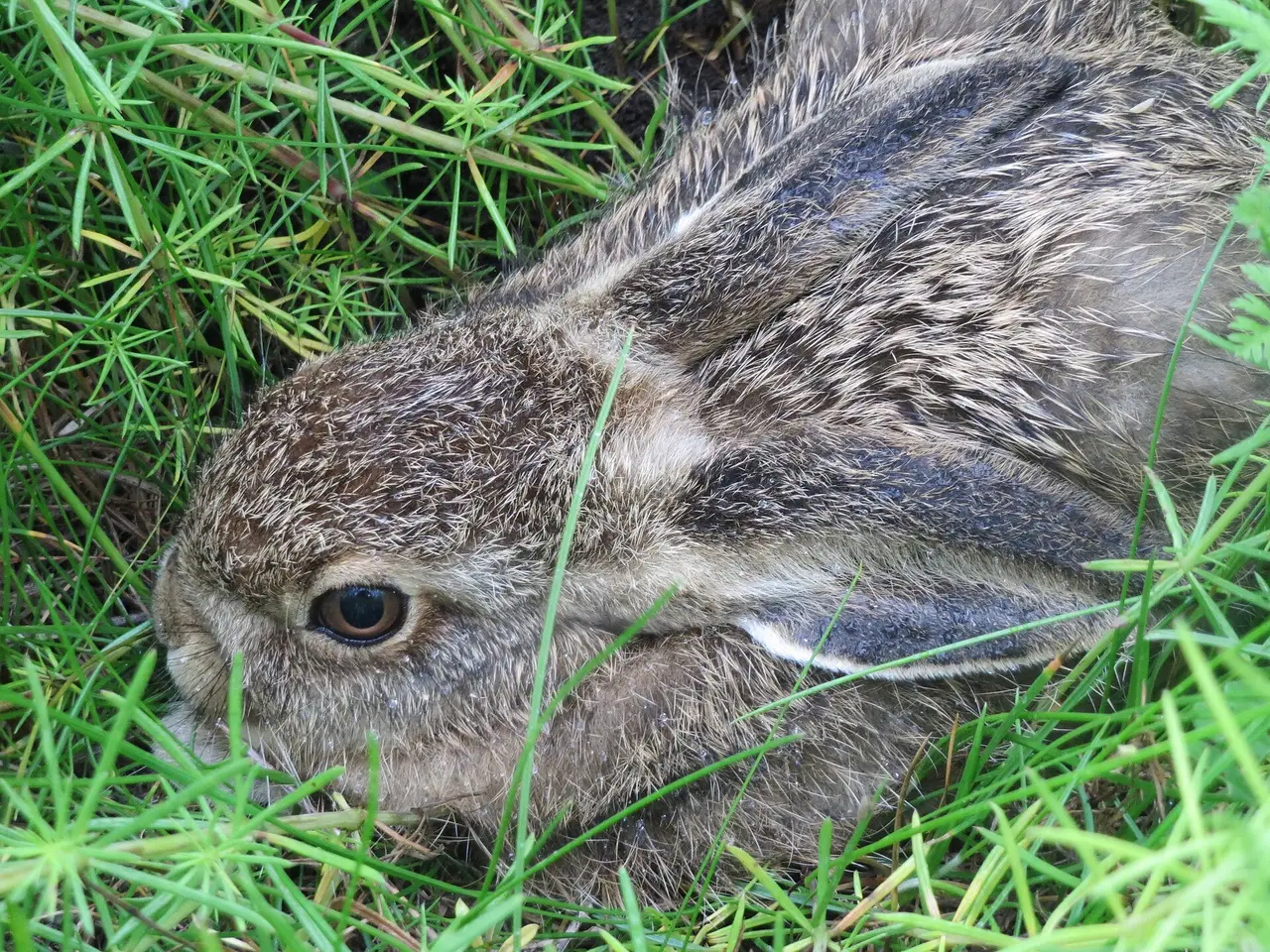
Finding a leveret on its own in the grass, a garden or a field is normal: its mother only comes back to see it at feeding time.[2][4] It is best to watch the situation from a distance before touching anything: a leveret that looks healthy probably has its mother nearby, and it should not be touched.[4] If it looks injured, exhausted or starving, call the nearest wildlife rescue centre, which will tell you what to do.[4] Taking it in to raise at home is not a solution: a wild animal is not a pet, and keeping a non-domestic species is regulated.[4] If it has to be handled, on the advice of the rescue centre, wear gloves and keep contact to the strict minimum.[4]
Leverets and farm work
Faced with danger, the leveret freezes instead of fleeing: it is its defence against predators, but it does not protect it from a mower.[12] In a study by the Agrifaune network in Ille-et-Vilaine, on 369 hectares of lucerne mown at 20 km/h, 16 % of the hares present were killed on average at each cut, or about 7 hares per 100 hectares, while lucerne is mown three to four times a year.[12] Several practices limit these losses: mowing from the inside of the plot outwards (centrifugal mowing) or in strips, so as not to trap the animals in the centre; driving at under 10 km/h, especially near field edges; raising the cutting height; avoiding night work; fitting the machine with a flushing bar that drives the animals to flee.[12] Agrifaune, a programme set up in 2006, brings together the OFB, Chambres d'agriculture France, the FNSEA and the Fédération nationale des chasseurs to develop these wildlife-friendly practices.[13]
At GIBIS
GIBIS rears European hares in grass paddocks at Chatte, in the Isère, for restocking hunting grounds; they are presented on the page our hares. The photographs in this article show wild leverets, not our animals. This article remains independent of our offer: it documents the young of the wild hare, its biology and its survival, with no commercial purpose.
References
- ↑Wiktionnaire, entries « levraut », « hase » and « bouquin », fr.wiktionary.org, and Larousse, *Dictionnaire de français*, entry « levraut » (« jeune lièvre », young hare), larousse.fr, accessed in 2026.
- ↑Thompson P., « Species of the month: March — Brown hare », Game & Wildlife Conservation Trust (GWCT), 2009, gwct.org.uk, accessed in 2026 — litters, leverets born furred and with open eyes, separate forms, one suckling every 24 hours lasting about five minutes, about one hour after sunset.
- ↑Schai-Braun S. C., Steiger P., Ruf T., Arnold W. & Hackländer K., « Maternal effects on reproduction in the precocial European hare (*Lepus europaeus*) », *PLOS ONE*, vol. 16, e0247174, 2021 — breeding colony in Vienna (1989-2004): litter size by season, birth weight, suckling once a day, weaning at four to five weeks, mortality during lactation.
- ↑École nationale vétérinaire de Toulouse, Clinique faune sauvage, species sheet « Le lièvre d’Europe », 2023, envt.fr, accessed in 2026 — gestation, litters, weaning, what to do about a leveret found alone.
- ↑Roellig K., Goeritz F., Fickel J., Hermes R., Hofer H. & Hildebrandt T. B., « Superconception in mammalian pregnancy can be detected and increases reproductive output per breeding season », *Nature Communications*, vol. 1, article 78, 2010 — superfetation in *Lepus europaeus*, up to 35.4 % more young per season.
- ↑Hackländer K., Arnold W. & Ruf T., « Postnatal development and thermoregulation in the precocial European hare (*Lepus europaeus*) », *Journal of Comparative Physiology B*, vol. 172, 2002, pp. 183-190 — growth, solid food, thermoregulation of leverets.
- ↑Grandière D., Guitton J.-S., Fuselier M., Mauvy B. & Péroux R., « La radiographie : plus fiable que la palpation pour déterminer l’âge des lièvres », *Faune Sauvage* (ONCFS), no. 286, November 2009, ofb.gouv.fr — study carried out with FDC 03, 42, 43, 49, 63 and 69.
- ↑Karp D. & Gehr B., « Bad hare day: very low survival rate in brown hare leverets », *Wildlife Biology*, 2020 (2), wlb.00645 — 63 leverets radio-tracked in Switzerland.
- ↑Cukor J., Riegert J., Krivopalova A., Vacek Z. & Šálek M., « The low survival rate of European hare leverets in arable farmland: evidence from the predation experiment », *PeerJ*, vol. 12, e17235, 2024 — predation experiment with decoys in the Czech Republic.
- ↑Faehndrich M. et al., « Status of infectious diseases in free-ranging European brown hares (*Lepus europaeus*) found dead between 2017 and 2020 in Schleswig-Holstein, Germany », *Pathogens*, vol. 12, no. 2, article 239, 2023.
- ↑Stankevičiūtė J., Pėtelis K., Baranauskaitė J. & Narauskaitė G., « Comparison of two age determination methods of the European hares (*Lepus europaeus* Pallas, 1778) in Southwest Lithuania », *Acta Biologica Universitatis Daugavpiliensis*, vol. 11, no. 1, 2011, pp. 22-28 — Stroh method (ossification of the ulna, Stroh 1931).
- ↑Agrobio 35, biodiversity sheet no. 3 « Fauche sympa : épargner la faune lors des travaux de récolte », 2023, agrobio-bretagne.org — Agrifaune 35 study from 2010 on lucerne mowing, recommended mowing practices.
- ↑Office français de la biodiversité, « Agrifaune » page, ofb.gouv.fr, accessed in 2026 — programme created in 2006 by the OFB, Chambres d’agriculture France, the FNSEA and the FNC.
See also
Gallery
- Wild European hare, illustrative photo (not an animal from the GIBIS farm): Iwona Kałuzińska, CC BY-SA 4.0, Wikimedia Commons
- Wild European hare, illustrative photo (not an animal from the GIBIS farm): Cindy kuiphuis, CC BY-SA 4.0, Wikimedia Commons
See also
A question about the leveret?
This article is part of GIBIS's game encyclopaedia, a breeder in Chatte (Isère) since 1951. For a question about the species, the team answers by telephone or email. For an injured wild leveret, call a wildlife rescue centre first.