
Feathered game — cereal plains and hedgerow country
Grey partridge for sale — pure French strain
The emblematic bird of the cereal plains of northern France, bred from a pure French strain with no crossing. Coveys with an adult leader, birds of 14-15 weeks and season adults, delivered throughout France — the Hauts-de-France and Picardy included.
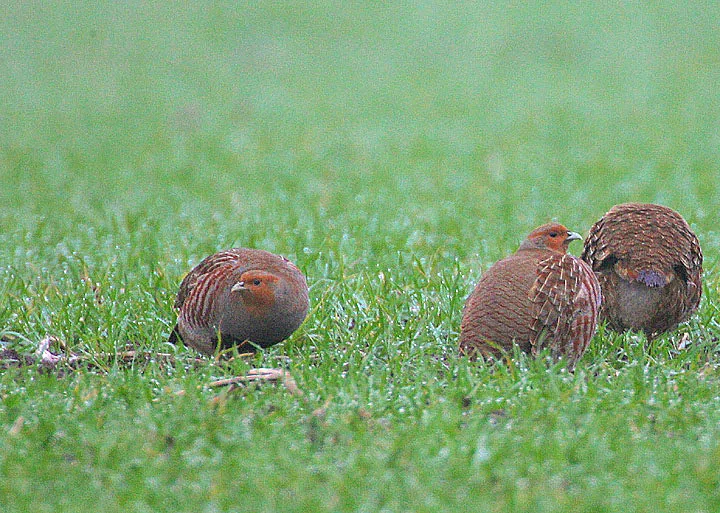
Perdix perdix
The grey partridge, bird of the northern plains
The grey partridge (Perdix perdix) is the historic small game bird of the cereal plains and hedgerow country of the northern half of France: the Hauts-de-France, Picardy, Champagne, the Beauce, Normandy and the Île-de-France. A casualty of changing farming practice — the loss of insects, hedges and grass margins — it has become scarce across much of its historic range. GIBIS is one of the few French breeders still keeping breeding stock of grey partridges from pure French strains, reared at Chatte, in the Isère, since 1951. This page is the profile of the grey partridge; our umbrella partridge page also covers the red-legged partridge, and the full biology of the species is detailed in our Perdix perdix encyclopaedia entry.
- A heritage species
- The grey partridge in France has been in marked decline since the 1970s: every serious restocking programme contributes to its preservation.
- A bird of the north
- Cereal plains, open field and hedgerow country in the northern half of the country: the historic habitat of the grey, where the red-legged occupies the southern two thirds.
- Bred by GIBIS since 1951
- Three generations of breeders at Chatte, in the Isère. Grey partridge breeding stock kept separate from the other species.
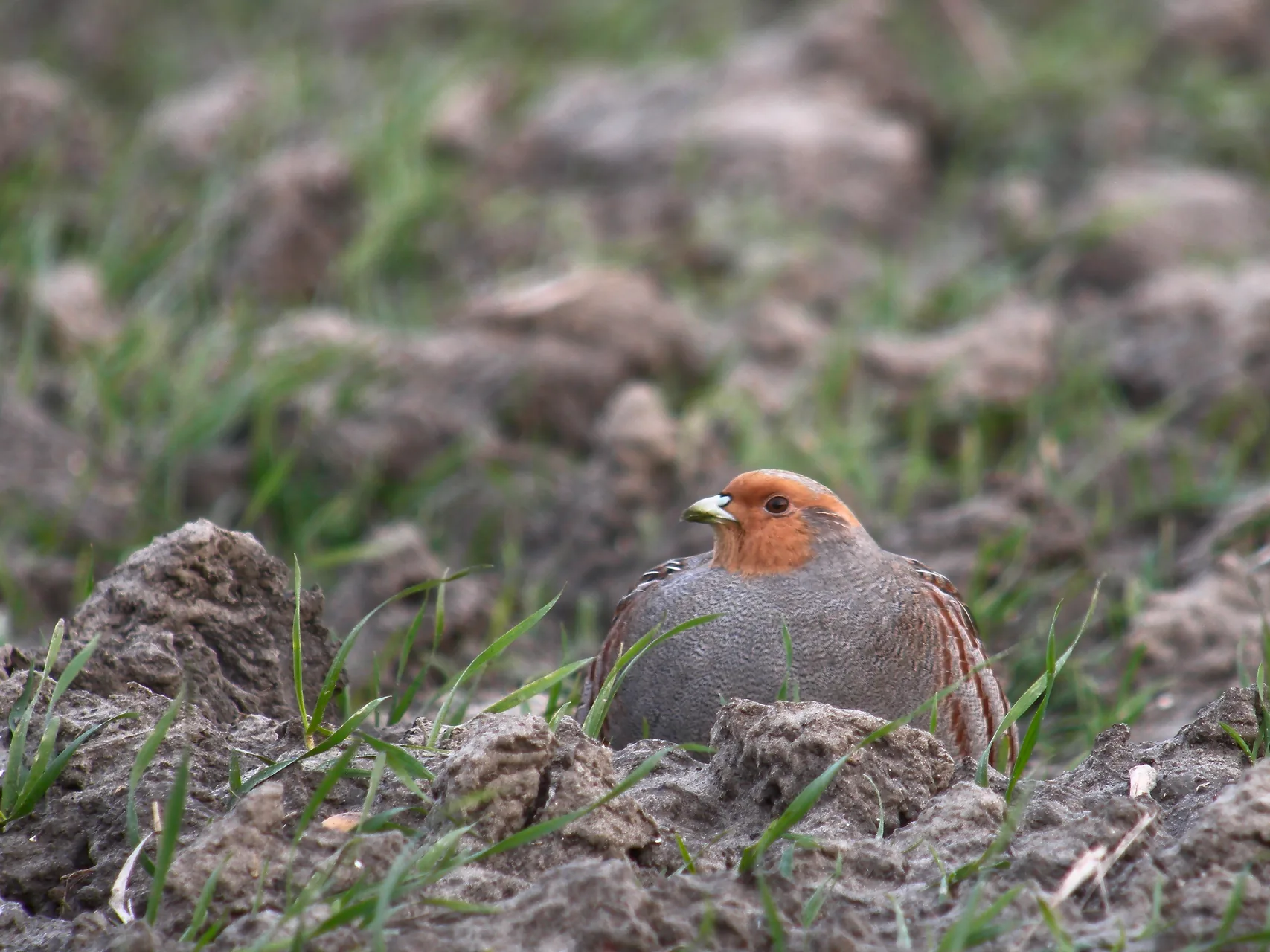
Genetics preserved
A pure French strain, with no crossing
All our grey partridges descend from pure French strains, kept without crossing with Eastern European stock or hybridised bloodlines. That choice has a cost — lower prolificacy, more demanding husbandry — but it guarantees birds true to the wild French type: size, plumage, covey behaviour and hardiness in the face of the oceanic and continental climate of the north of the country. The greys are reared in low-density aviaries, on a ration enriched with insects and wild seeds that respects the natural diet of the species and prepares the young birds to feed themselves after release.
Pure French strain
No crossing with foreign strains: the genetic authenticity of the French grey partridge is preserved.
Low-density aviaries
Deliberately low densities to limit stress, preserve the plumage and maintain the social behaviour of the covey.
Natural feeding
A ration enriched with insects and wild seeds: the birds know how to feed themselves on the plain from the day they are released.
Rigorous selection
Breeding stock chosen on conformation, plumage, wary temperament and flight quality.
Where should grey partridges be released?
The habitat of the grey: cereal plain and hedgerow country
The grey partridge is a bird of open field and hedgerow country: cereal stubbles, lucerne, beet, fallow land, grass margins and low hedges make up its ideal territory. It is perfectly suited to the plains of the Hauts-de-France, Picardy, Champagne, the Beauce or Normandy — regions where the red-legged, a bird of dry Mediterranean hillsides, is out of place. Before a release, the quality of the ground counts as much as the quality of the birds: keeping winter cover, leaving untreated field margins rich in insects for future broods, providing supplementary feeding and controlling predators. GIBIS advises you on these measures according to your cropping pattern, as we do for all our restocking programmes.
- Cover and margins
- Stubbles, fallow land, grass margins and low hedges: the farmland mosaic that feeds and shelters the coveys.
- Target regions
- Hauts-de-France, Picardy, Champagne, the Beauce, Normandy and the Île-de-France: the historic heart of the grey’s range.
- Insects for the broods
- Partridge chicks live on insects for their first weeks: untreated margins determine whether natural breeding succeeds.
- Predator control
- Foxes, mustelids and corvids weigh heavily on ground nests: sustained trapping markedly improves survival.
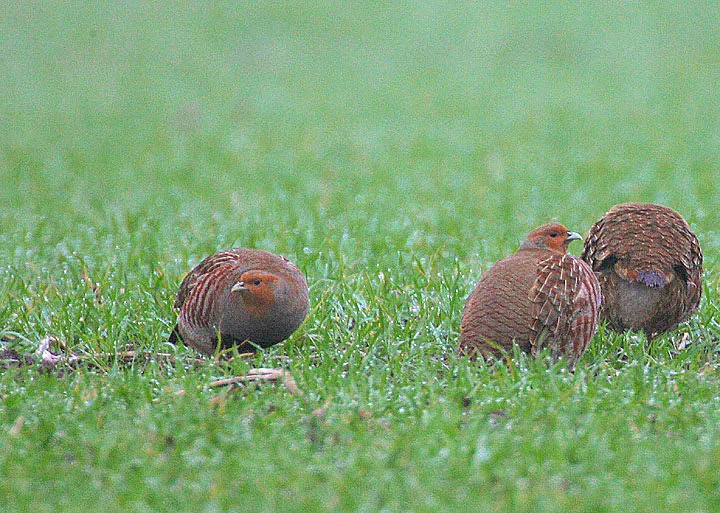
Getting them established
Restocking: release density and method
The grey partridge is released as a covey — the family group is the key to its survival. Our coveys of 9 birds accompanied by an adult leader reproduce that social structure: the leader keeps the young birds together, limits dispersal and passes on alarm behaviour. For restocking, allow one covey per 20 to 30 hectares of suitable plain, in summer releases (August) repeated over two or three seasons, aiming for a spring density of 3 to 5 pairs per 100 hectares — the threshold at which a population begins to sustain itself. For a shooting release during the season, adults are put out a few days before the driven day or the day over pointing dogs, on fields that hold cover.
- Covey with a leader
- 9 birds of 14 weeks + 1 adult leader: the natural social structure of the species, ready to release.
- Recommended density
- One covey per 20 to 30 suitable hectares; target 3 to 5 pairs per 100 hectares in spring for a viable population.
- Calendar
- Restocking releases in August, repeated for 2 to 3 years; shooting adults available from August to December.
- Technical follow-up
- GIBIS supports the setting up of the programme and the monitoring of released populations, spring counts included.
Transport in our fitted vehicles
Delivery to the Nord, Picardy and the whole of France
GIBIS delivers its grey partridges throughout France, with particular experience of deliveries to the Hauts-de-France — Nord, Pas-de-Calais, Somme, Oise, Aisne — where demand for the pure-strain grey is strongest. Transport is carried out in our own vehicles fitted for live birds, with health certificates. We also deliver to Belgium and Switzerland. Rounds to the north are shared during the season: order early to fit your release into a round and reduce the transport cost.
The whole of France
Delivery to every region, with regular rounds to the Hauts-de-France and the Paris basin in season.
Belgium and Switzerland
International deliveries, with the health and customs paperwork handled by us.
Health certificates
Every batch travels with its health documents; the farm is monitored by our veterinary surgeon.
Fast quotation
Call 04 76 38 31 01 or write to us: tailored quotation including transport within 24 hours.
Catalogue prices
Grey partridge prices
Our prices are ex-farm, falling with the quantity ordered. The covey (9 birds + 1 leader) is the formula we recommend for restocking; the 14-15 week bird suits population top-ups and the adult the shooting season. Grey partridge of pure French strain is produced in limited numbers: book in the spring to secure your August volumes. To compare with the red-legged partridge (10,30 € each, covey 102,00 €), see the partridge page.
Season 2026 Pricing
2026-2027 hunting season — prices current as of August 2026
Coveys and young grey partridges
Adult grey partridges — hunting season
Gallery
Frequently Asked Questions
How much does a grey partridge cost?
What habitat is needed to release grey partridges?
What release density should be used for grey partridge restocking?
Do you deliver grey partridges to the Nord and Picardy?
Grey or red-legged partridge: which should I choose?
What is a covey of grey partridges with a leader?
Why a pure French strain rather than an imported one?
Do you sell grey partridge eggs or breeding stock?
See also
Book your grey partridges of pure French strain
Production of pure greys is limited: let us talk about your ground, your acreage and your release calendar. Tailored quotation including transport, by telephone or by e-mail.