Skip to content
Home Hunting Dog Training

Encyclopaedia of game

European rabbit

Oryctolagus cuniculus (Linnaeus, 1758). A small, gregarious, burrowing lagomorph, also called the wild rabbit, native to the Iberian Peninsula and now one of the most widely distributed mammals in the world — threatened at home, invasive abroad.
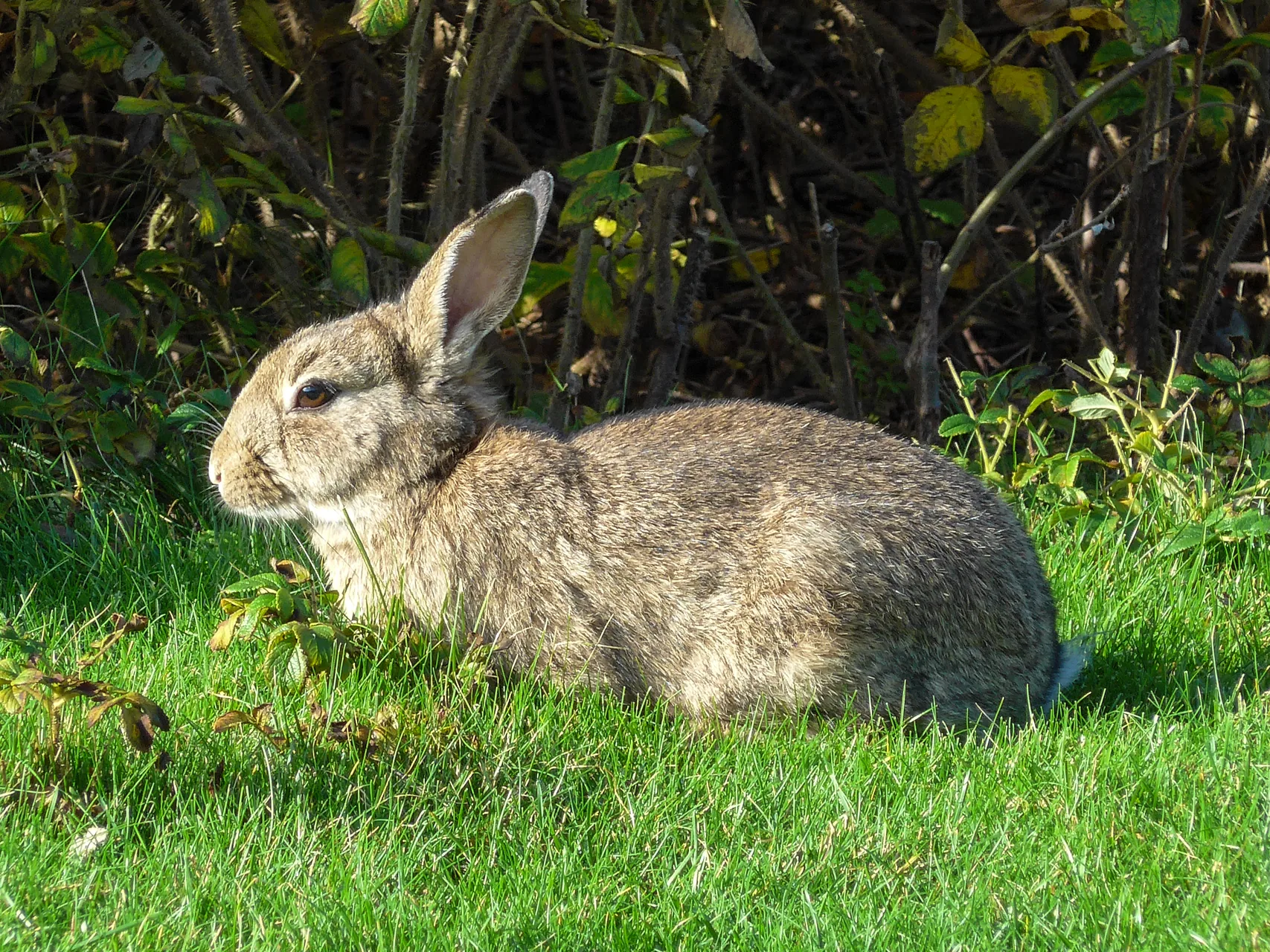
European rabbit

Not to be confused with the European hare (Lepus europaeus), a different genus: the European rabbit is smaller, lives in colonies and digs a burrow in which its young are born naked and blind, whereas the hare is solitary, does not dig and gives birth above ground to furred leverets with their eyes open. For the hare, see our hares; for another lowland game species, see Common pheasant.

Description
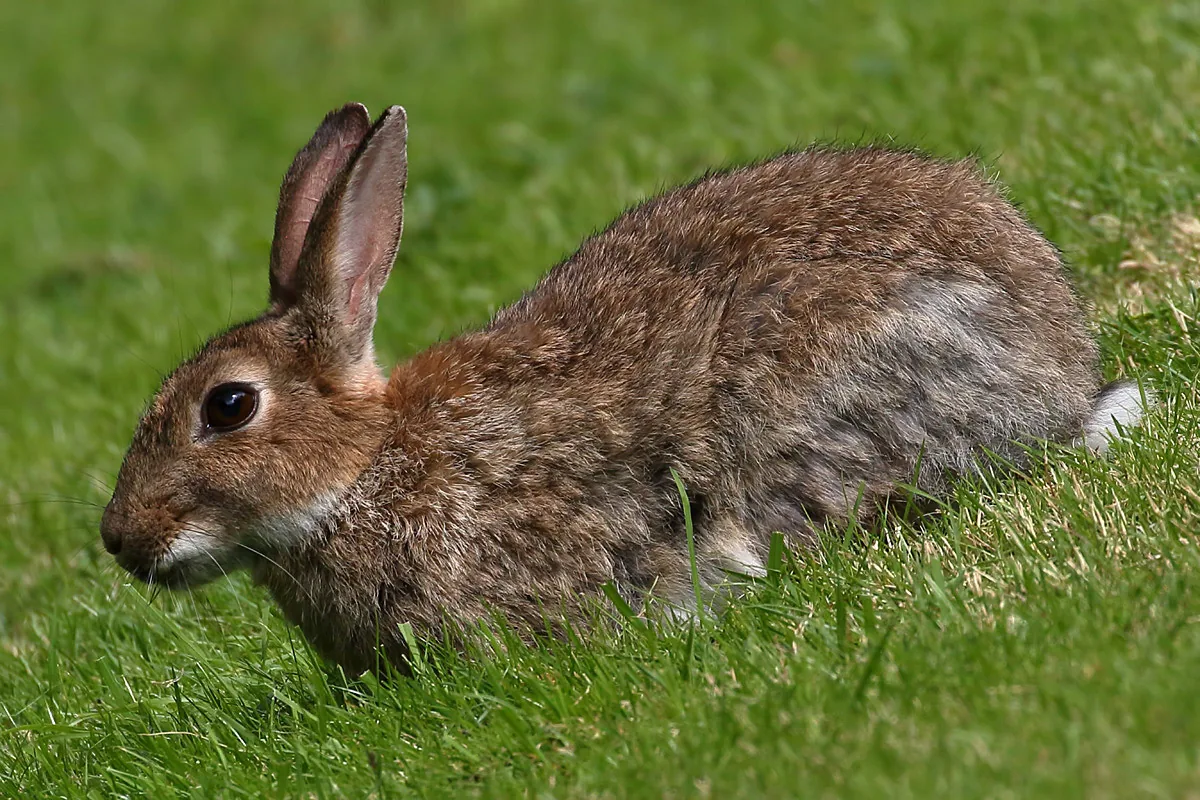
The European rabbit is a small, stocky lagomorph 34 to 50 cm in length, weighing between 1.2 and 2.5 kg, exceptionally a little more.[2][4] The pelage is grey-brown agouti — each guard hair is banded with brown and black — with a rufous-tinged nape, while the underside of the body and the underside of the short tail (the "scut") are white.[2][4] This white flashes like an alarm signal when the animal bolts for its burrow. The ears, 6 to 8 cm, are markedly shorter than those of the hare and lack the black tip that marks the latter.[2][4] Compared with the European hare (Lepus europaeus), the rabbit is smaller, with shorter ears and legs, and flees to an underground refuge rather than relying on its speed in the open; for the related species, see our hares.[2][4] Compared with the domestic rabbit, the European rabbit is uniformly agouti and of modest size, whereas domestic breeds display every coat, size and ear shape — all derived from the wild subspecies O. c. cuniculus.[4][7]
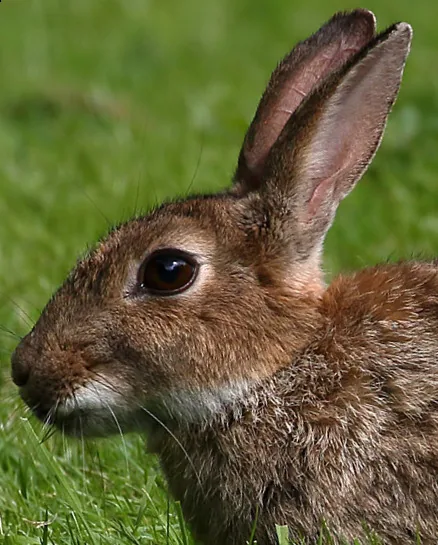
European rabbit in profile: short ears without a black tip and a short tail with a white underside

Size and weight

34 to 50 cm long and 1.2 to 2.5 kg — noticeably smaller than a hare.[2][4]

Short ears

6 to 8 cm, without the hare's black tip: an immediate distinguishing criterion.[2][4]

White-undersided tail

The white "scut", flashed in flight, serves as an alarm signal towards the burrow.[2][4]

Compared with the domestic rabbit

The wild rabbit stays uniformly agouti; all domestic breeds derive from the subspecies O. c. cuniculus.[4][7]

Taxonomy and systematics

The species was described by Carl Linnaeus in 1758, in the tenth edition of the Systema Naturae, under the name Lepus cuniculus.[6] The genus Oryctolagus was erected by the Swedish zoologist Wilhelm Lilljeborg in 1873, with the rabbit as its type species; it is this transfer out of the genus Lepus that explains the parentheses around the author in the valid binomen, Oryctolagus cuniculus (Linnaeus, 1758).[3][5] The genus name combines the Greek oryktós, "digging, dug up", and lagṓs, "hare": literally the "burrowing hare"; the epithet cuniculus is the Latin word for "rabbit", which also denoted the underground tunnel.[3] The rabbit belongs to the order Lagomorpha, not to the rodents: lagomorphs possess a second pair of small upper incisors — the peg teeth, located behind the large incisors — a character that separates them from rodents.[3][4] The family Leporidae is shared with the hares of the genus Lepus.[3][4] Oryctolagus cuniculus is today the only living species of its genus, and the ancestor of all breeds of domestic rabbit.[4][7] Two subspecies are recognised: O. c. cuniculus, widespread across most of the range and the source of all domestic and introduced stock, and O. c. algirus, confined to the south-west of the Iberian Peninsula and the north-west of Africa.[16]
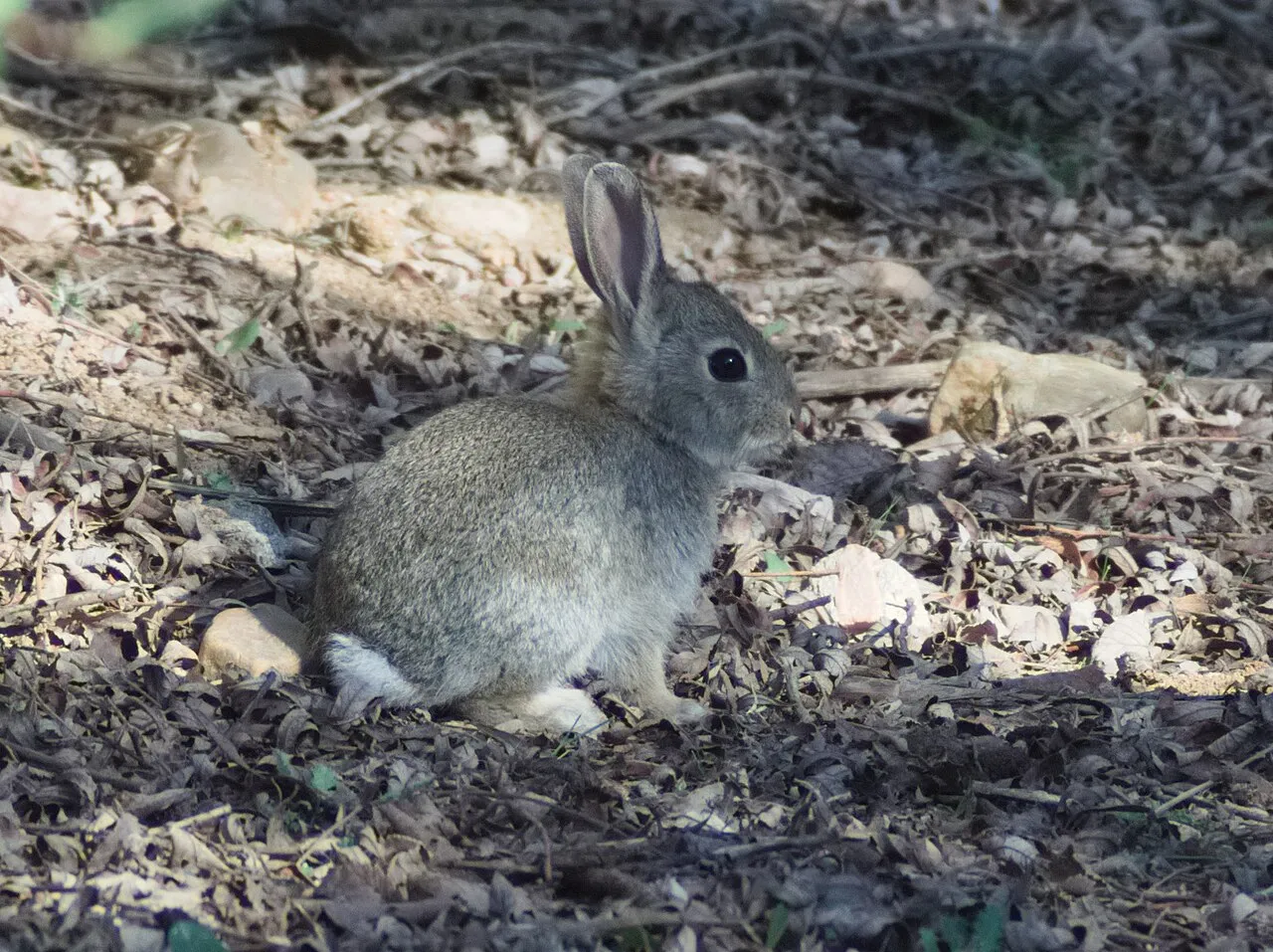
Young European rabbit, the only living species of the genus Oryctolagus

Protonym

Lepus cuniculus Linnaeus, 1758 — reclassified in the genus Oryctolagus erected by Lilljeborg in 1873, hence the parentheses around the author.[3][5][6]

Etymology

Oryctolagus, "burrowing hare" (Greek oryktós + lagṓs); cuniculus, "rabbit" in Latin, also the underground tunnel.[3]

A lagomorph, not a rodent

Two pairs of upper incisors (the peg teeth) distinguish lagomorphs from rodents.[3][4]

Two subspecies

O. c. cuniculus, source of all domestic stock, and O. c. algirus of south-west Iberia and the Maghreb.[16]

Distribution and the history of a worldwide expansion
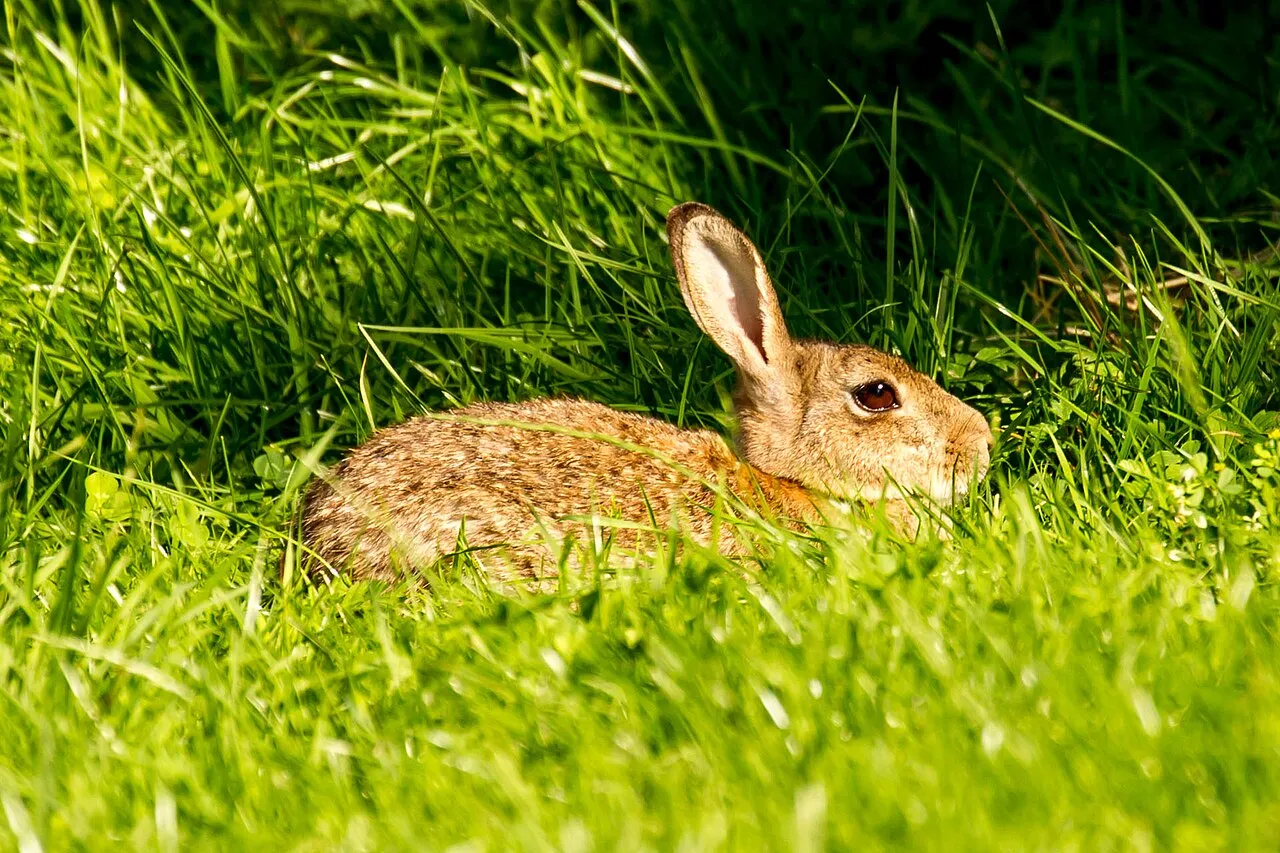
The European rabbit is native to the Iberian Peninsula and the adjacent regions of south-west France and north-west Africa.[2][4][16] It reached the rest of Europe through human action: transport in Roman times and then, in the Middle Ages, breeding in enclosed warrens for meat — notably in monasteries, where the kits, or laurices, were eaten during the fasts of Lent.[8][15] Having become one of the most widely introduced mammals on the planet, it is now established on every continent except Antarctica and on hundreds of islands.[2] The Australian case has remained famous: a few dozen rabbits — thirteen according to the National Museum of Australia, about twenty in the batch according to some recent genetic sources — were released on Christmas Day 1859 by Thomas Austin at Barwon Park, in the State of Victoria, for hunting; within some fifty years the species colonised most of the continent and became an agricultural and ecological scourge of the first magnitude.[9] The same animal is therefore, depending on the region, a native species in steep decline or a destructive invader — a paradox at the heart of its conservation status.[1][2]
European rabbit at the entrance of its burrow, in an open, sandy habitat

Native range

Iberian Peninsula, south-west France and north-west Africa: a narrow Iberian cradle.[2][4][16]

Spread by humans

Roman transport then medieval breeding in enclosed warrens for meat, notably monastic.[8][15]

Australia, 1859

A few dozen rabbits (thirteen according to the NMA) released by Thomas Austin at Barwon Park; continent colonised in ~50 years.[9]

Worldwide distribution

Established on every continent except Antarctica and on hundreds of islands.[2]

Habitat, warren and burrow

The European rabbit seeks open to semi-open habitats with well-drained, easily dug soil: heaths, dunes, garrigue, edges, banks, field margins and hedgerows; it avoids dense, damp forests and waterlogged ground, incompatible with dry burrows.[2][4][15] The word "garenne" (warren) first denoted a hunting reserve: from the Old French warenne, from the Medieval Latin warenna, it referred to an estate where the right to take game was reserved to the lord, guarded by a warennier — the same root gave the English warren.[8] By extension, the word came to name the network of burrows itself. For the rabbit is colonial and territorial: it lives in groups sharing a warren, a system of interconnected tunnels with multiple entrances, typically holding one to five adult males and one to eight females.[2][14] Dominance hierarchies are established in both sexes — dominant females secure the safest nest sites, dominant males priority of access to females.[2][14] Marking is done by chin-rubbing ("chinning", which deposits a glandular secretion) and by communal latrines at the edge of the territory; thumping of the hind feet serves as an alarm signal.[2][14] The species is chiefly crepuscular and nocturnal, staying close to the cover of the burrows; the reference study remains The Private Life of the Rabbit by R. M. Lockley (1964).[14]
European rabbits in a group, a colonial and gregarious species

Preferred habitats

Heaths, dunes, garrigue, banks and margins with drained, loose soil; dense forests and waterlogged soils avoided.[2][4][15]

The word "warren"

From Old French warenne, a hunting reserve guarded by a warennier; by extension, the network of burrows.[8]

Colonial life

Groups of 1 to 5 males and 1 to 8 females sharing a warren, with dominance hierarchies in both sexes.[2][14]

Marking and alarm

Chin-rubbing, communal latrines and thumping of the hind feet.[2][14]

Diet

The European rabbit is a strict herbivore: it eats grasses, young shoots, leaves and herbaceous plants, supplementing its diet with bark and roots in winter.[2][4] Its feeding has an essential digestive peculiarity, caecotrophy: the animal produces two types of droppings, and the soft, mucus-coated droppings, known as caecotrophes or night droppings, are re-ingested directly as they leave the anus.[2][12] This second passage through the digestive tract makes it possible to recover the proteins and B-group vitamins synthesised by the microbial fermentation of the caecum. This is a normal and indispensable digestive physiology, not a disorder: the rabbit thus makes the most of poor, fibrous vegetation.[12] This feeding efficiency, combined with rapid reproduction, explains the density the species can reach where soil and cover suit it — and the damage it causes in its areas of introduction.
European rabbit grazing in short vegetation

Diet

Grasses, young shoots, leaves and herbaceous plants; bark and roots in winter.[2][4]

Caecotrophy

Re-ingestion of the soft night droppings to recover proteins and B vitamins from a second digestive passage.[2][12]

Normal physiology

Caecotrophy is not a pathology but an adaptation to fibrous, poor vegetation.[12]

Reproduction and life cycle
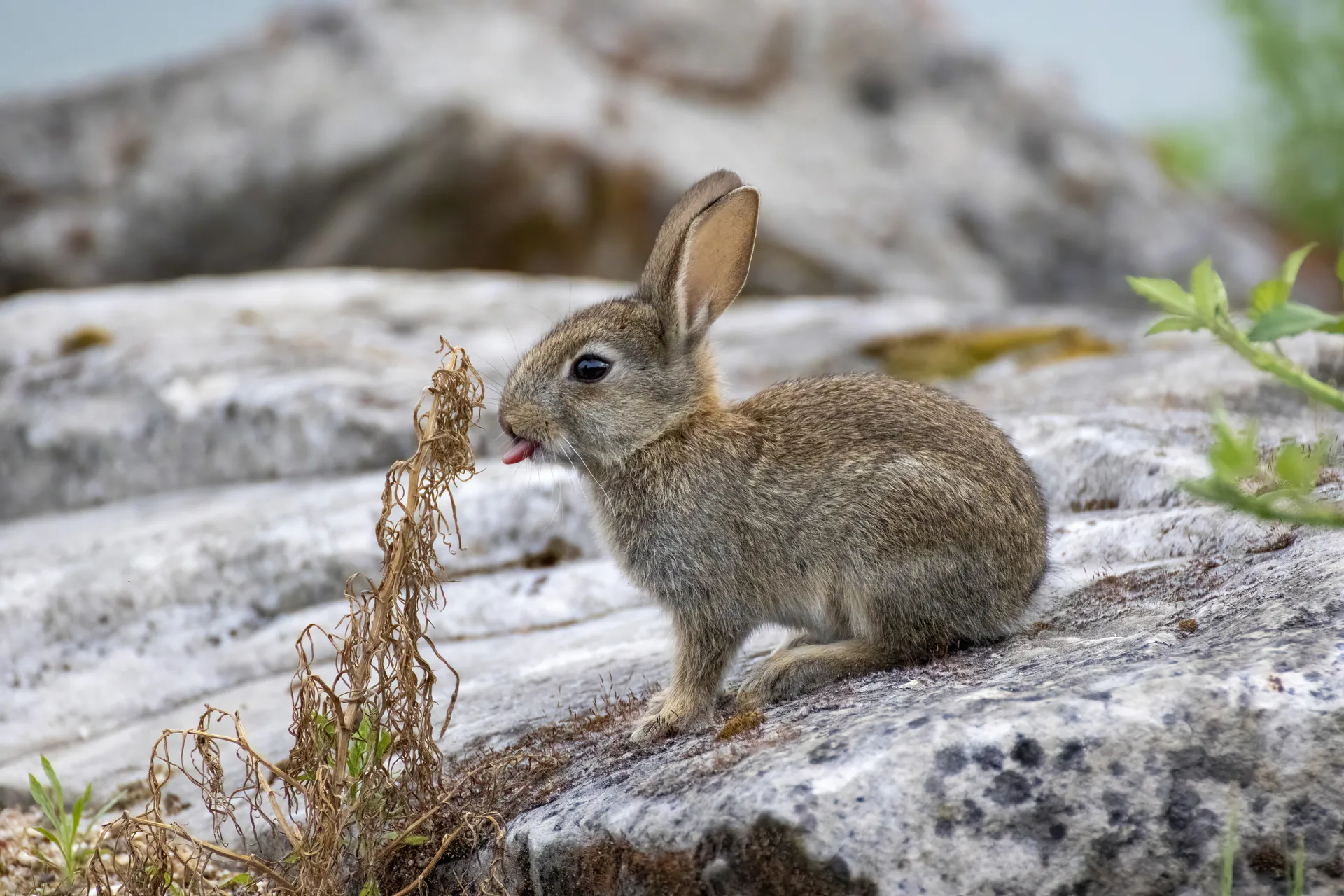
The rabbit's reputation for fecundity rests on its physiology. The female is an induced ovulator, or reflex ovulator: she has no spontaneous oestrous cycle, ovulation being triggered by mating, about ten hours afterwards, which keeps her receptive over long periods and greatly raises conception rates.[2][13] Gestation lasts about 28 to 31 days.[2][13] Litters most often number three to seven kits, and the female produces several litters over a long breeding season that runs, in France, from late winter to summer; she can be fertilised again almost immediately after giving birth, and sexual maturity is reached as early as three to four months — hence the expression "breeding like rabbits".[2][4] The kits are altricial: they are born blind, deaf and almost naked, in a nest chamber lined with grass and fur, at the bottom of a short breeding burrow called a "stop" (rabouillère), which the mother seals with earth between her brief nursing visits, once a day — a strategy of protection against predators.[2][4][14] This development contrasts radically with that of the hare's leveret, precocial, born furred and with its eyes open on the open ground.[2][4]
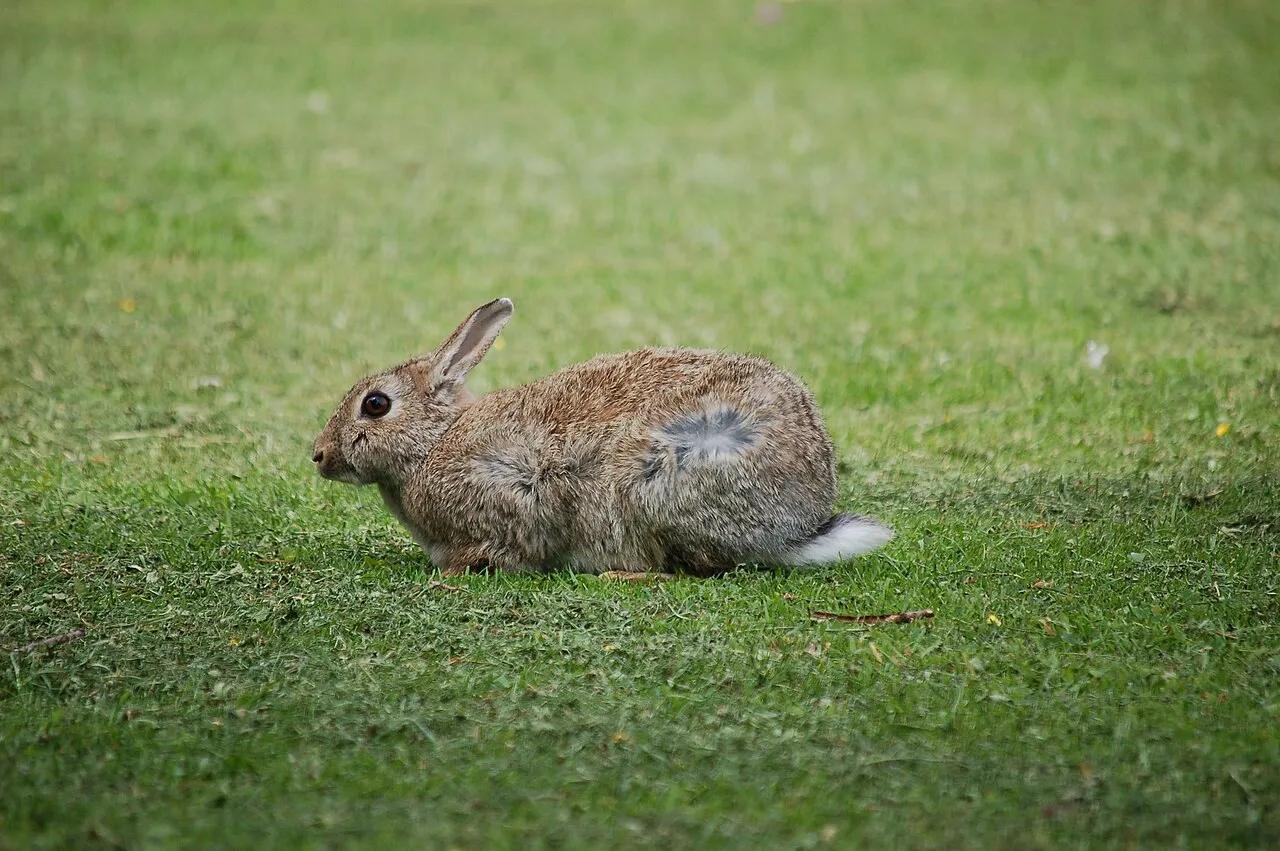
European rabbit at rest during the breeding season, in low vegetation

Reflex ovulation

No oestrous cycle: ovulation is triggered by mating, hence high conception rates.[2][13]

Gestation

About 28 to 31 days.[2][13]

Litters

3 to 7 kits, several litters per season, maturity as early as 3 to 4 months: the basis of a proverbial fecundity.[2][4]

Altricial kits

Born naked and blind in a breeding stop sealed by the mother — the opposite of the hare's precocial leveret.[2][4][14]

Rabbit or hare: do not confuse them

The European rabbit and the European hare are regularly confused in everyday language, although they belong to two distinct genera of the same family Leporidae: Oryctolagus for the rabbit, Lepus for the hare.[3][4] They are therefore not two variants of the same animal. The rabbit is smaller (1.2 to 2.5 kg), with short ears without a black tip and shorter legs; the hare is distinctly larger, with long, black-tipped ears and long legs.[2][4] The clearest difference lies in the way of life and the birth of the young. The rabbit is a burrower and colonial: it digs a warren where it lives in a group, and its kits are born altricial there — blind, deaf and naked.[2][4][14] The hare, by contrast, is solitary and does not dig a burrow: it rests in a simple "form", a depression in the open, and its leverets are born precocial, furred, with their eyes open, able to move very fast.[2][4] Disturbed, the rabbit bolts for its burrow while the hare relies on its speed on open ground.[2][4] This distinction is not merely a matter of vocabulary: it recently prompted the correction of a translation error on this site. For the related species, see our hares.
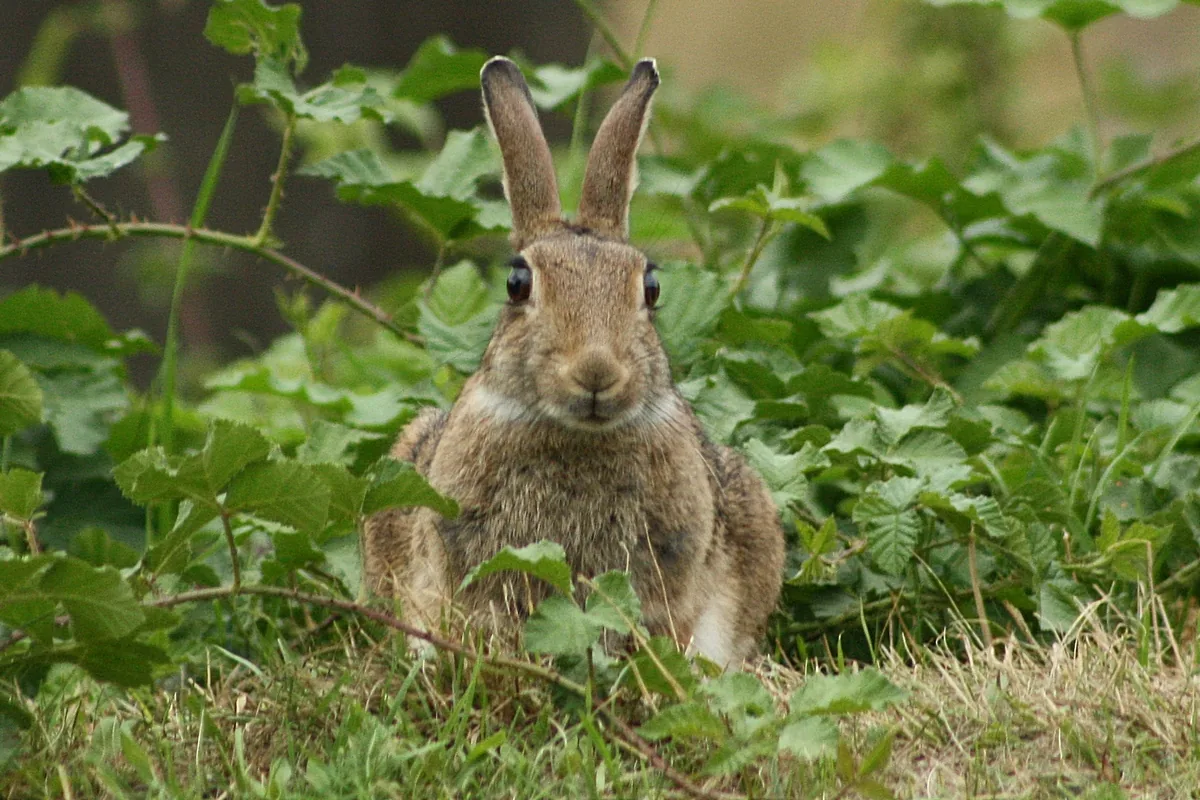
European rabbit on alert, short ears raised and white tail visible

Two genera

Oryctolagus cuniculus (rabbit) and Lepus europaeus (hare): same family, different genera.[3][4]

Size and ears

Rabbit smaller, short ears without a black tip; hare larger, long ears with a black tip.[2][4]

Burrow or form

The rabbit digs a warren and lives in a colony; the hare, solitary, lies in a simple form in the open.[2][4]

Young: altricial or precocial

Kits naked and blind in the burrow; leverets furred, eyes open, born on the ground.[2][4]

Diseases: myxomatosis and VHD/RHD

Two viral diseases weigh decisively on numbers. Myxomatosis is caused by the myxoma virus, native to the American rabbits of the genus Sylvilagus and transmitted by fleas and mosquitoes. It was deliberately introduced into France in June 1952 by the physician Paul-Félix Armand-Delille, who inoculated two rabbits on his walled estate at Maillebois, in Eure-et-Loir, to protect his crops; the virus escaped and swept across France and then Europe, causing a mortality of the order of 90 to 98% of France's wild rabbits between 1952 and 1955.[10] Rabbit haemorrhagic disease (VHD, or RHD in English) is caused by a calicivirus first reported in China in 1984 — more than 140 million farmed rabbits lost in under a year — before reaching Europe, in Italy, as early as 1986; it kills more than 90% of adults through a fulminant liver failure within a few days.[11] A new antigenic variant, RHDV2, emerged in France in 2010 and then spread across Europe and the islands; it also kills the young and vaccinated animals, aggravating the declines.[11] This double pathogen burden, combined with predation, explains the see-saw dynamics of the populations and the collapse observed in the native range.[1][2][15]
European rabbit in its natural habitat, a species subject to the epizootics of myxomatosis and VHD

Myxomatosis (1952)

Myxoma virus introduced at Maillebois by Armand-Delille; 90 to 98% mortality in France from 1952 to 1955.[10]

VHD / RHD

Calicivirus reported in China in 1984, in Europe from 1986; more than 90% mortality of adults through liver damage.[11]

RHDV2 (2010)

Variant that appeared in France, also killing young and vaccinated animals, which aggravates the declines.[11]

See-saw dynamics

High fecundity against recurrent epizootics and predation: violently fluctuating populations.[1][2][15]

Conservation status and management in France

The European rabbit is listed as Endangered (EN) on the global IUCN Red List, following the 2019 assessment (corrected version published in 2020): the species is declining sharply in its native Iberian range, even as it swarms as an invader elsewhere.[1] The drivers of the decline are the successive viral epizootics — myxomatosis, VHD and then RHDV2 —, habitat loss linked to agricultural change and, in places, excessive harvesting pressure.[1][15] The stakes go beyond the species alone: in Iberia, the rabbit is the main prey of the Iberian lynx and the Spanish imperial eagle, so that its collapse reverberates on these threatened predators — which explains why a "swarming pest" elsewhere is a conservation priority at home.[1][15] In France, the European rabbit is an emblematic game species: before the myxomatosis of 1952 and then VHD, it made up "the mainstay of the hunt" for most small-game hunters, so abundant was it.[15] Modern management proceeds by restocking warrens — building artificial warrens, releasing captive-bred animals or translocation, work on the habitat — to rebuild local nuclei, with a success constrained by disease and predation.[15]

IUCN status

Endangered (EN), 2019 assessment (2020 errata): marked decline in the native Iberian range.[1]

Drivers of the decline

Epizootics (myxomatosis, VHD, RHDV2), loss of agricultural habitats and locally excessive harvesting.[1][15]

A keystone species

Main prey of the Iberian lynx and the Spanish imperial eagle: its decline threatens these predators.[1][15]

French game

Long "the mainstay of the hunt" for small game; current management by restocking warrens.[15]

At GIBIS

GIBIS is a game farm established at Chatte, in Isère, since 1951. The European rabbit is bred there for the restocking of territories and for hunting: the production is presented on the wild rabbits page, the husbandry on the our farm page, and the principles of population-reinforcement operations on the restocking page. This encyclopaedic article remains independent of those pages: it documents the wild species, its biology and its status, with no commercial aim.

A family farm since 1951

Production of feathered game and small game at Chatte, in Isère.

European rabbit bred here

Animals intended for restocking and hunting: see the wild rabbits page.

Restocking

Population-reinforcement operations are detailed on the restocking page.

References

  1. Villafuerte R. & Delibes-Mateos M., "*Oryctolagus cuniculus*" (corrected version published in 2020), *The IUCN Red List of Threatened Species* 2019: e.T41291A170619657 — category: Endangered (EN), iucnredlist.org, accessed in 2026.
  2. Wikipedia contributors, "European rabbit", *Wikipedia* — general synthesis (morphology, distribution, diet, behaviour, diseases), corroborated by the primary sources below.
  3. ITIS (Integrated Taxonomic Information System), *Report: Oryctolagus cuniculus* (Linnaeus, 1758) — classification and authority, itis.gov, accessed in 2026.
  4. MNHN & OFB, Inventaire national du patrimoine naturel (INPN), *Oryctolagus cuniculus* (Linnaeus, 1758) record, inpn.mnhn.fr, accessed in 2026.
  5. Wilson D. E. & Reeder D. M. (eds.), *Mammal Species of the World*, 3rd ed., Johns Hopkins University Press, 2005 — genus *Oryctolagus* Lilljeborg, 1873.
  6. Linnaeus C., *Systema Naturae*, 10th ed., Stockholm, 1758 — original description under *Lepus cuniculus*.
  7. Carneiro M. et al., "Rabbit genome analysis reveals a polygenic basis for phenotypic change during domestication", *Science*, vol. 345, 2014, pp. 1074-1079 — the domestic rabbit derives from *O. c. cuniculus*.
  8. "Garenne", *Wikipédia* and CNRTL, *Trésor de la langue française informatisé* — etymology of "garenne" (*warenne*, hunting reserve) and history of medieval warrens, accessed in 2026.
  9. National Museum of Australia, "Rabbits introduced" — release by Thomas Austin, Barwon Park, Victoria, 25 December 1859, nma.gov.au, accessed in 2026.
  10. Bartrip P. W. J., *Myxomatosis: A History of Pest Control and the Rabbit*, I.B. Tauris, London, 2008 — introduction in France, Maillebois, June 1952, mortality of 90 to 98%.
  11. Abrantes J., van der Loo W., Le Pendu J. & Esteves P. J., "Rabbit haemorrhagic disease (RHD) and rabbit haemorrhagic disease virus (RHDV): a review", *Veterinary Research*, vol. 43, no. 12, 2012; with Le Gall-Reculé G. et al. on the emergence of RHDV2 in France (2010).
  12. Hörnicke H. & Björnhag G., "Coprophagy and related strategies for digesta utilization", in *Digestive Physiology and Metabolism in Ruminants*, 1980 — caecotrophy in the rabbit.
  13. Boiti C. et al., review on the induction of ovulation in the doe rabbit, *World Rabbit Science* — reflex ovulation triggered by mating, gestation of about 28 to 31 days.
  14. Lockley R. M., *The Private Life of the Rabbit*, André Deutsch, London, 1964 — social behaviour, hierarchies, marking, crepuscular activity and the warren.
  15. Office français de la biodiversité (OFB) and Fédération nationale des chasseurs, "European rabbit (*Oryctolagus cuniculus*)" record — small game, population dynamics and the restocking of warrens in France, ofb.gouv.fr, accessed in 2026.
  16. Díaz-Ruiz F. et al., "Unravelling the historical biogeography of the European rabbit subspecies in the Iberian Peninsula", *Mammal Review*, vol. 53, 2023 — native Iberian range and the subspecies *cuniculus* and *algirus*.

See also

Gallery

See also

A question about the European rabbit?

This article is part of GIBIS's encyclopaedia of game, a breeder at Chatte (Isère) since 1951. For a question about the species or about our animals, the team answers by telephone or by e-mail.

Call us