Skip to content
Home Hunting Dog Training

Game encyclopaedia

Common Pheasant

Phasianus colchicus Linnaeus, 1758. A galliform native to a discontinuous range stretching from the Caucasus to the Far East, introduced into Western Europe as early as Roman times, and now the most familiar lowland bird of French hunting grounds.
Common Pheasant

Not to be confused with the red-legged partridge (Alectoris rufa), another lowland galliform, nor with the Reeves's pheasant (Syrmaticus reevesii), a species of a different genus.

Description
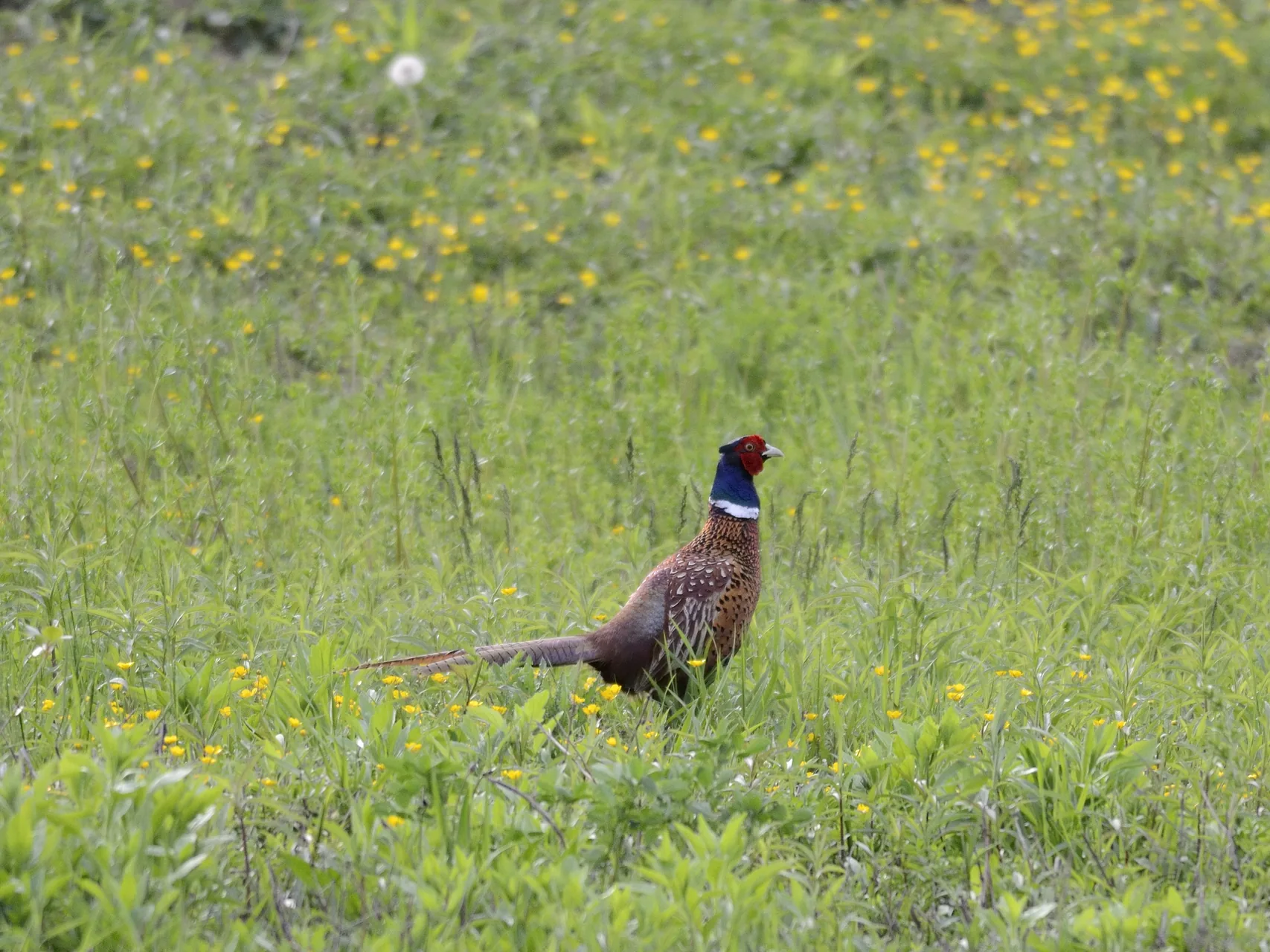
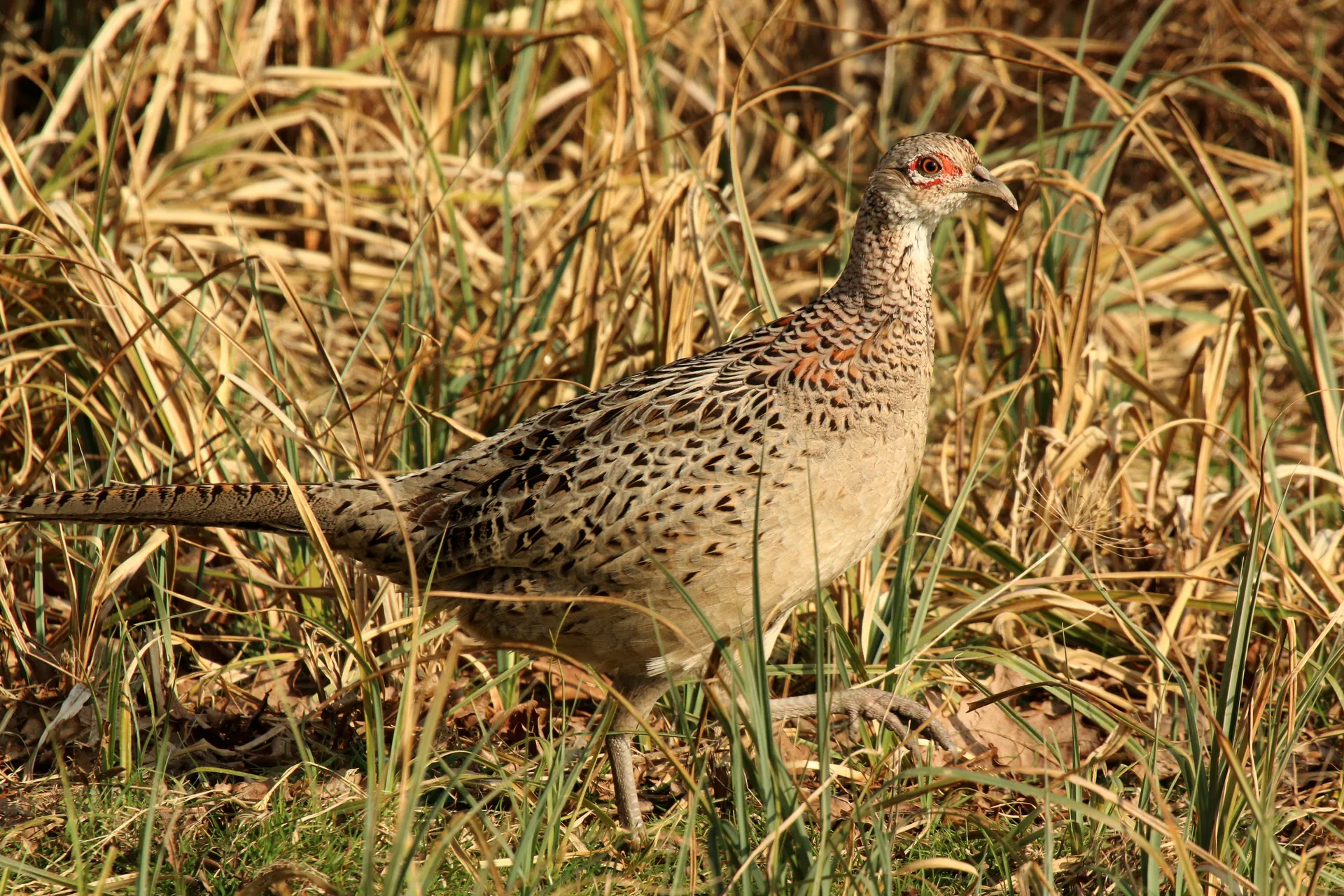
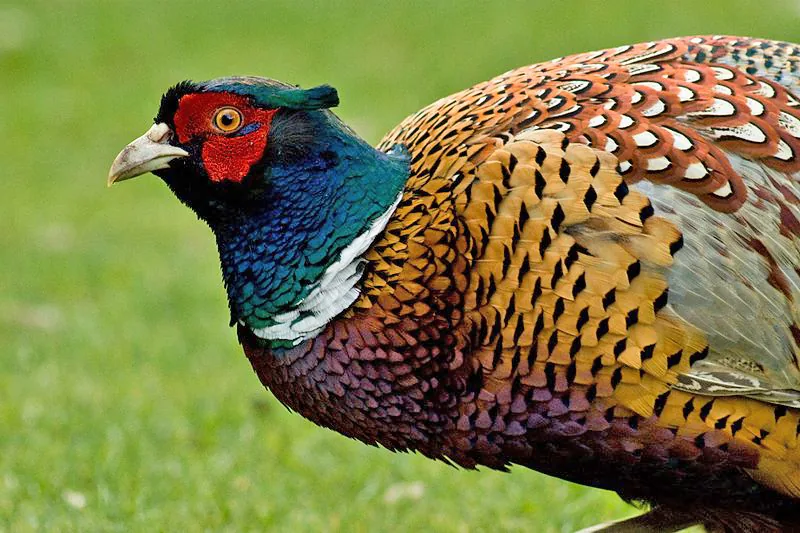
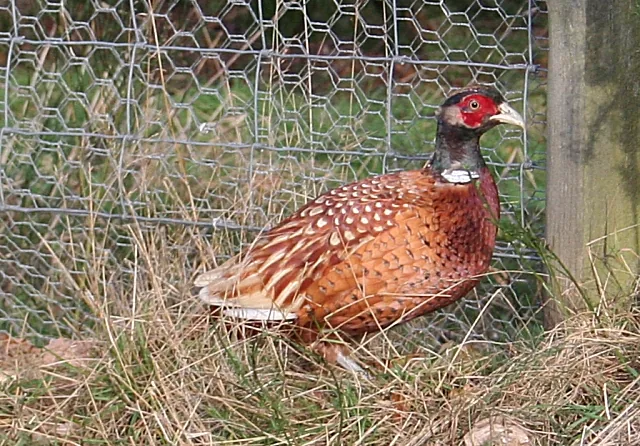
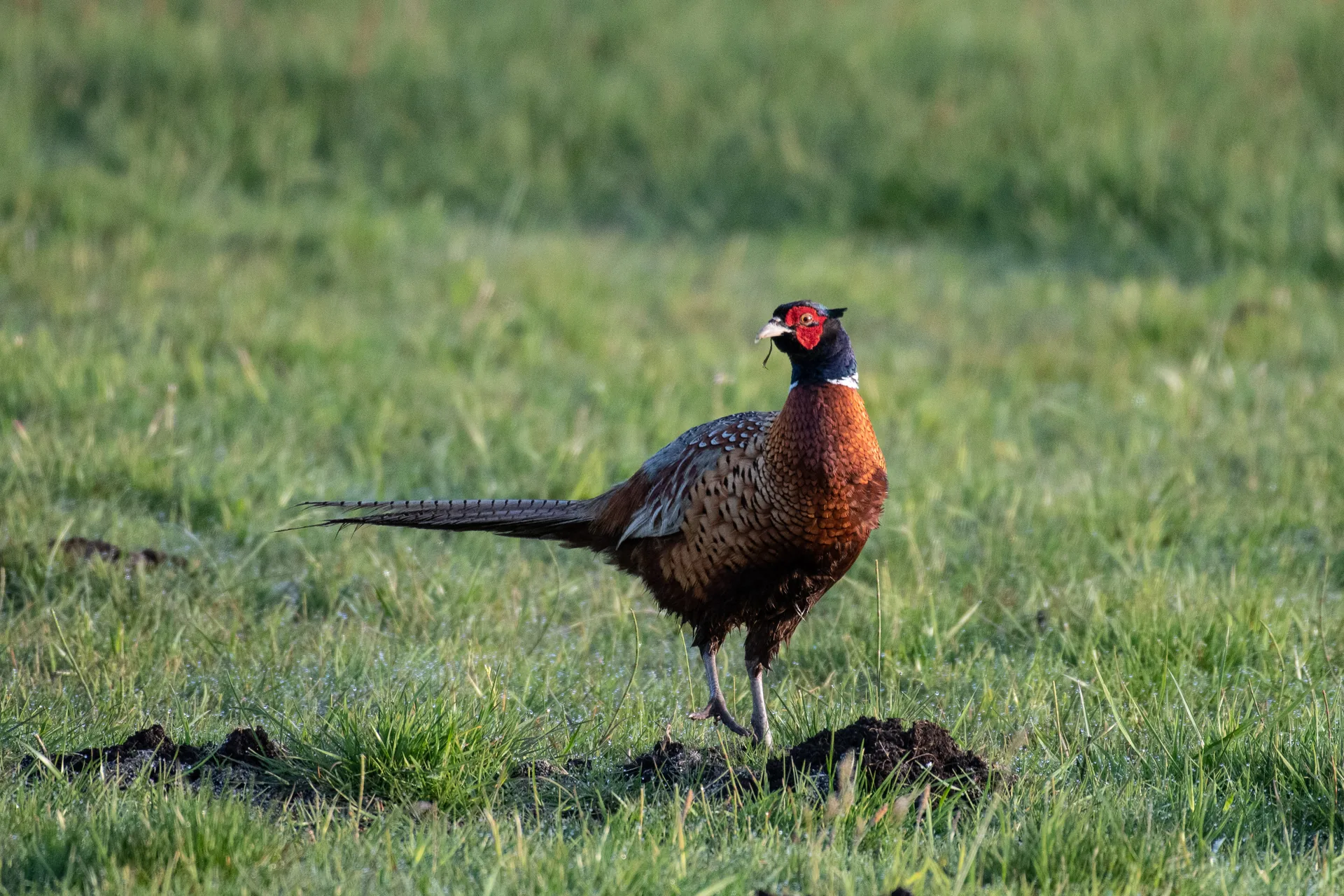
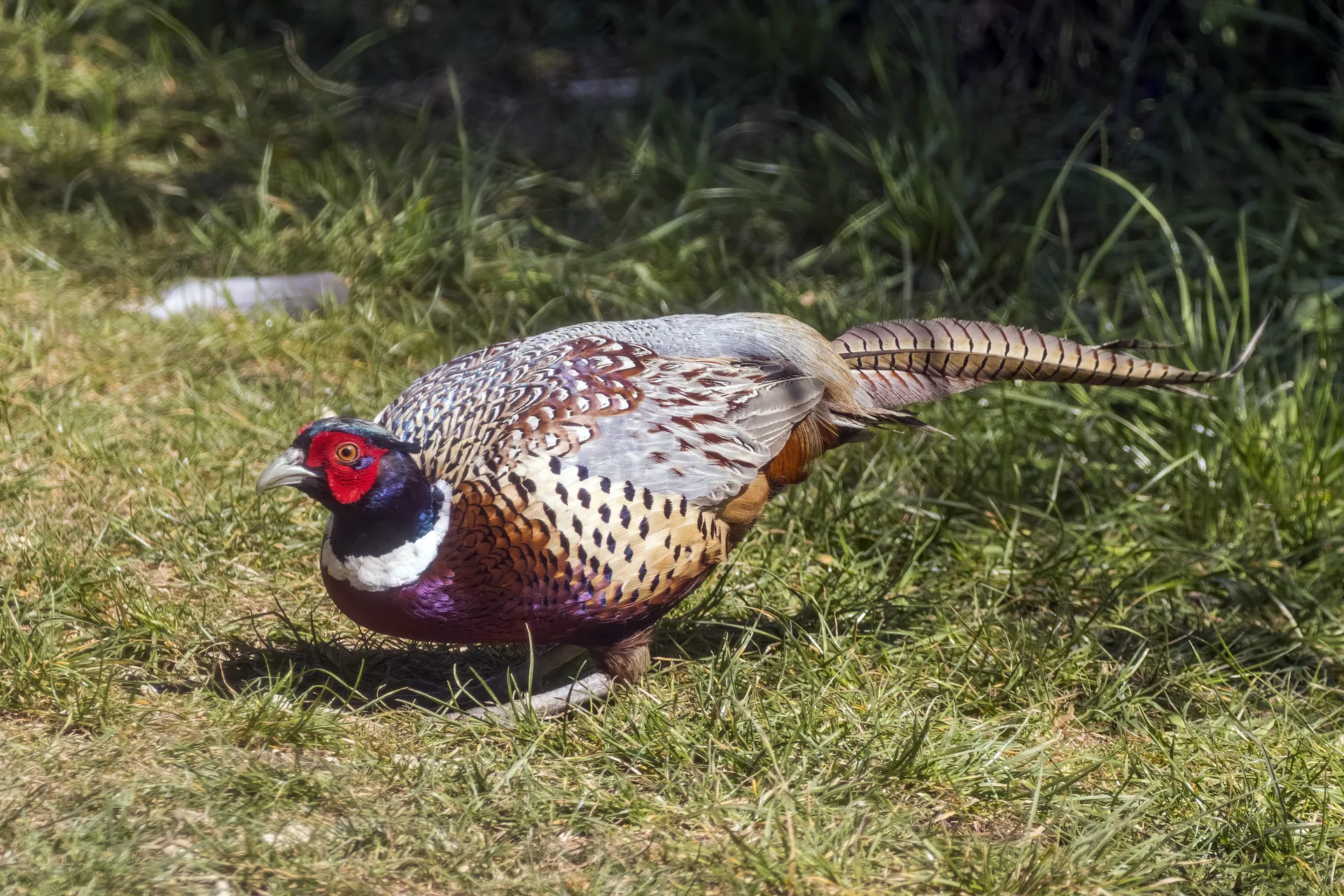
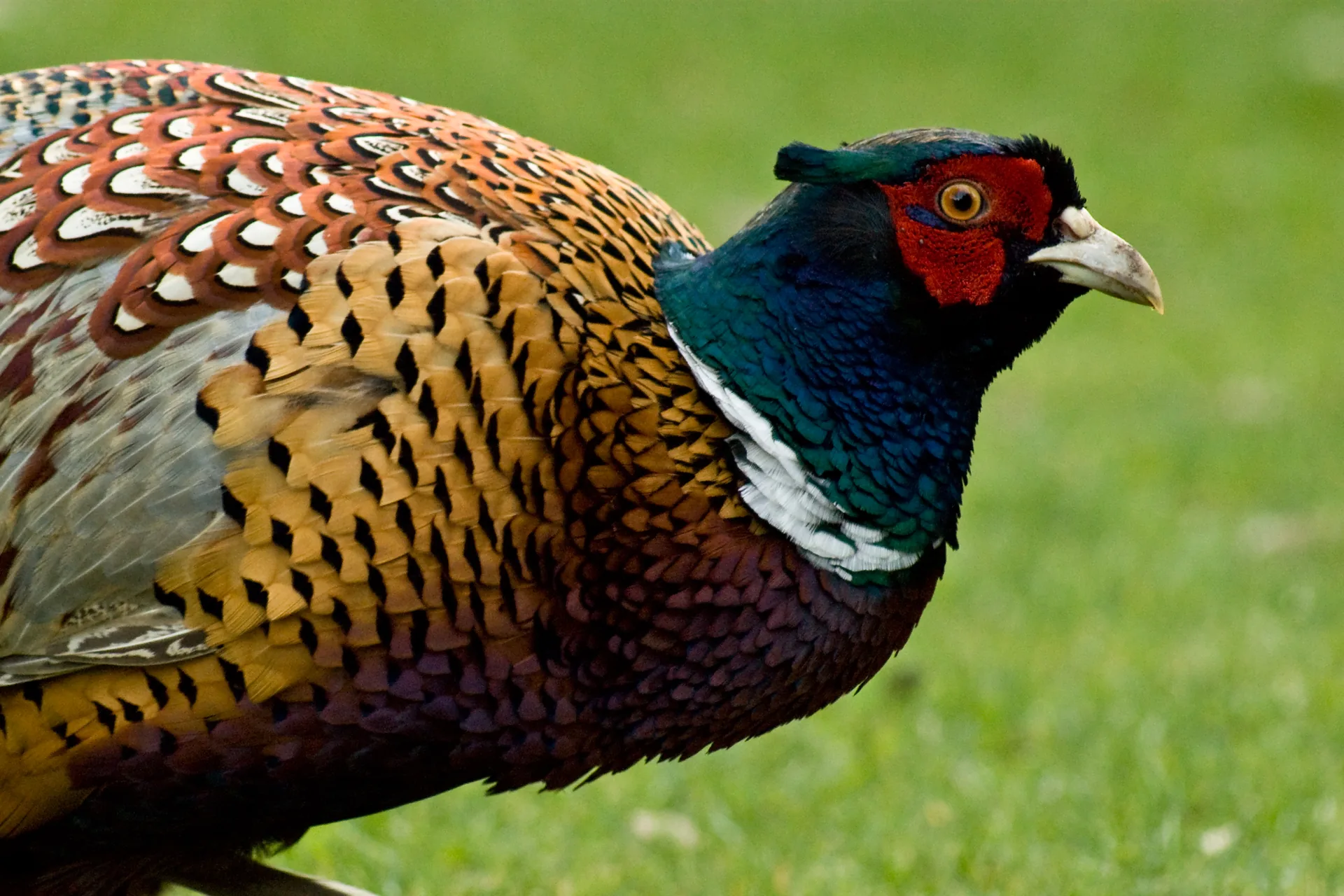
The common pheasant is a large galliform marked by pronounced sexual dimorphism. The male measures 75 to 89 cm in total length, the female only 53 to 62 cm: most of the difference lies in the tail, some fifty centimetres long in the cock against about twenty in the hen.[5] The wingspan is 70 to 90 cm, for mean weights of around 1.2 kg in the male and 0.9 kg in the female.[5] In the male, the head and neck are deep green with dark blue iridescence; the face bears bright red wattles, which develop with age, and two small tufts of dark feathers above the ear coverts, forming "little ears".[5][6] The body ranges through warm shades from russet beige to dark chestnut, with iridescent sheen, with a long graduated beige tail barred with brown.[5] The cock's tarsus bears spurs, used in territorial fights.[5][6] The female, by contrast, has cryptic plumage in beige tones marked with dark, without iridescence — camouflage suited to incubation on the ground — and a yellow eye surrounded by a reddish area.[5]
Adult male common pheasant: iridescent russet plumage, red facial wattles and long tail

Total length

75 to 89 cm in the male, 53 to 62 cm in the female.[5]

Tail

Graduated, some fifty centimetres long in the cock against about twenty in the hen: it accounts for most of the size difference between the sexes.[5]

Wingspan and weight

70 to 90 cm wingspan, for mean weights of the order of 1.2 kg in the male and 0.9 kg in the female.[5]

Hen's plumage

Beige marked with dark, without iridescence: camouflage suited to brooding on the ground.[5]

Taxonomy and subspecies
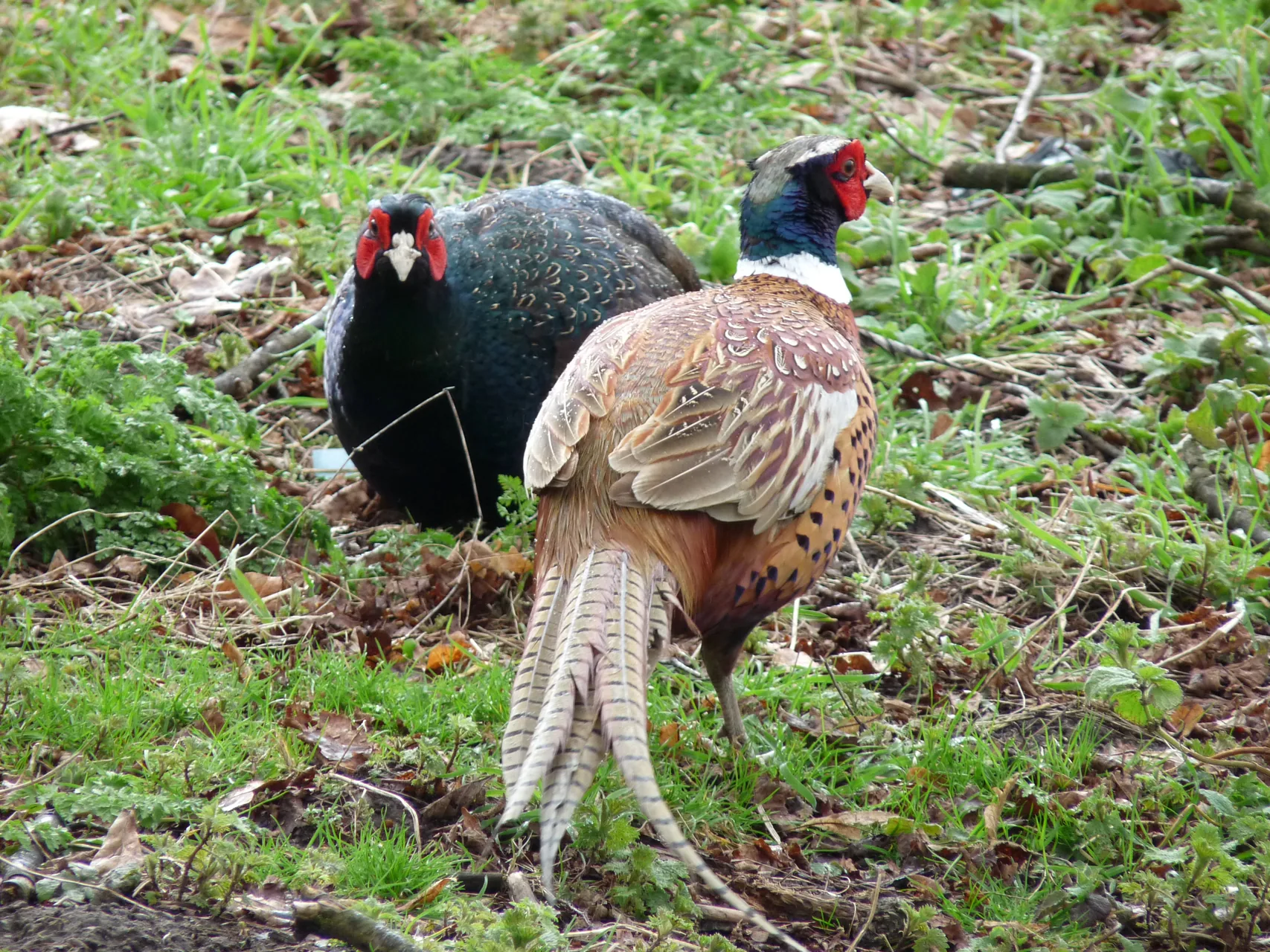
The species was described by Carl von Linné in 1758 in the tenth edition of the Systema Naturae; the full authority is therefore written Phasianus colchicus Linnaeus, 1758.[1][2] It belongs to the order Galliformes and the family Phasianidae.[2] Some thirty subspecies have been described, defined mainly by the plumage characters of the males and by geographical range; they have been grouped into five groups on criteria of morphological resemblance and biogeographical affinity.[4][3] This geographical variation is exceptionally marked for a single species; in Europe, repeated releases of birds of various origins have largely blurred the boundaries of these forms, and today's hunting populations result from a long-standing mixing.[3] The "melanistic pheasant", finally, is not a subspecies: it is a melanic mutation of the species, observed in captivity in the early 20th century and maintained ever since by selection. Frequent in captive breeding, it is very rare in the wild.[17]
Ring-necked pheasant, eastern form of the torquatus group

P. c. colchicus (Linnaeus, 1758)

Nominate form of the Caucasus — Georgia, Azerbaijan, north-western Iran. It entirely lacks the white collar.[3]

P. c. torquatus (Gmelin, 1789)

Eastern China. Pronounced white collar: this is the form most massively introduced outside its natural range.[3]

P. c. mongolicus (Brandt, 1844)

Central Asia, from the Tian Shan to Lake Balkhash. Well-developed white collar and white greater wing coverts.[3]

var. tenebrosus — the melanistic pheasant

A melanic mutation fixed in captive breeding, and not a subspecies; very rare in the wild.[17]

Distribution and the history of an introduction
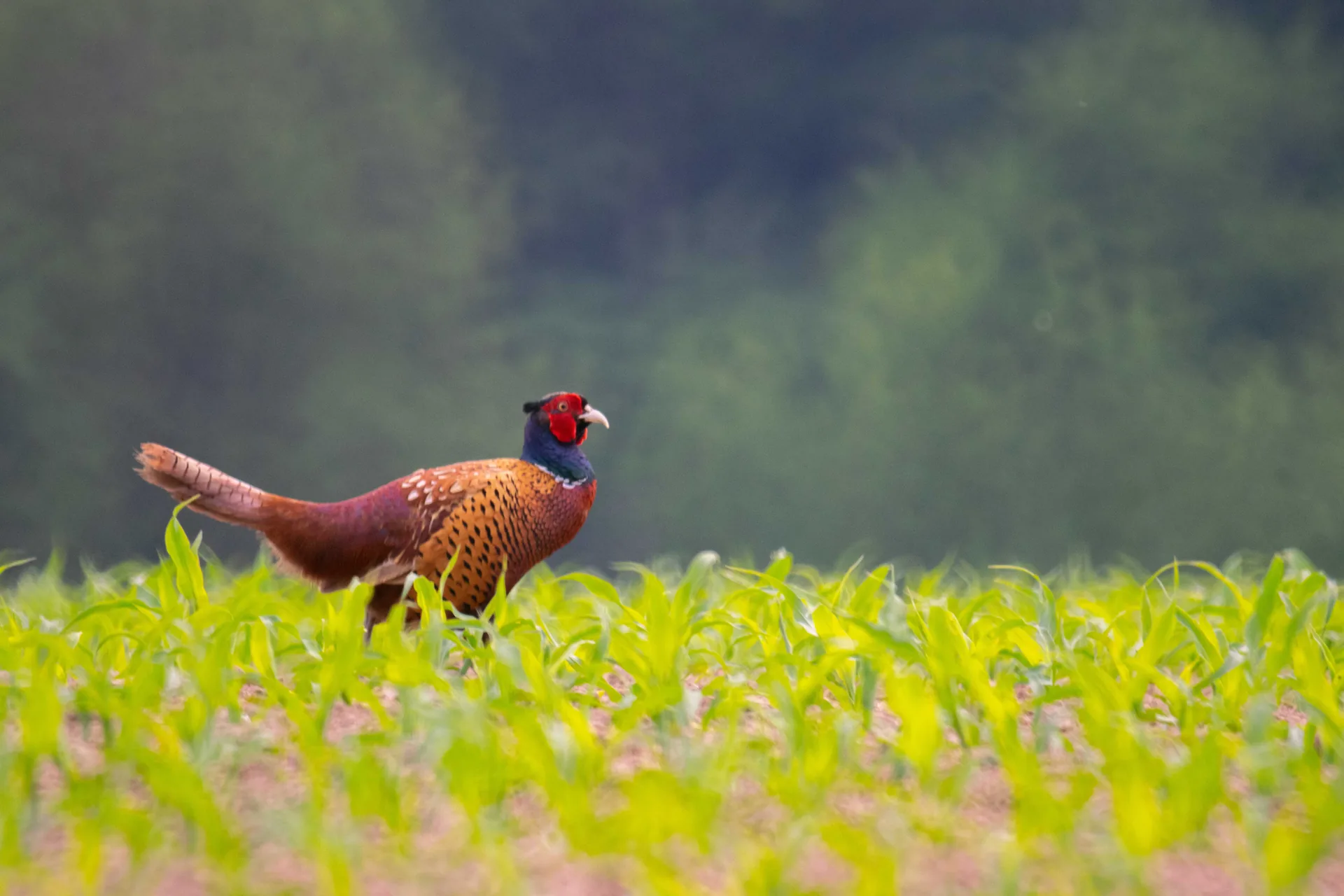
The natural range of the common pheasant extends, discontinuously, from the Caucasus to eastern China.[5][3] The species has been introduced to Europe, North America, New Zealand and Hawaii, where it has become common.[5][3] Its specific epithet refers to Colchis, an ancient region corresponding to present-day western Georgia, crossed by the river Phasis — today's Rioni.[7] The bird has been present in Greece since at least the 5th century BC; it is first mentioned in Roman Italy by Pliny, Statius and Martial in the 1st century AD, and probably spread from there to the rest of the Empire.[8] Yeomans (2025) concludes that the Romans introduced the pheasant to Western Europe and that it was subsequently reared there on a large scale for food in the Middle Ages.[9] For Britain, the picture is more nuanced: Poole (2010) lists a small number of Roman sites that have yielded pheasant remains, most often high-status settlements, which suggests a luxury import rather than acclimatisation; remains are rarer still for the Saxon period, and there is scarcely any evidence of established breeding populations in Roman Britain. Whether the species became established shortly before 1066 or shortly after the Norman conquest remains, in his view, an open question.[8] Yeomans notes, finally, that managed pheasants have not been the object of intensive selective breeding, the game sector seeking on the contrary to keep them close to wild birds in their physical and behavioural traits.[9]
Common pheasant in open farmland, a species introduced to Western Europe

Habitat and diet

The pheasant occupies very varied habitats, in lowland as well as mid-altitude country, but avoids dense forests, arid zones and high mountains.[5] It seeks out crops provided with windbreaks, grasslands and marsh edges — that is, mosaics offering cover and food at the same time.[5] In France, the Office français de la biodiversité records its presence in coastal and transitional habitats, wetlands (marshes, peat bogs), open habitats (grasslands, edges, heaths) and wooded habitats (forests, hedgerow landscapes, hedges), across the whole of mainland France apart from high-altitude regions.[10] The diet is omnivorous with a plant-based predominance: seeds, cereals, young shoots, buds, fruits and berries, supplemented with invertebrates — slugs, earthworms, ant eggs, caterpillars, grasshoppers, larvae.[5] Chicks and growing juveniles feed mainly on invertebrates before switching to an essentially vegetarian diet at around five to six weeks of age: the availability of insects therefore directly determines brood survival.[5]
Common pheasant in grassy cover at the edge of a crop

Habitats used

Crops with windbreaks, grasslands, marsh edges, hedgerow landscapes and hedges; dense forests and arid zones avoided.[5][10]

Adult diet

Omnivorous with a plant-based predominance: seeds, cereals, shoots, buds, fruits and berries, supplemented with invertebrates.[5]

Chick diet

Essentially invertebrates, until the switch to plant food at around five to six weeks.[5]

Breeding and life cycle

The pheasant is polygynous: the cock defends a territory and gathers several hens within it.[5][6] In courtship display the male runs around each female, the wing on her side lowered, the tail tilted and the facial wattles engorged.[6] The nest is a simple shallow scrape on the ground, lined with twigs, grasses and rootlets, concealed in tall vegetation.[5] The clutch numbers 8 to 14 glossy olive brown-green eggs; the nesting season runs from March to August, peaking in April-June.[5][6] Incubation lasts 23 to 25 days from the laying of the last egg and is carried out by the female alone, the cock taking no part in it.[5][6] The chicks are precocial: they leave the nest and follow their mother from hatching. They are capable of short flights from the age of 12 to 14 days, but only achieve true flight between 8 and 11 weeks.[5] The maximum recorded longevity is 27 years in captivity[16] — a captive-breeding figure, unrelated to the actual lifespan in the wild, which is far shorter: in Britain, a radio-telemetry study of about 450 nests monitored between 1990 and 2003 at six sites establishes an overall nest survival of only 10%.[11]
Pheasant hen in cryptic plumage, suited to brooding on the ground

Clutch

8 to 14 olive brown-green eggs, from March to August with a peak in April-June.[5][6]

Incubation

23 to 25 days, carried out by the female alone from the last egg laid.[5][6]

Precocial chicks

They leave the nest from hatching; short flights at 12-14 days, true flight between 8 and 11 weeks.[5]

Nest survival

About 450 nests of radio-tagged hens, monitored from 1990 to 2003 at six British sites: overall nest survival of 10%.[11]

Behaviour, flight and voice

Contrary to what its spectacular take-off suggests, the pheasant is above all a walker: it "would rather flee on foot than take wing, unless it is truly forced to".[5] Most daytime activity takes place on the ground, but the birds habitually go to roost — perch in trees — for the night.[5] The flight is powerful, fast and direct, but always short: it cannot be sustained for long because of the disproportion between the bird's high weight and the small area of its wings, and the take-off is very noisy.[5] Speed reaches 43 to 61 km/h in level flight and up to 90-95 km/h when the bird is pursued by a predator.[6] This combination of power and zero endurance is explained by the muscular physiology of galliforms, whose flight muscles are composed almost exclusively of fast glycolytic fibres working anaerobically.[15] As for the voice, the cock's territorial call is a powerful "hraah hraah" accompanied by loud wing-beating; the alarm call is a hard, raucous "ko-KOK", and take-off is accompanied by a rapid "kuk-uk, kuk-uk".[5][6] Nests are threatened by foxes and corvids, which alone account for at least half of the recorded predation cases; the young are preyed on by raptors and mustelids.[11][6] Predator control weighs heavily: nest predation rates are significantly lower at sites where such control is intensive than at those where it is limited.[11]
Noisy, near-vertical take-off of a common pheasant

Conservation status and game management in France
The common pheasant is classed as Least Concern (LC) on the IUCN Red List, 2016 assessment: the world population is very large, but the population trend is decreasing, without the decline being rapid enough to warrant a higher category.[12] In France, the species is explicitly described as a "non-native bird" by the ONCFS: its presence results from successive introductions, then from releases.[14] The national hunting bag for the 2013-2014 season was estimated at 3,064,219 birds (95% confidence interval: 2,815,905 – 3,312,534), making it the most heavily harvested species of sedentary lowland small game.[13] This bag is mostly supplied by reared birds, the spring wild population having been estimated at about 200,000 cocks in 2008.[13] The harvest is spread mainly between Nouvelle-Aquitaine, Hauts-de-France, Centre-Val de Loire, Occitanie and Auvergne-Rhône-Alpes.[13] Management of wild populations rests on counting territorial cocks in April, based on their call, or at roost in winter, and on estimating breeding success expressed in young per hen: a good year exceeds 6.5 young per hen, a bad year stays below 5.[14] The selective shooting of cocks only, "made possible by the species' sexual dimorphism and justified by the pheasant's polygamy", illustrates how the bird's biology directly underpins the management regime.[14] The OFB describes the trend in French densities between 2008 and 2018 as broadly positive.[10]
Common pheasant in arable lowland, the most harvested small game species in France

IUCN status

Least Concern (LC), 2016 assessment; decreasing global trend.[12]

French hunting bag

3,064,219 pheasants estimated for the 2013-2014 season, the leading species of sedentary lowland small game.[13]

Wild populations

About 200,000 cocks in spring 2008: most of the bag comes from reared birds.[13]

Breeding indicator

More than 6.5 young per hen for a good year, fewer than 5 for a bad one.[14]

At GIBIS
GIBIS is a game bird farm established at Chatte, in Isère, since 1951; the common pheasant is reared there for restocking hunting grounds and for shooting. The following pages of the site describe the birds reared and the corresponding practices, outside the encyclopaedic scope of this article: game pheasants for a general overview, FAISAN PUR CHASSE® for the in-house strain, poults for the young birds intended for summer releases, melanistic pheasant for the melanic variety described above, Chinese pheasant for the ring-necked forms of the torquatus group, pheasant eggs for the supply of hatching eggs, and pheasant rearing for the technical aspects of husbandry.
Common pheasants in a planted aviary at the GIBIS farm, Chatte (Isère)

Références

  1. Linné C., *Systema Naturae*, 10th edition, Stockholm, 1758 — original description of *Phasianus colchicus*.
  2. ITIS, *Report: Phasianus colchicus*, TSN 175905, Integrated Taxonomic Information System, accessed in 2026.
  3. Madge S. & McGowan P. J. K., *Pheasants, Partridges and Grouse*, Christopher Helm, London, 2002.
  4. Liu Y., Liu S., Zhang N., Chen D., Que P., Liu N., Höglund J., Zhang Z. & Wang B., "Genome Assembly of the Common Pheasant Phasianus colchicus: A Model for Speciation and Ecological Genomics", *Genome Biology and Evolution*, vol. 11, no. 12, 2019, pp. 3326-3331.
  5. François J., species account "Faisan de Colchide (Phasianus colchicus)", Oiseaux.net, 2019.
  6. "Faisan de Colchide", Oiseaux-birds.com, species account, accessed in 2026.
  7. CNRTL, *Trésor de la langue française informatisé*, entry "faisan" (etymology), accessed in 2026.
  8. Poole K., "Bird Introductions", in O'Connor T. & Sykes N. (eds.), *Extinctions and Invasions: A Social History of British Fauna*, Oxbow Books, Oxford, 2010, pp. 156-165.
  9. Yeomans L., "Zooarchaeology of Managed, Captive, Tame, and Domestic Birds: Shifts in Human–Avian Relationships", *Journal of Archaeological Research*, vol. 33, no. 4, 2025, pp. 587-628.
  10. OFB (formerly ONCFS), "Le faisan commun", Éclairages collection, April 2019, ref. DOC00070236.
  11. Draycott R. A. H., Hoodless A. N., Woodburn M. I. A. & Sage R. B., "Nest predation of Common Pheasants Phasianus colchicus", *Ibis*, vol. 150, supplement 1, 2008, pp. 37-44.
  12. BirdLife International, *Phasianus colchicus* account, IUCN Red List of Threatened Species, 2016 assessment.
  13. Bro E., Guitton J.-S., Ponce F. & Aubry P., "Estimations des prélèvements des espèces de petit gibier sédentaire de plaine en France pour la saison 2013-2014", *Faune sauvage*, special issue, ONCFS/OFB, December 2019.
  14. Mayot P., "Gestion cynégétique du faisan commun : tendances actuelles", *Faune sauvage*, no. 274, ONCFS, December 2006.
  15. Butler P. J., "The physiological basis of bird flight", *Philosophical Transactions of the Royal Society B*, vol. 371, no. 1704, 2016, article 20150384.
  16. AnAge, *The Animal Ageing and Longevity Database*, entry *Phasianus colchicus*, Human Ageing Genomic Resources, accessed in 2026.
  17. "Faisan obscur (Phasianus colchicus tenebrosus)", Ornithomedia.com, 2 December 2019.

See also

Gallery

See also

A question about the common pheasant?

A game bird breeder at Chatte, in Isère, since 1951, GIBIS answers technical questions on the biology, rearing and release of the pheasant.

Call us