news from the territoriesInfochasse mag' n° 72 · June 2026 · p. 11
Looking back at the 2025 pheasant poult scheme
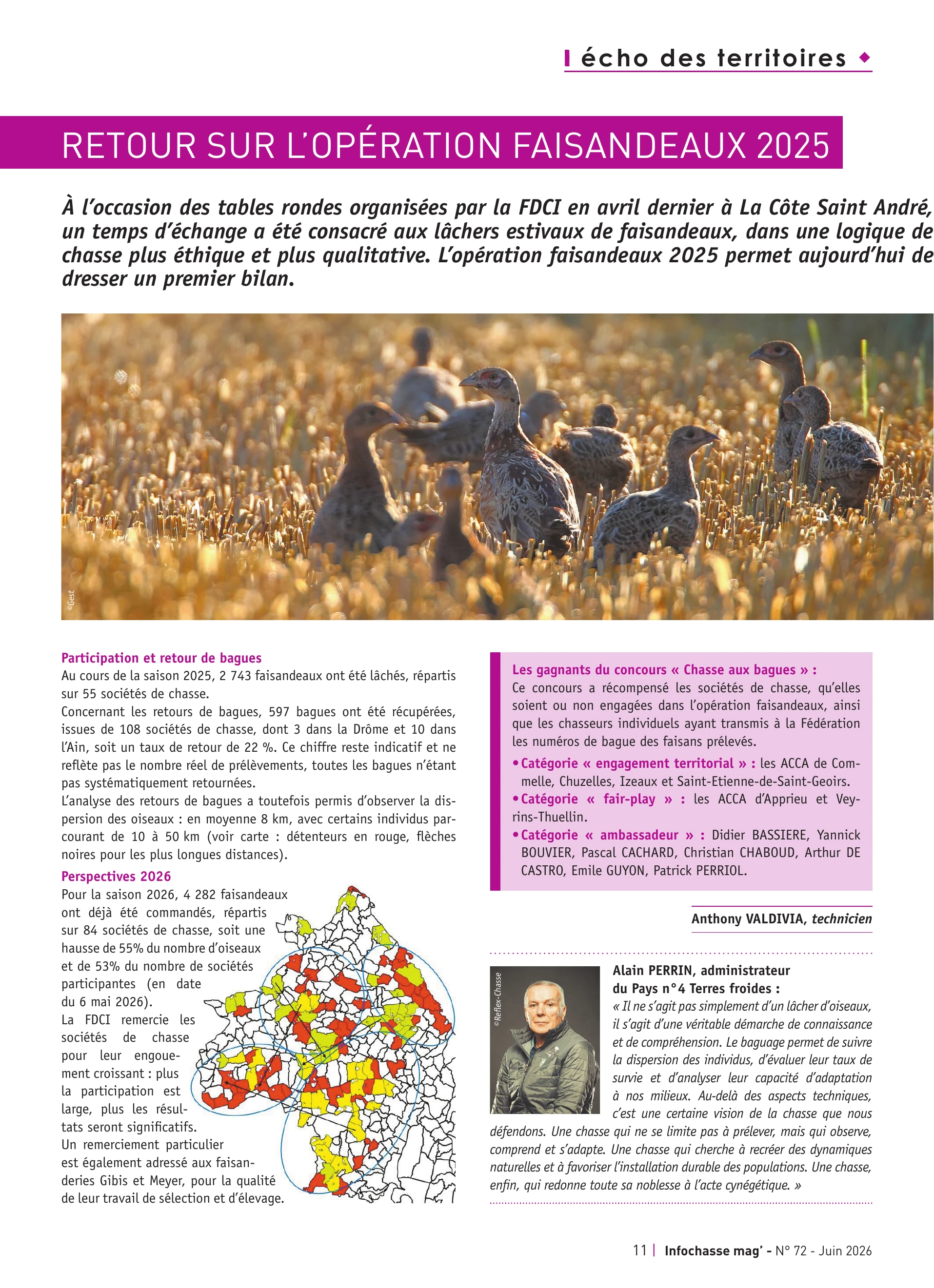
At the round tables organised by the FDCI last April in La Côte Saint André, a discussion session was devoted to summer releases of pheasant poults, as part of a move towards more ethical and higher-quality hunting. The 2025 pheasant poult scheme now makes it possible to draw up a first review.
Anthony VALDIVIA, technician
Participation and ring returns
During the 2025 season, 2,743 pheasant poults were released, spread over 55 hunting clubs.
As for ring returns, 597 rings were recovered, from 108 hunting clubs, including 3 in the Drôme and 10 in the Ain, a return rate of 22%. This figure remains indicative and does not reflect the actual number of birds shot, as not all rings are systematically returned.
Analysis of the ring returns nevertheless made it possible to observe the dispersal of the birds: 8 km on average, with some individuals travelling 10 to 50 km (see map: holders in red, black arrows for the longest distances).
[The map can be seen on the page facsimile and in the PDF.]
Outlook for 2026
For the 2026 season, 4,282 pheasant poults have already been ordered, spread over 84 hunting clubs, an increase of 55% in the number of birds and 53% in the number of participating clubs (as at 6 May 2026).
The FDCI thanks the hunting clubs for their growing enthusiasm: the wider the participation, the more significant the results will be.
Particular thanks are also addressed to the Gibis and Meyer pheasant farms, for the quality of their selection and rearing work.
“This is not simply a release of birds, it is a genuine effort of knowledge and understanding. Ringing makes it possible to monitor the dispersal of individuals, to assess their survival rate and to analyse their ability to adapt to our habitats. Beyond the technical aspects, it is a certain vision of hunting that we are defending. Hunting that is not limited to shooting, but that observes, understands and adapts. Hunting that seeks to recreate natural dynamics and to encourage the lasting establishment of populations. Hunting, finally, that restores all its nobility to the act of the hunt.”
PDF · 1 page · 1.5 MB — page 11 of the magazine (original in French)