
Hares in Sweden: the mountain hare versus the brown hare
Sweden has two hares with opposite histories. The mountain hare, skogshare, is native and found throughout the country. The brown hare, fälthare, was introduced by people and has spread northwards from Scania[1]. How the two coexist is one of the most studied topics in small-game management in Scandinavia.
Two species, two statuses
The mountain hare (Lepus timidus) lives in all habitats except the most open farmland; its populations are sparse in the far south[1]. Sweden has two forms of it: the northern form, which turns white in winter, and the southern « mohare », with a bluish-grey winter coat[1]. Previously classed as « least concern » by Artdatabanken, it was proposed in 2020 for the « near threatened » category because of declining populations[1].
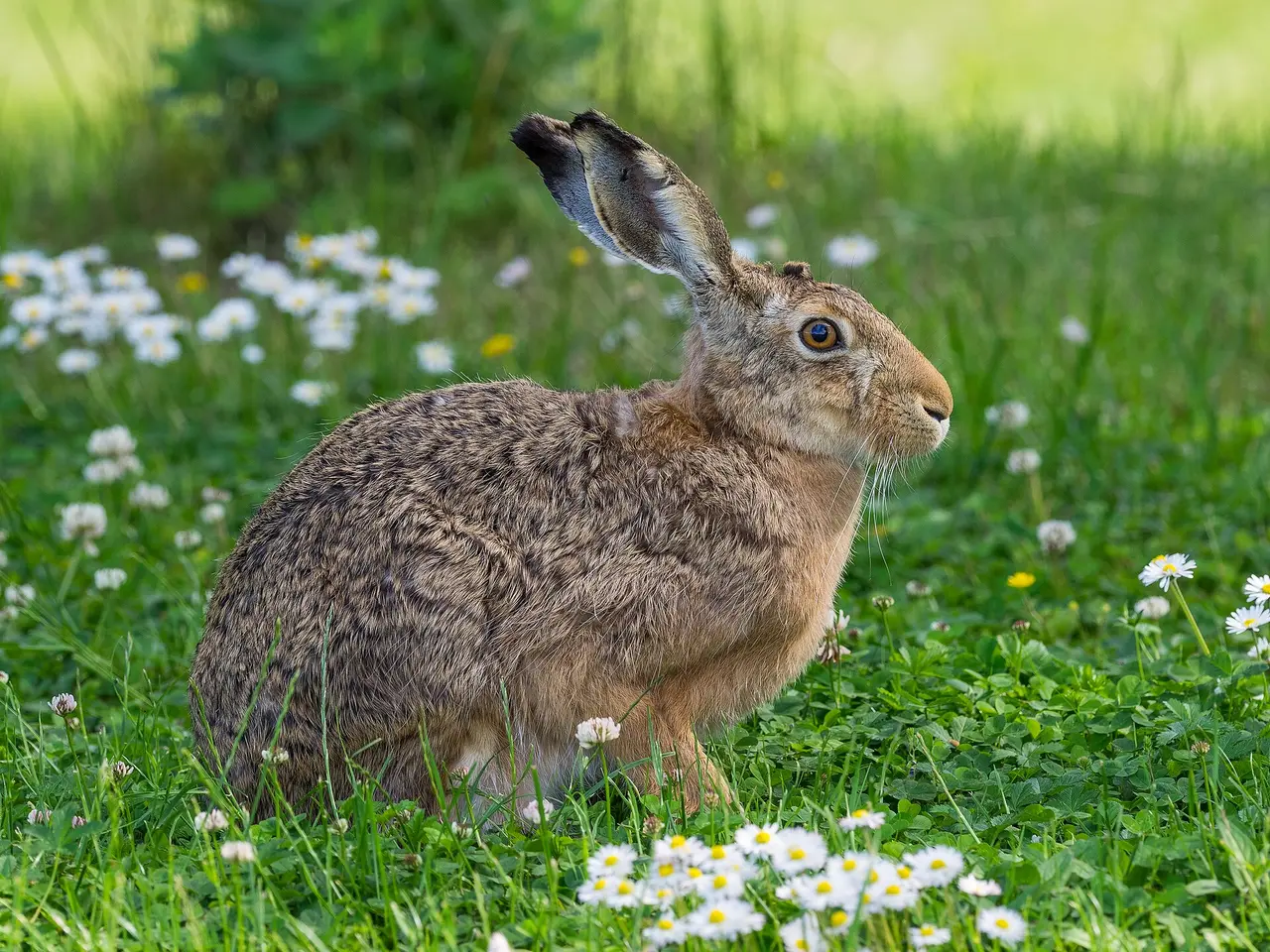
The brown hare (Lepus europaeus) is an introduced species, naturalised before 1800 and first established in Scania[1]. It lives mainly on cultivated land, forms established populations as far north as northern Svealand, and isolated individuals are reported as far as Norrbotten[1]. As an introduced species, it is not assessed on the Red List; it is not classed as invasive, but Artdatabanken has placed it in the highest risk class because of its effects on the mountain hare[1]. For its biology, see our brown hare profile.
Hybridisation and climate
The two species can interbreed, and hybridisation is considered mainly harmful to the mountain hare[1]. The mountain hare's decline in southern Scania coincided with the arrival of the brown hare around 1900[1]. Adapted to cold, snowy winters, the mountain hare is expected to suffer from a milder climate, whereas the brown hare may on the contrary spread further north[1].
What the hunting bags say
For the 2022/2023 hunting year, the national bag is estimated at 21,958 brown hares and 11,364 mountain hares[2]. The Swedish Association for Hunting and Wildlife Management (Svenska Jägareförbundet) considers that the downward trend probably reflects both a fall in populations and less hunting, for both species[2]. It points out that reporting bags is voluntary for most species in Sweden; these figures are estimates with an uncertainty interval[2].
The 2020 study adds nuance: after a peak in the 1980s, when sarcoptic mange had temporarily decimated the red fox, bags of both hares fell, and they closely track the number of registered hare hounds[1]. A change in hunting practices therefore explains at least part of the decline, hence the need to cross-check these data with other indicators[1].
The hunting framework
Hunting seasons are set at national level, in Annex 1 of the Jaktförordningen (Hunting Ordinance); the county administrative boards (länsstyrelser) may restrict them for a species when snow, ice or temperature so require[3]. We do not reproduce any dates: consult the text in force. The mountain hare is hunted mainly with hounds; so is the brown hare, and driven hunts are common where it is abundant[1].
Return to the wild: authorisation is the rule
The Jaktförordningen sets out a clear principle: game may not be released into the wild, except as provided for in the text, and it is the Swedish Environmental Protection Agency (Naturvårdsverket) that may issue rules or grant exemptions case by case[3]. For any project, check with the Naturvårdsverket and the länsstyrelse concerned. In the Swedish context, introducing brown hares also raises the issue of hybridisation with the mountain hare[1].
See also our guide to returning hares to the wild. GIBIS, a game breeder based in Chatte, in the Isère department of France, raises young hares there and also offers wild-caught hares from Central Europe: see our hares.
Frequently asked questions
Is the brown hare native to Sweden?
No. It was introduced and became naturalised before 1800, first in Scania; only the mountain hare is native[1].
How many hares are taken in Sweden?
For 2022/2023, the Svenska Jägareförbundet estimates the bag at 21,958 brown hares and 11,364 mountain hares, down for both species[2].
Can hares be returned to the wild in Sweden?
The Jaktförordningen prohibits releasing game into the wild except in specified cases; the Naturvårdsverket may grant exemptions[3]. Check with the agency before any project.
A question about the brown hare? Write to us.
Contact usSources
This page summarises public sources consulted when it was written; it does not replace the texts in force or the advice of the competent authority.
- [1]Trender i utbredning och avskjutning av skogshare och fälthare i Sverige (Viltforum 1/2020) · Svenska Jägareförbundet – G. Bergqvist & B. Elmhagen · jagareforbundet.se
- [2]Årsrapport nationell avskjutning jaktåret 2022/2023 (Viltforum 1/2023) · Svenska Jägareförbundet – G. Bergqvist, N. Liljebäck & B. Elmhagen · jagareforbundet.se
- [3]Jaktförordning (1987:905) · Sveriges riksdag · riksdagen.se