
The hare in Romania: a historic game species under quotas
In Romania, the lowland hare is the brown hare (Lepus europaeus), the "iepurele-de-câmp" of the hunting law, which sets its hunting season in an annex[1]. For more than half a century, it was the country's main game species, both in numbers and in its distribution across the whole country[3]. Its management rests on populations assessed every year and harvest quotas approved by the State[1][2].
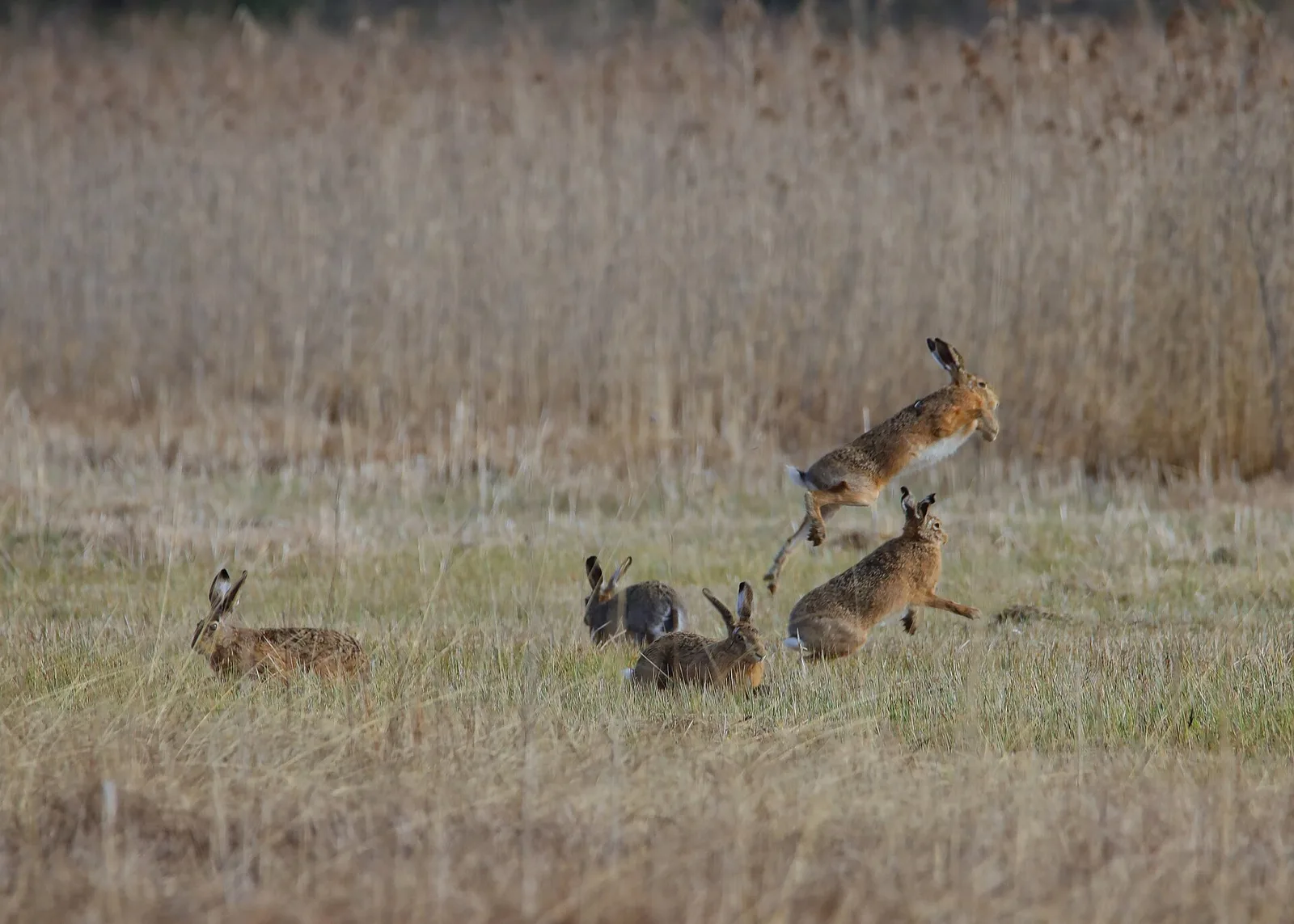
A major game species, declining in the southern plains
According to a study by the University of Agronomic Sciences and Veterinary Medicine of Bucharest published in 2022, hunters across the country have been warning for a decade about the decline of the hare and the pheasant, and the pheasant appears to have replaced the hare as the main game species[3]. The authors consider the decline particularly marked in the southern plains, dominated by large monocultures, mechanisation and heavy herbicide use; they also mention the climate, birds of prey and the spread of the golden jackal[3].
The case of Giurgiu County
The same study analyses official data from the Ministry of the Environment for Giurgiu County (județ), south of Bucharest, between 2016 and 2021[3]. The assessed hare population there fell from 31,003 to 25,934 animals, and the number of hares harvested from 2,384 to 1,514, with a low of 1,252 in 2020[3]. Approved quotas fell over the same period from 3,240 to 1,710[3].
The authors nevertheless question the reliability of these official figures, which they consider more reassuring than the situation on the ground[3]. For the species' biology, see our entry Brown hare.
Who manages hunting in Romania?
Law No. 407/2006 entrusts the administration of game wildlife to the central public authority responsible for hunting, the "administrator"[1]. Hunting grounds (fonduri cinegetice) are assigned for management to licensed Romanian legal entities, the managers: hunters' associations, the forest administration or other approved bodies[1][3]. The administrator publishes data on game populations and harvests every year[1].
The hare hunting season is set by Annex No. 1 of the law, for the whole country[1]. The law notably prohibits hunting hares at feeding points or between sunset and sunrise[1]. We do not reproduce the dates: consult the text in force.
Population assessment and harvest quotas
Every year, the administrator approves, by species and by manager, a "cotă de recoltă", that is, the number of animals that may be harvested on a hunting ground[1]. The Ministry of Environment, Waters and Forests describes the procedure: managers carry out the assessment of resident species, coordinated by the forest guards (gărzile forestiere) according to instructions approved by ministerial order in 2022, then the data are checked and centralised by hunting ground and by county[2]. The law prohibits providing false information on population numbers[1].
Restocking: what the law provides
Romanian law explicitly regulates restocking. Stocking a hunting ground with imported animals of a native species requires the approval of the central public authority responsible for forestry, based on a certification of their genetic quality by a scientific institution working in game management, and with the agreement of the authority responsible for the environment[1]. Restocking with animals that are sick, degenerate or from farms intended for other purposes is prohibited[1].
For the practical application of these rules, check with the Ministry of Environment, Waters and Forests. Our guide to returning hares to the wild points out that adding animals replaces neither habitat nor monitoring. GIBIS, a game breeder based in Chatte, in the Isère department of France, raises young hares there and also offers wild-caught hares from Central Europe: see our hares.
Frequently asked questions
Who sets the hare hunting season in Romania?
Hunting law No. 407/2006 itself, in its Annex No. 1, for the whole country[1]. Consult the text in force for the dates.
How are hare harvests set?
Is the hare declining in Romania?
A 2022 study describes a clear decline in the southern plains; in Giurgiu County, the assessed population fell from 31,003 to 25,934 hares between 2016 and 2021[3].
Can hunting grounds be restocked with imported hares?
The law makes such stocking subject to ministerial approval and genetic certification[1]. Check with the Ministry of Environment, Waters and Forests.
A question about the brown hare? Write to us.
Contact usSources
This page summarises public sources consulted when it was written; it does not replace the texts in force or the advice of the competent authority.
- [1]Legea nr. 407 din 9 noiembrie 2006 a vânătorii și a protecției fondului cinegetic (formă consolidată) · Portal legislativ al Ministerului Justiției (legislatie.just.ro) · legislatie.just.ro
- [2]Referat de aprobare — proiect de ordin privind aprobarea cotelor de recoltă pentru specia Căprior, perioada de vânătoare 2025–2026 · Ministerul Mediului, Apelor și Pădurilor — Direcția Biodiversitate · mmediu.ro
- [3]Study regarding the evolution of some sedentary game populations in Giurgiu County (Gheța, Maftei, Posan, Vlad, Nicolae — Scientific Papers. Series D. Animal Science, vol. LXV, n° 2, 2022) · University of Agronomic Sciences and Veterinary Medicine of Bucharest · animalsciencejournal.usamv.ro