
Hares in Germany: a lowland game species under close watch
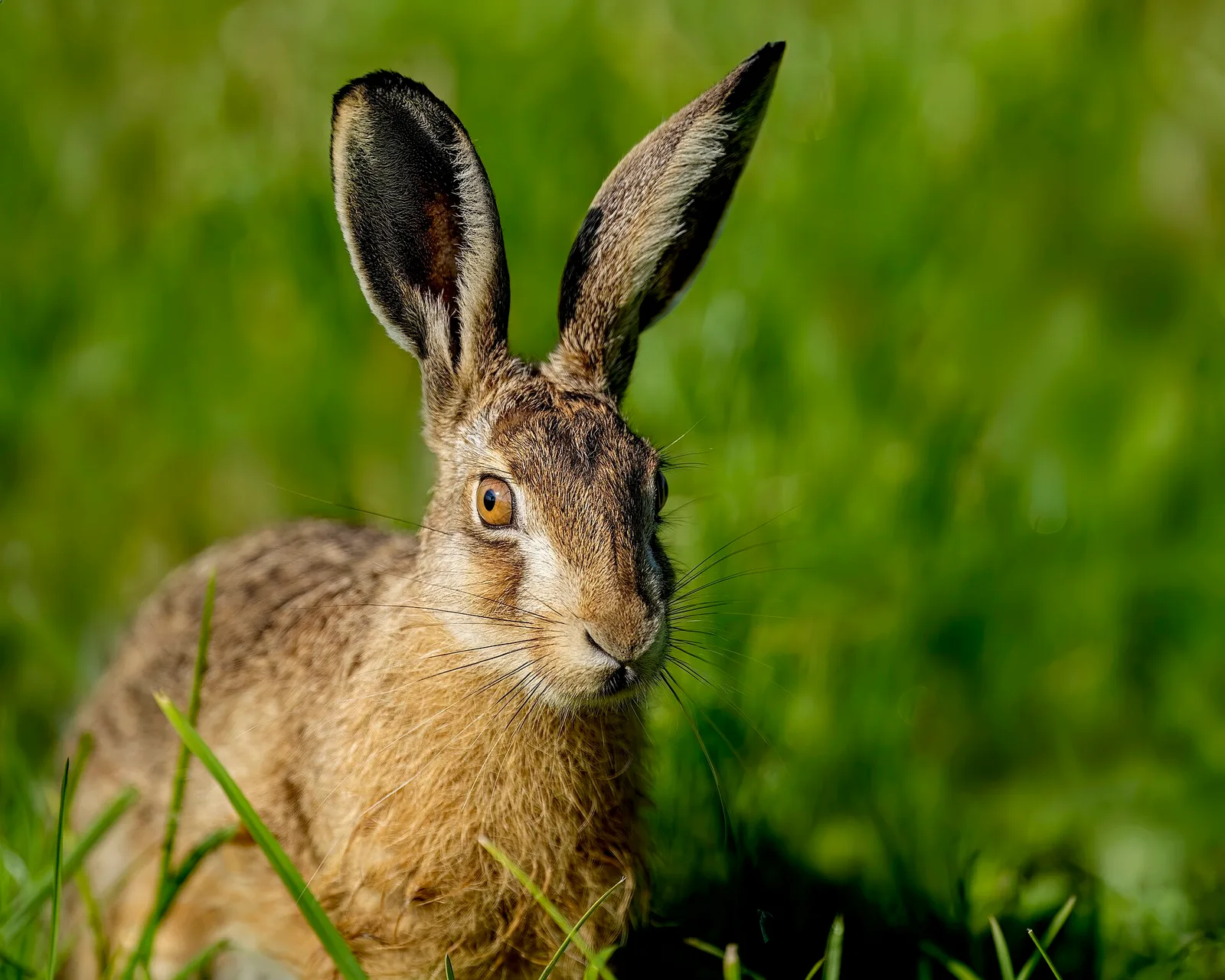
In Germany, the brown hare — the Feldhase — is both a traditional game species of the arable lowlands and a species on the national Red List of mammals. This apparent paradox has a simple explanation: the Red List looks at trends over several decades, while hunters' annual counts show a recent recovery. A second hare, the mountain hare, survives only in the Bavarian Alps.
Two species, two very different situations
The Red List of German mammals published in 2020 under the auspices of the Federal Agency for Nature Conservation (Bundesamt für Naturschutz) classifies the brown hare (Lepus europaeus) as « gefährdet » (endangered), the same category as in the previous edition[1]. The species profile describes it as « moderately common », with a strong long-term decline and a moderate short-term decrease[1].
The mountain hare (Lepus timidus), which turns white in winter, is strictly confined in Germany to the Bavarian Alps. It is classed there as « extremely rare », and the profile states that no monitoring data are available to show how its numbers are changing[2]. For the biology of the brown hare, see our brown hare profile.
Why the Feldhase declined
The Red List attributes the threat to agricultural intensification: herbicides, the spread of maize and energy crops, and the degradation of open habitats[1]. It cites the counts of the German Hunting Association (Deutscher Jagdverband, DJV), which also link the decline observed on the surveyed areas to the end of the EU set-aside requirement[1].
For the mountain hare, the same source considers other risks: increased competition and possible hybridisation with the brown hare as the climate warms, as well as growing tourist pressure in the Alps above 1,300 m[2].
What recent counts show
The DJV and its regional associations monitor the hare through counts on reference areas, as part of the Wildlife Information System of the German Länder (Wildtier-Informationssystem der Länder Deutschlands, WILD). In spring 2025, more than 400 reference areas gave an average of 19 hares per square kilometre of fields and meadows, a record for the third year in a row and roughly a quarter higher than twenty years ago[3]. The highest densities, around 30 hares per square kilometre, were recorded in the north-western lowlands[3].
The DJV links this result to a mild winter and a very dry spring, both favourable to a species that originated on the steppe. It also reports that myxomatosis, detected in hares in 2023, has spread to several Länder, with no confirmed widespread negative effect so far[3].
Who sets the hunting rules
The brown hare is listed among the furred game (Haarwild) of the Federal Hunting Act, the Bundesjagdgesetz[6]. The Act provides that the federal ministry sets the hunting seasons by ordinance, with the consent of the Bundesrat, but that the Länder may shorten or abolish them[4]. In practice, the hare season and any restrictions therefore depend on the Land, or even on local decisions: we do not publish any dates. Check with the hunting authority of the Land concerned (oberste or untere Jagdbehörde) and the regional hunters' association (Landesjagdverband).
Return to the wild: what federal law says
Section 28 of the Federal Hunting Act prohibits releasing wild boar and wild rabbits, makes the release of non-native species subject to written authorisation from the Land, and allows the Länder to restrict or prohibit the keeping or release of other species[5]. For hares, the applicable rule therefore depends on the law of the Land: before any project, check with the hunting authority of the Land.
As for method, our guide to returning hares to the wild explains the approach. GIBIS, a game breeder based in Chatte, in the Isère department of France, raises young hares there and also offers wild-caught hares from Central Europe: see our hares.
Frequently asked questions
Is the hare endangered in Germany?
Who sets the hare hunting season in Germany?
The framework is federal, but the Länder may shorten or abolish hunting seasons[4].
Can hares be returned to the wild in Germany?
The Länder may restrict or prohibit the release of species such as the hare[5]: check with the hunting authority of the Land.
A question about the brown hare? Write to us.
Contact usSources
This page summarises public sources consulted when it was written; it does not replace the texts in force or the advice of the competent authority.
- [1]Artensteckbrief Feldhase (Lepus europaeus) – Rote Liste und Gesamtartenliste der Säugetiere Deutschlands (Meinig et al., 2020) · Rote-Liste-Zentrum / Bundesamt für Naturschutz · rote-liste-zentrum.de
- [2]Artensteckbrief Schneehase (Lepus timidus) – Rote Liste und Gesamtartenliste der Säugetiere Deutschlands (Meinig et al., 2020) · Rote-Liste-Zentrum / Bundesamt für Naturschutz · rote-liste-zentrum.de
- [3]Erneut Rekordwert beim Feldhasen · top agrar (Ergebnisse des Deutschen Jagdverbands, WILD) · topagrar.com
- [4]Bundesjagdgesetz (BJagdG), § 22 Jagd- und Schonzeiten · Bundesministerium der Justiz – gesetze-im-internet.de · gesetze-im-internet.de
- [5]Bundesjagdgesetz (BJagdG), § 28 Sonstige Beschränkungen in der Hege · Bundesministerium der Justiz – gesetze-im-internet.de · gesetze-im-internet.de
- [6]Bundesjagdgesetz (BJagdG), § 2 Tierarten · Bundesministerium der Justiz – gesetze-im-internet.de · gesetze-im-internet.de