
The hare in the United Kingdom: four nations, several regimes
In the United Kingdom, talking about "the" hare is not enough. The brown hare, the European hare of the continent, lives on lowland farmland; the mountain hare lives mainly in the Scottish Highlands; Northern Ireland is home to the Irish hare. And each nation of the UK applies its own rules: what holds in England does not necessarily hold in Scotland.
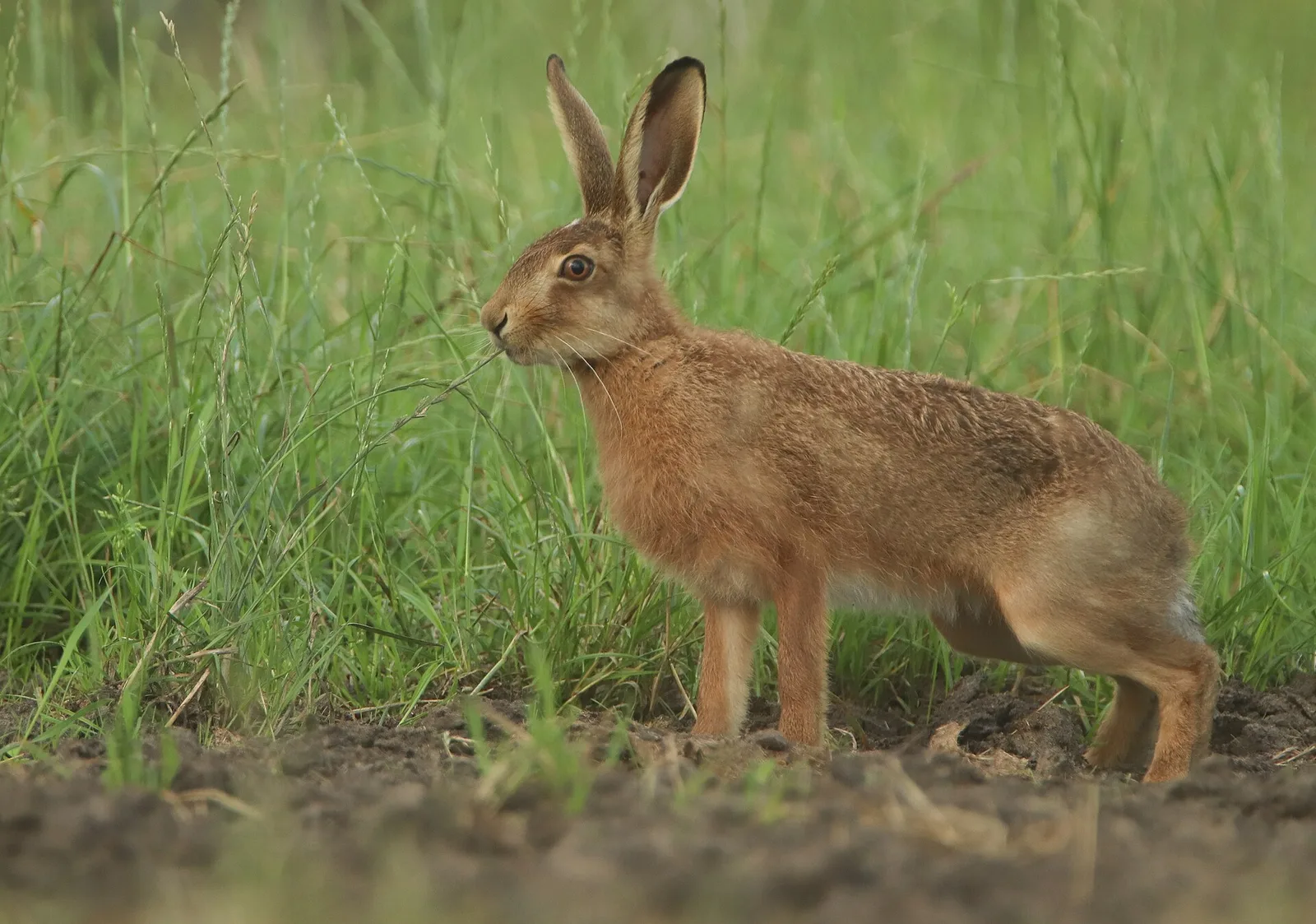
Brown hare, mountain hare and Irish hare
The brown hare (Lepus europaeus), described in our Brown hare profile, is probably not native to Great Britain: according to the Mammal Society, it was introduced in Roman times or earlier, then spread across the lowlands[3].
The mountain hare (Lepus timidus), on the other hand, is native. It is found mainly on the Scottish mainland; it has also been introduced to several islands such as Shetland, Hoy, Lewis and Skye, and a small population survives in the English Peak District; it also occurs throughout the island of Ireland, as the Irish hare (Lepus timidus hibernicus)[2]. The GWCT cites an older spring estimate (Harris et al.) of about 432,500 mountain hares in the UK, 350,000 of them in Scotland[2].
Very different trends from region to region
The GWCT's National Gamebag Census, which compiles bag records returned by estates, shows a 46% decline in brown hares between 1961 and 2009 across the UK, but a recovery of more than 50% since 1987. The regional contrast is stark: a clear recovery in England, a 76% decline in Scotland and near disappearance from bags in Wales, while data for Northern Ireland are too sparse to analyse[1].
The decline is attributed to agricultural intensification and fox predation; the recovery coincides with set-aside and agri-environment schemes[1]. The Mammal Society nevertheless reports a notable decline since the start of the century[3]. For the mountain hare, bags follow cycles with no significant trend over the period 1961-2009[2].
England: a game species with little protection
In England, the brown hare has the status of "ground game" and of game: any occupier of land has the right to shoot or control it. There is no close season on enclosed land; on moorland and unenclosed non-arable land, it may only be shot from 11 December to 31 March[1]. An 1892 Act does, however, prohibit its sale from March to July[4]. A code of practice drawn up by farming, shooting and conservation organisations recommends, on a voluntary basis, concentrating control in winter[4].
Since the Hunting Act 2004, hunting hares with dogs has in principle been banned in England and Wales, and taking part in hare coursing events is an offence[3][7].
Scotland: a statutory close season and a protected mountain hare
Scotland has taken a different path. The Wildlife and Natural Environment (Scotland) Act 2011 created a statutory close season for the brown hare; check the current text for the dates[5].
The mountain hare has gone further: since 1 March 2021, it has been fully protected in Scotland. It is now an offence to kill, injure or take one at any time of year, except under a licence issued by NatureScot for defined purposes, such as preventing damage to forestry[6].
Return to the wild, Northern Ireland and GIBIS
Northern Ireland has its own game legislation, which covers in particular the Irish hare. For any restocking project or regulatory question, check with the competent authority of the nation concerned: Natural England, NatureScot, Natural Resources Wales or DAERA in Northern Ireland. Our guide to returning hares to the wild sets out the preparation steps from a French perspective.
GIBIS, a game breeder based in Chatte, in the Isère department of France, raises young hares there and also offers wild-caught hares from Central Europe: see our hares. The photos on this page show the species in their habitat and do not depict our animals.
Frequently asked questions
Is the brown hare native to Great Britain?
Probably not: the Mammal Society states that it was introduced in Roman times or earlier[3].
Is there a close season for hares in England?
Can mountain hares be shot in Scotland?
No. Since 1 March 2021, they have been protected all year round; only NatureScot licences for specific purposes can permit control[6].
Is hare coursing allowed?
In England and Wales, taking part in a hare coursing event is an offence under the Hunting Act 2004[7].
A question about the brown hare? Write to us.
Contact usSources
This page summarises public sources consulted when it was written; it does not replace the texts in force or the advice of the competent authority.
- [1]Brown hare – National Gamebag Census: mammal bags comprehensive overviews · Game & Wildlife Conservation Trust (GWCT) · gwct.org.uk
- [2]Mountain hare – National Gamebag Census: mammal bags comprehensive overviews · Game & Wildlife Conservation Trust (GWCT) · gwct.org.uk
- [3]Brown hare · The Mammal Society · mammal.org.uk
- [4]Brown Hares: Code of Practice for Brown Hare Management and Welfare in England · Game & Wildlife Conservation Trust (GWCT) · gwct.org.uk
- [5]Wildlife and Natural Environment (Scotland) Act 2011, section 6 · legislation.gov.uk · legislation.gov.uk
- [6]SPICe briefing – Petition PE1859: Retain falconers rights to practice upland falconry in Scotland · Scottish Parliament Information Centre (SPICe) · parliament.scot
- [7]Hunting Act 2004, section 5 · legislation.gov.uk · legislation.gov.uk