
The hare in Liechtenstein: from the Rhine valley to the Alps
Liechtenstein, a small Alpine country wedged between Switzerland and Austria, is home to two hares: the brown hare (Feldhase) of the valley floors and the mountain hare (Schneehase) of the mountains, both on the list of huntable species in the Hunting Act[1]. The former has become rare in the meadows of the Rhine valley[3][4]. The hunting framework, for its part, is entirely national: no cantons, but leased hunting grounds (Reviere) and rules set by the government[1][2].
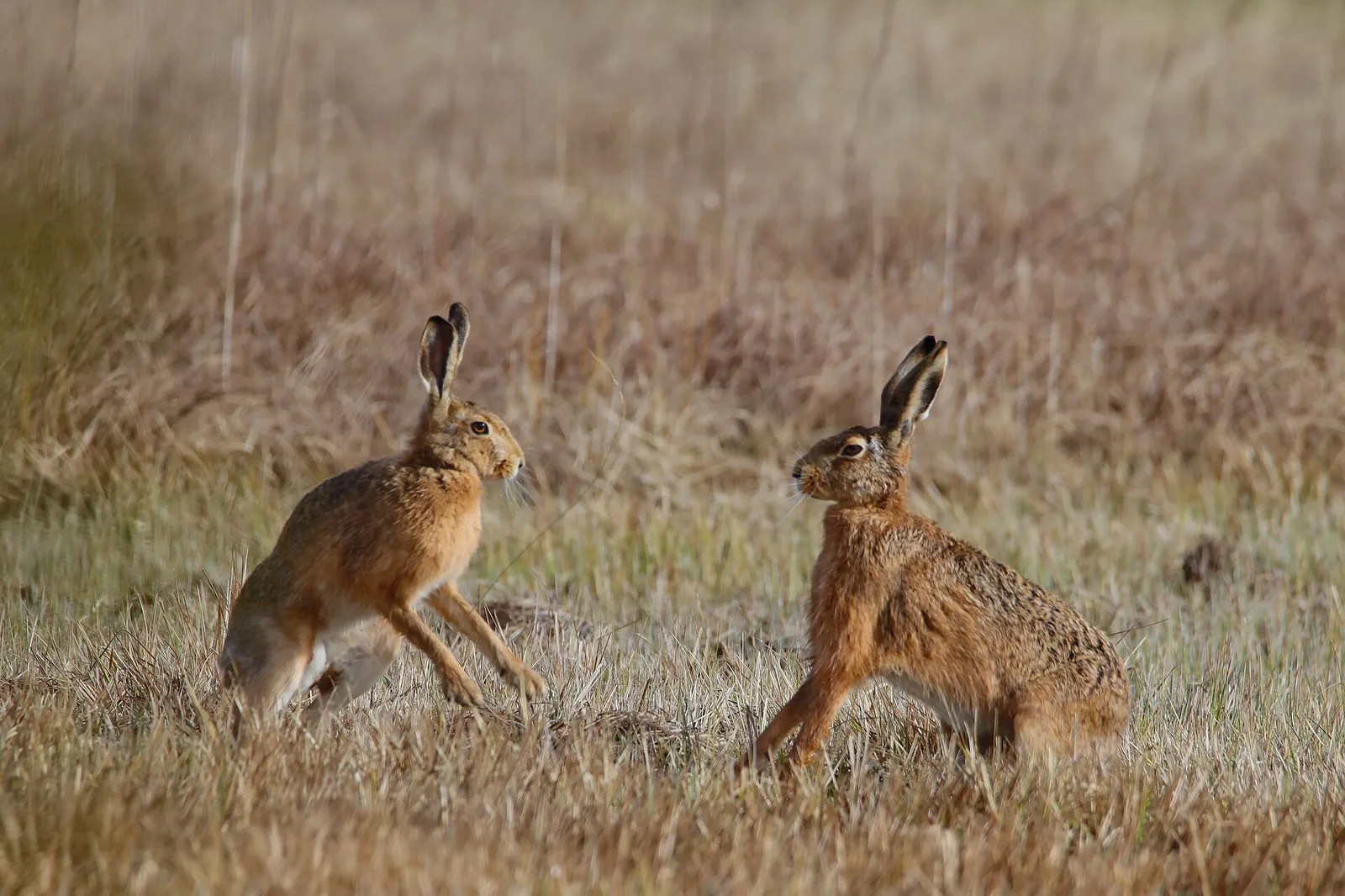
A brown hare grown rare
According to the Historical Lexicon of Liechtenstein, brown hare populations have declined sharply since the 1950s; at the last count, in 1996, only small numbers remained in the Ruggeller Riet, in the wet meadows between Eschen and Schaan and at Balzers[3].
Biologist Michael Fasel noted in 2017 that the hare, a very prolific species, was still common in the country a few decades ago, but has become very rare and has disappeared entirely between the Schaaner Riet and Balzers[4]. He attributes this mainly to frequent mechanical tillage and a lack of structure in the open landscape, and stresses that the species would benefit from measures taken for ground-nesting birds, such as leaving strips of meadow unmown until mid-August[4]. For the biology of the species, see our Brown hare profile.
Tularaemia, an additional threat
In November 2018, a first case of tularaemia was detected in the Ruggeller Riet[5]. Three hares found dead, two in the Ruggeller Riet and one in Triesenberg, tested positive at the national reference laboratory, and the disease went from a local outbreak to an epizootic affecting the whole country[5]. As tularaemia can be transmitted to humans, a hare found dead should be handled with care.
Hunting leased by hunting ground
The whole national territory is divided into hunting grounds (Reviere), whose boundaries are set by the government after consulting the municipalities and the alpine pasture and citizens' corporations[1]. A hunting ground may not be smaller than 500 hectares and, as a rule, does not exceed 1,500 hectares[1]. The hunting right is leased, by public auction or by private agreement, to groups of at least four natural persons, for a period of six to eight years set by the government[1].
The authority responsible for hunting is the Office of Environment (Amt für Umwelt) in Vaduz[6]. The game management ordinance provides for game population surveys, carried out with the hunting syndicates and the gamekeepers of each hunting ground[2].
Hunting seasons set by ordinance
In Liechtenstein, hunting seasons are a matter neither for the municipalities nor for the hunting grounds: they are set for the whole country by the government's game management ordinance (Hegeverordnung), issued under the Hunting Act[2]. The brown hare and the mountain hare each have their own season[2]. The annual shooting plan adopted by the government covers ungulates (Schalenwild), not hares[2]. We do not reproduce the dates here: consult the ordinance in force.
Return to the wild and GIBIS
We have not found any public source setting out the Liechtenstein rules applicable to releasing hares into the wild: check with the Amt für Umwelt before any project. Above all, the sources cited above show that the hare needs a more structured landscape[4]. Our guide to returning hares to the wild stresses that adding animals is never a substitute for habitat. GIBIS, a game breeder based in Chatte, in the Isère department of France, raises young hares there and also offers wild-caught hares from Central Europe: see our hares.
Frequently asked questions
Which hares live in Liechtenstein?
The brown hare (Feldhase) and the mountain hare (Schneehase), both huntable under the Hunting Act[1].
Is the brown hare still present in Liechtenstein?
Who sets the hare hunting season in Liechtenstein?
The government, through the game management ordinance, which applies to the whole country[2]. Consult the ordinance in force for the dates.
A question about the brown hare? Write to us.
Contact usSources
This page summarises public sources consulted when it was written; it does not replace the texts in force or the advice of the competent authority.
- [1]Jagdgesetz (JagdG) vom 30. Januar 1962, LGBl. 1962 Nr. 4 — Fassung 01.08.2026 · Gesetze.li — Liechtensteinisches Landesgesetzblatt · gesetze.li
- [2]Hegeverordnung (HegeV) vom 30. September 2003, LGBl. 2003 Nr. 198 — Fassung 01.08.2026 · Gesetze.li — Liechtensteinisches Landesgesetzblatt · gesetze.li
- [3]Fauna (Mario F. Broggi, Stand 15.4.2023) · Historisches Lexikon des Fürstentums Liechtenstein online (eHLFL) · historisches-lexikon.li
- [4]Wildtiere in der Feldlandschaft (Michael Fasel, avril 2017) · 60plus — Das Liechtensteiner Senioren Magazin · 60plus.li
- [5]Liechtenstein: Die Hasenpest geht um (SDA, 24 avril 2019) · BauernZeitung · bauernzeitung.ch
- [6]Amt für Umwelt — Jagd (Liechtenstein), fiche adresse · Konferenz der Vorsteher der Umweltschutzämter der Schweiz (KVU) · kvu.ch