
The hare in Spain: three species, hunting managed by the regions
Spain has three hare species. The Iberian hare (Lepus granatensis), endemic to the peninsula, occupies almost the whole country; the brown hare (Lepus europaeus) is confined to the north; the broom hare, or Cantabrian hare (Lepus castroviejoi), lives only in the Cantabrian Mountains[1][2][3]. Hunting is managed by the autonomous communities, which makes Spanish rules a regional patchwork[4].
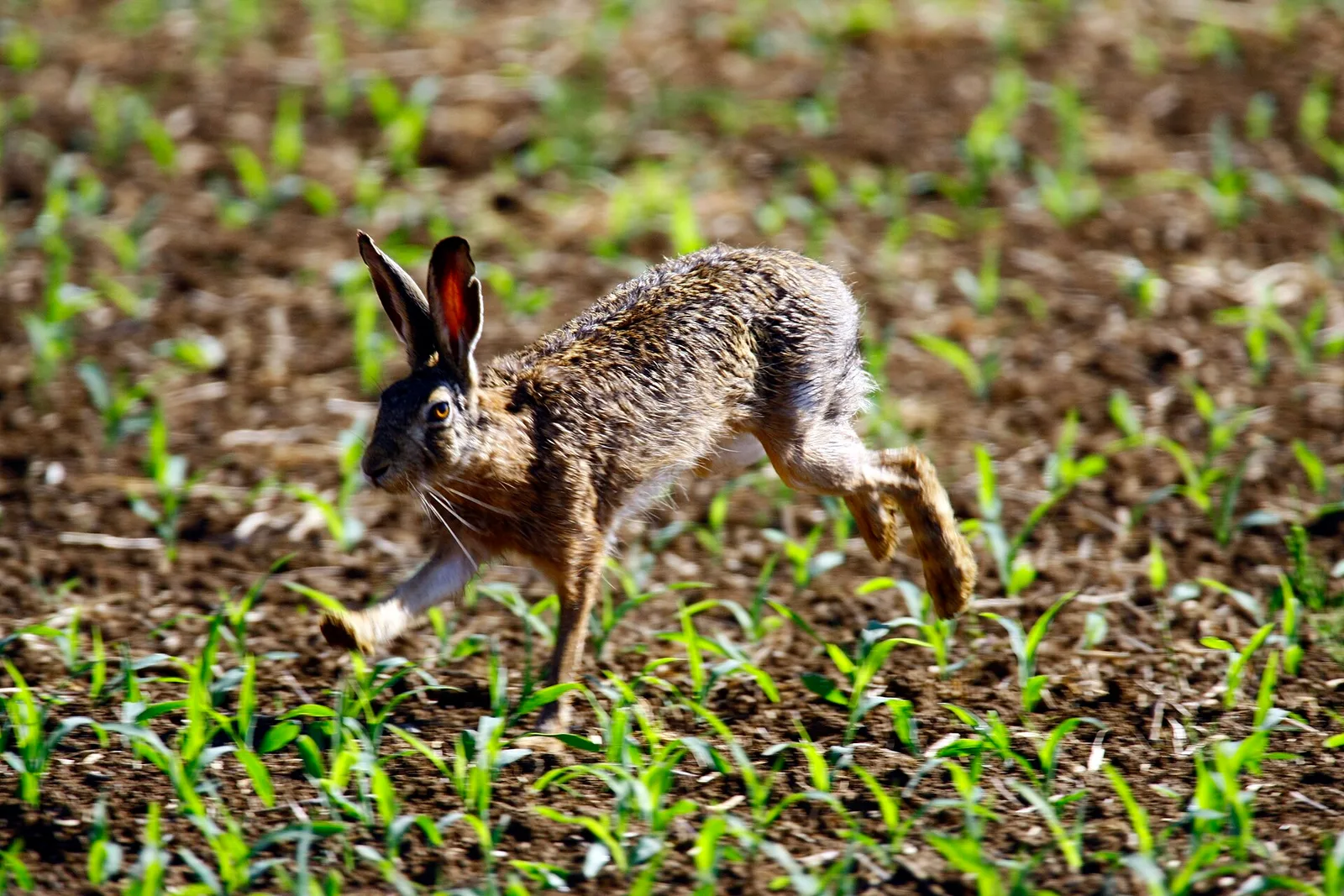
The Iberian hare, game of the whole peninsula
The Iberian hare occupies most of the peninsula, except for a northern strip running from northern León and western Asturias to the mouth of the Ebro[1]. Three subspecies are recognised, including one specific to Galicia and one to the island of Mallorca[1]. Its densities vary greatly with habitat, from about 80 animals per km² in Andalusian olive groves to 22 in intensive cereal fields in León[1].
It is a highly prized small game species: the Atlas of Terrestrial Mammals of Spain stated that more than a million hares were harvested there every year[1]. The authors cite among the threats the homogenisation of crops, overhunting, pesticides, poaching and roads[1].
The brown hare, confined to the north
In Spain, the brown hare occupies only the north, from the Catalan coast north of the Ebro to central Asturias, and from the plateaus of Burgos and Palencia to the French border[2]. It is scarce across most of its range and has disappeared from several areas, including parts of the Basque Country, Navarre and the Catalan coast[2].
The same species account reports restocking with captive-bred hares or hares from natural European populations, some of low viability, and lists "unsuitable restocking" among the threats, particularly for health reasons[2]. For the species' biology, see our entry Brown hare.
The broom hare, a Cantabrian endemic
The broom hare lives only in the Cantabrian Mountains, in a strip about 230 km long between the Sierra de los Ancares and the Sierra de Peña Labra, at altitudes of 1,000 to 1,900 m, in broom and heather scrub[3]. It is classified as "vulnerable" in Spain as well as on the IUCN global Red List (2006 assessment cited by the Atlas)[3].
Hunting it is closed in Asturias, save for very occasional exceptions, while León and Cantabria take only a few hundred a year[3]. The Atlas states that no restocking has been carried out with this species or with other hares within its range[3].
The 2018 myxomatosis outbreak
In summer 2018, abnormal mortality among Iberian hares was reported on hunting grounds in the province of Córdoba, then in Jaén and Cuenca[5]. According to the Ministry of Agriculture, myxomatosis, a rabbit disease, had never before been detected in the Iberian hare; by September 2018, areas in eight provinces of Andalusia and Castilla-La Mancha were affected[5]. The disease is not transmissible to humans[5].
Hunting managed by the autonomous communities
It is the autonomous communities that issue hunting licences and manage hunting grounds and reserves, most cotos being private[4]. Hunting seasons and arrangements are therefore set region by region. The 2019 national statistics record a fall in hare captures compared with 2018 and put the province of Badajoz in first place, with 9% of captures[4]. For the introduction or translocation of live hares, check with the hunting service of the autonomous community concerned.
The principles of a successful return to the wild are presented on our page on returning hares to the wild. GIBIS, a game breeder based in Chatte, in the Isère department of France, raises young hares there and also offers wild-caught hares from Central Europe: see our hares.
Frequently asked questions
How many hare species live in Spain?
Is the broom hare protected?
Who sets hare hunting seasons in Spain?
Each autonomous community, which is responsible for licences and hunting management[4]. Consult the annual order of the region concerned.
Can hares be introduced in Spain?
The matter falls to the autonomous communities. Check with the hunting service of the region concerned before any project.
A question about the brown hare? Write to us.
Contact usSources
This page summarises public sources consulted when it was written; it does not replace the texts in force or the advice of the competent authority.
- [1]Atlas y Libro Rojo de los Mamíferos Terrestres de España – Lepus granatensis, liebre ibérica · Ministerio para la Transición Ecológica y el Reto Demográfico (MITECO) – F. Carro, R. C. Soriguer · miteco.gob.es
- [2]Atlas y Libro Rojo de los Mamíferos Terrestres de España – Lepus europaeus, liebre europea · MITECO – F. Ballesteros · miteco.gob.es
- [3]Atlas y Libro Rojo de los Mamíferos Terrestres de España – Lepus castroviejoi, liebre de piornal · MITECO – F. Ballesteros · miteco.gob.es
- [4]Anuario de Estadística Forestal 2019 – 10. Estadística Anual de Caza · MITECO · miteco.gob.es
- [5]Situación de brote de mixomatosis en liebres (12/09/2018) · Ministerio de Agricultura, Pesca y Alimentación (MAPA) – copia publicada por la Federación Galega de Caza · federaciongalegadecaza.com